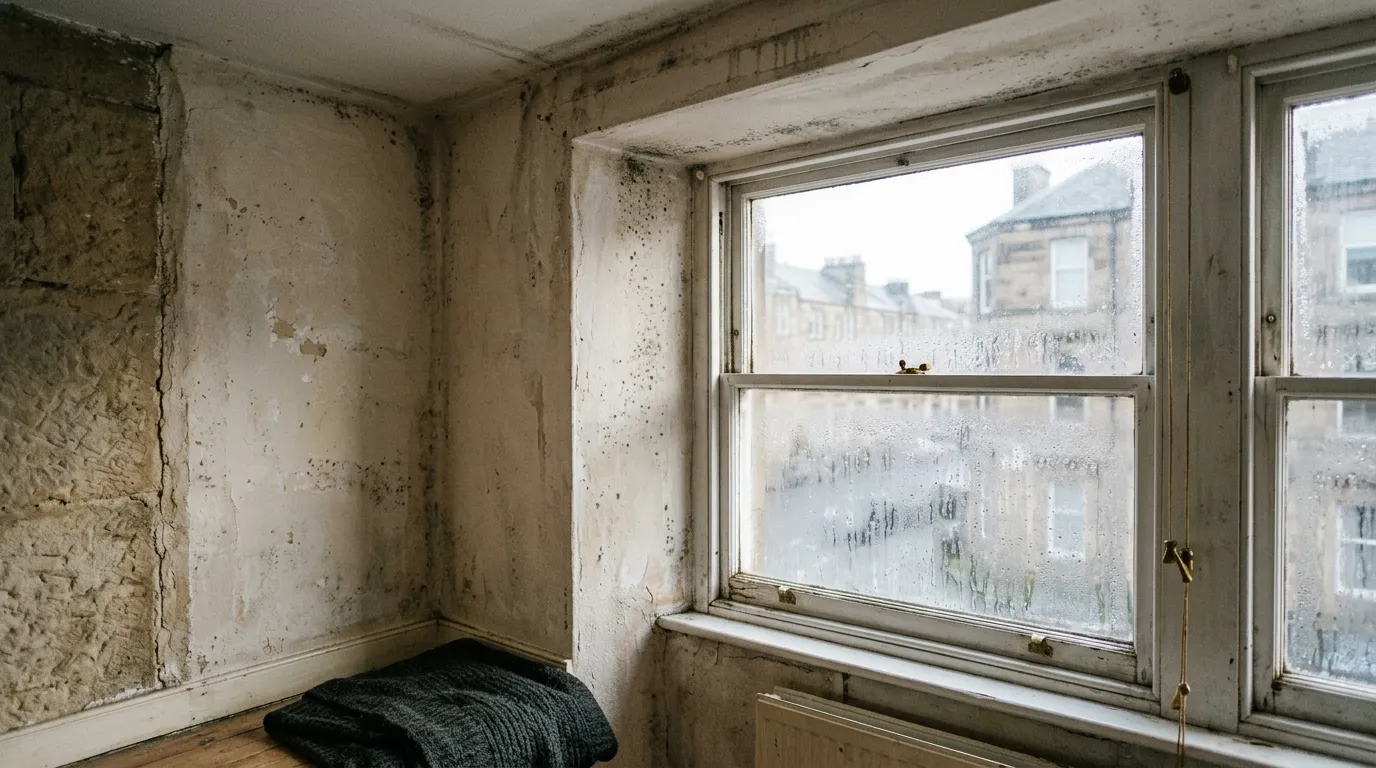
Fix the cause first: paint can't cure damp. For condensation mould, kill it with a 1:5 bleach-to-water wash (Glasgow City Council), dry the wall, stain-block marks, then finish with an anti-mould paint as the top coat, never painted over. A small bedroom repaint runs £250–£400 (MyJobQuote, Sep 2026).
Black spots in the corner of a bedroom, paper lifting behind a wardrobe, a brown tidemark on a ground-floor wall: damp is one of the most common reasons people in Glasgow call a decorator. Paint and wallpaper can’t cure damp, but the right products, put on after the cause is fixed, stop it coming back. This guide covers how to tell which kind of damp you have, what has to happen before any decorating, and which paints and papers to use. Prices checked: October 2026.
What kind of damp do you have?
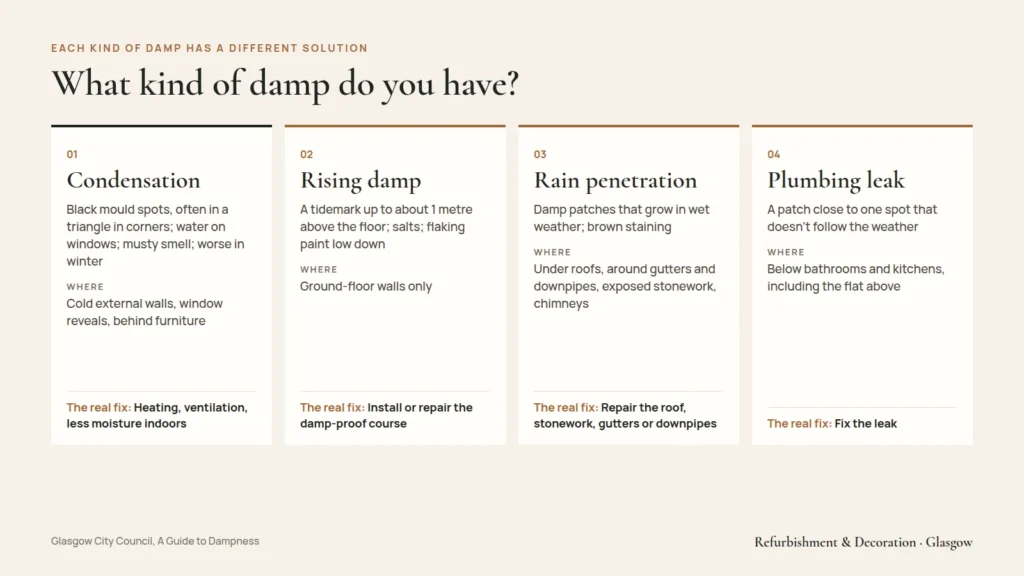
Glasgow City Council’s Guide to Dampness starts by pointing out that there are different types of dampness, and each has a different solution. Painting over the wrong one wastes money. The council lists four main types.
| Type | Typical signs | Where you find it | The real fix |
|---|---|---|---|
| Condensation | Black mould spots, often in a triangle in corners; water on windows; musty smell; worse in winter | Cold external walls, window reveals, behind furniture, wall and ceiling corners, kitchens and bathrooms | Heating, ventilation, less moisture indoors |
| Rising damp | A tidemark up to about 1 metre above the floor; salts; flaking paint low down | Ground-floor walls only | Install or repair the damp-proof course |
| Rain penetration | Damp patches that grow in wet weather; brown staining | Under roofs, around gutters and downpipes, on exposed stonework, near chimneys | Repair the roof, stonework, gutters or downpipes |
| Plumbing leak | A patch close to one spot that doesn’t follow the weather | Below bathrooms and kitchens, including the flat above | Fix the leak |
The council also makes a useful point: black mould grows on the pure water from condensation, and is “not generally an indicator of penetrating or rising damp”. So if your problem is black spotty mould, condensation is the most likely cause. If it is a brown stain or a tidemark with no mould, look at the building instead.
Why condensation is so common in Glasgow flats
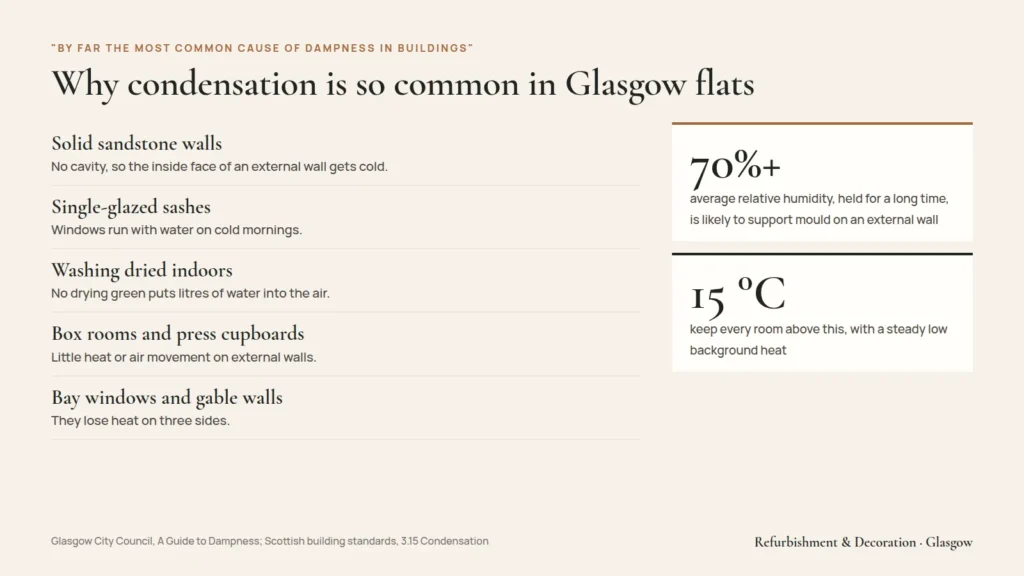
The council describes condensation as “by far the most common cause of dampness in buildings”, and worst in homes that are poorly heated and insulated. A lot of Glasgow’s housing fits that description in winter:
- Sandstone tenements have solid walls with no cavity, so the inside face of an external wall gets cold.
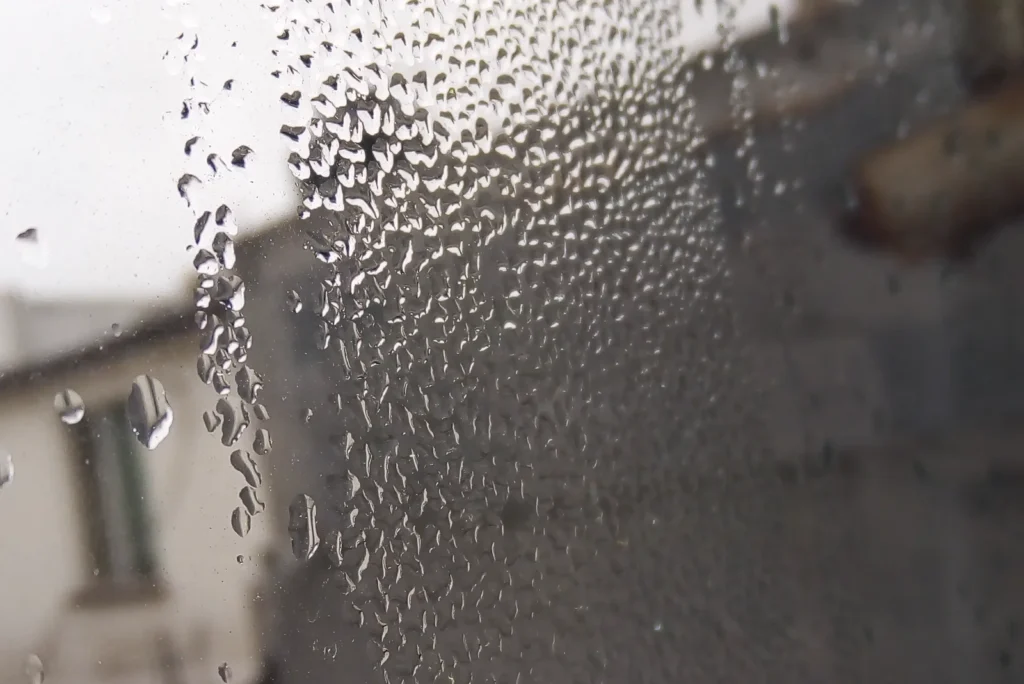
- Single-glazed sash windows run with water on cold mornings.
- Flats without a garden or drying green often dry washing indoors, which puts litres of water into the air.
- Box rooms and press cupboards on external walls get little heat or air movement.
- Bay windows and gable walls lose heat on three sides.
Scottish building standards guidance puts a number on the risk: if the average relative humidity in a room stays at or above 70% for a long time, the humidity at the external wall will be higher still and is likely to support mould growth. A cheap digital hygrometer, a few pounds online, tells you whether you are in that range.
What needs to happen before you decorate?
The order matters. If you paint first, the mould or stain returns, often within one winter.
1. Fix the cause
For rain penetration and rising damp, that means a roofer, stonemason, plumber or damp specialist, not a decorator. In a tenement, roofs, gutters, downpipes and outside stonework are usually shared repairs. Speak to your factor or the other owners, as your title deeds or the Tenement Management Scheme set out how the cost is split. If you rent, report damp to your landlord in writing.
For condensation, the council’s main advice is:
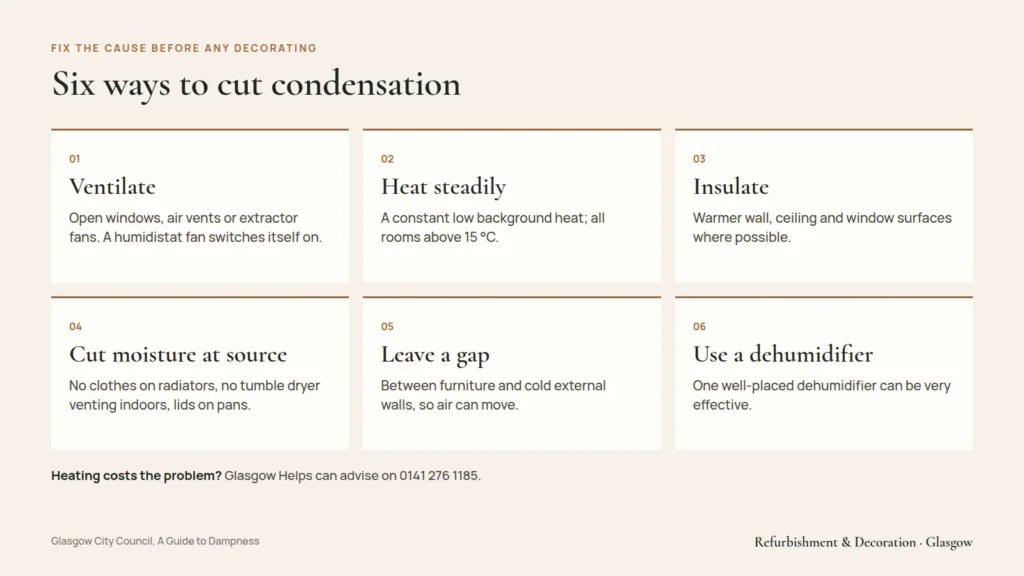
- Ventilate. Open windows, fit air vents or use extractor fans, and remove steam at source in kitchens and bathrooms. A humidistat-controlled fan switches itself on when humidity rises, so it doesn’t rely on anyone remembering.
- Heat steadily. Keep a constant low background heat, and try to keep all rooms above 15 °C.
- Insulate where possible, so wall, ceiling and window surfaces are warmer.
- Cut moisture at source. Avoid drying clothes on radiators, never vent a tumble dryer indoors, keep lids on pans, and close the kitchen or bathroom door while opening the window.
- Leave a gap between furniture and cold external walls so air can move.
- Use a dehumidifier. The council notes one well-placed dehumidifier can be very effective.
If heating costs are the problem, the council’s Glasgow Helps service can advise on 0141 276 1185.
2. Kill and remove the mould
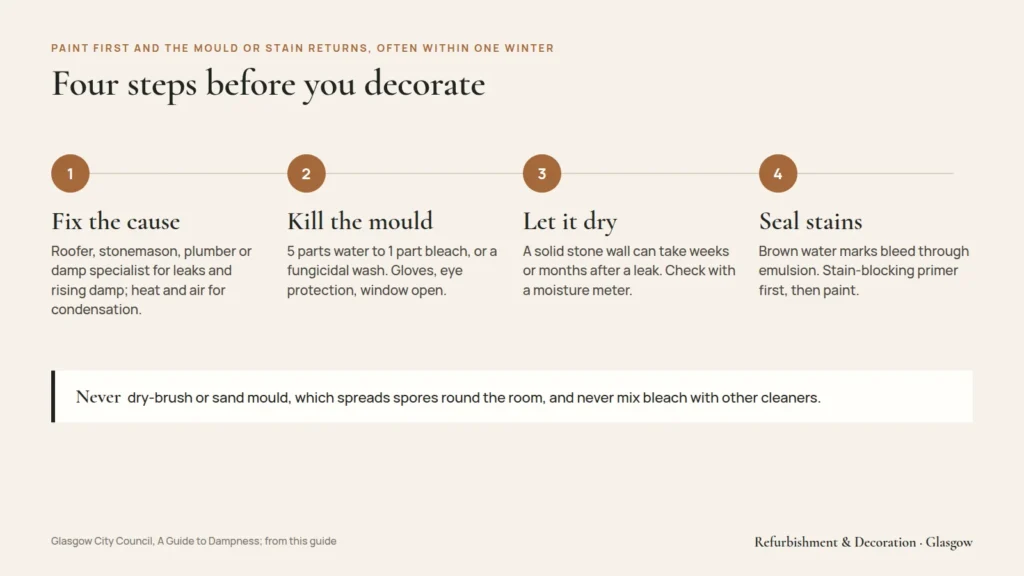
The council suggests washing mould with a mixture of 5 parts water to 1 part bleach, drying it with a cloth, and repeating as needed. Specialist fungicidal washes are an alternative. Always follow the label, wear rubber gloves and eye protection, keep the window open, and never mix bleach with other cleaners. Don’t dry-brush or sand mould, because that spreads spores around the room.
3. Let the wall dry out
After a leak or rain penetration, a solid stone wall can take weeks or months to dry. Painting or papering onto a wet wall traps the moisture. We check walls with a moisture meter before decorating anywhere that has had a leak.
4. Seal stains before painting
Brown water stains bleed straight through ordinary emulsion, sometimes after two or three coats. Once the wall is dry, they need a stain-blocking primer first. This step is the one most often skipped, and it is why so many ceilings show a faint ring again a month after painting.
Decorator’s tip: fit the extractor fan or fix the leak a few weeks before booking the decorator. You will see whether the problem has really stopped, and the wall has time to dry. A repaint on a wall that is still damp is money wasted.
Which paint should you use against condensation and mould?
There are four kinds of paint people reach for, and they do quite different jobs.
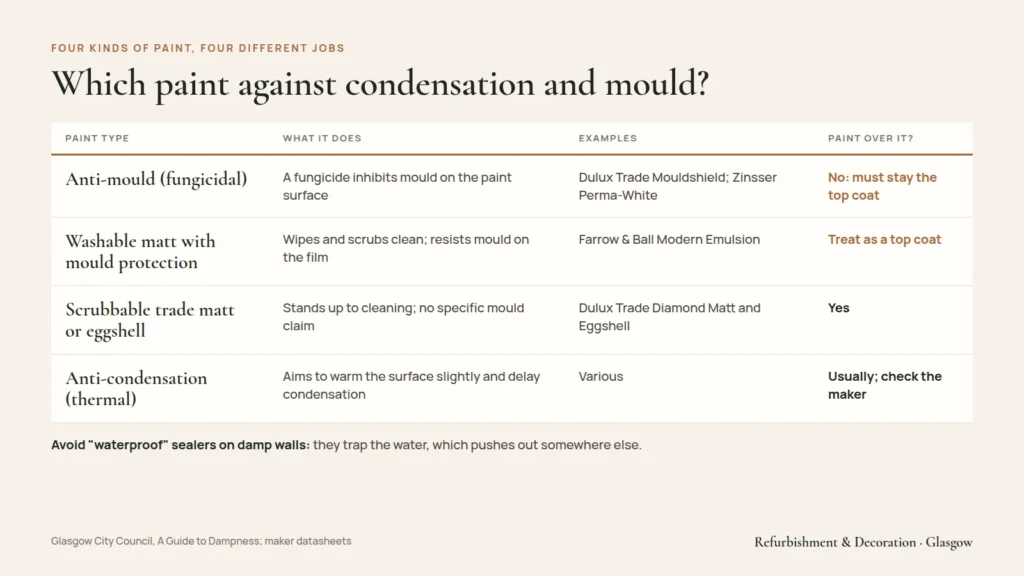
| Paint type | What it does | Example products | Can you paint over it? |
|---|---|---|---|
| Anti-mould (fungicidal) paint | Contains a fungicide that inhibits mould on the paint surface | Dulux Trade Mouldshield Fungicidal Matt and Eggshell; Zinsser Perma-White | No. Glasgow City Council says anti-mould paints “must not be decorated over once applied” |
| Durable washable matt with mould protection | Wipes and scrubs clean; resists mould on the film | Farrow & Ball Modern Emulsion | Treat as a top coat |
| Scrubbable trade matt or eggshell | Stands up to cleaning; no specific mould claim | Dulux Trade Diamond Matt and Diamond Eggshell | Yes |
| Anti-condensation (thermal) paint | Aims to make the surface feel slightly warmer and delay condensation | Various | Usually yes; check the maker’s instructions |
Anti-mould paint
Fungicidal paints are the right choice where mould keeps returning despite good heating and ventilation. Glasgow City Council says they are particularly useful in kitchens and bathrooms and where condensation is hard to control, and that they stay effective for longer than a mould wash. The key rule is that they must be the top coat. Paint over them with ordinary emulsion and the fungicide can’t do its job.
A few product details worth knowing:
- Dulux Trade Mouldshield Fungicidal Matt contains a fungicide that inhibits mould and fungi, covers up to 17 m² per litre, and should be applied by brush or roller only. Dulux Trade says not to spray it, for health and safety reasons. For rooms with frequent heavy condensation or water splashes, Dulux recommends the Mouldshield Fungicidal Eggshell instead.
- Zinsser Perma-White is a self-priming mould-resistant paint sold with a mould guarantee. Check the current guarantee terms on the tin, and note that retailers say not to apply it below 10 °C.
- Farrow & Ball Modern Emulsion is listed as washable, Class 1 for scrub resistance and protected against mould, with a 7% sheen. Farrow & Ball says it isn’t for shower enclosures or surfaces in direct contact with water.
Anti-condensation paint
These paints claim to reduce condensation by insulating the surface slightly. They may help a little on a marginal wall, but they can’t make a cold, unheated room warm, and they don’t remove the moisture that causes the problem. Treat them as a minor extra, not a fix.
Avoid “waterproof” sealers on damp walls
Sealing a wall that has rising damp or rain penetration doesn’t stop the water. It traps it in the wall, so the damp pushes out somewhere else, often higher up or into the next room. On the solid sandstone walls of a tenement, vapour-permeable (“breathable”) finishes let the wall dry out more easily. For example, Farrow & Ball’s Estate Emulsion is listed in the most vapour-permeable class (Class I), and its Modern Emulsion in Class II.
Can you wallpaper a room that has had damp or mould?
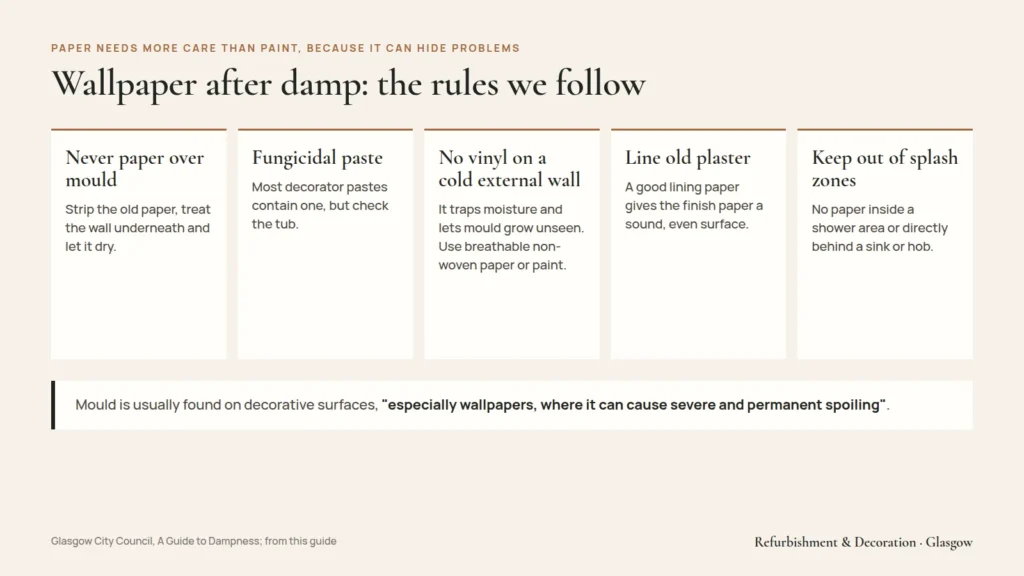
Yes, once the cause is fixed and the wall is dry. But wallpaper needs more care than paint, because it can hide problems. The council’s guide notes that mould is usually found on decorative surfaces, “especially wallpapers, where it can cause severe and permanent spoiling”.
The rules we follow
- Never paper over mould. Strip the old paper, treat the wall underneath, and let it dry. Mould under old paper is common on external walls and behind wardrobes.
- Use a paste with a fungicide. Most decorator pastes contain one, but check the tub.
- Think twice about vinyl on a cold external wall. Vinyl and other low-permeability papers stop moisture escaping, which can let mould grow behind the paper where you can’t see it. A breathable non-woven paper, or paint, is a safer choice on a wall that runs cold.
- Line old plaster with a good lining paper first, so the finish paper has a sound, even surface.
- Keep paper out of splash zones. No wallpaper inside a shower area or directly behind a sink or hob.
Kitchens and bathrooms
A well-ventilated bathroom with a working extractor can take a wallpaper, as long as it is away from the bath and shower. Vinyl or paper marked as suitable for kitchens and bathrooms is easier to clean. In a steamy bathroom with no fan, paint is the better choice until the ventilation is fixed. See our wallpaper hanging service for more on papers and preparation.
What does it cost to put right?
Decorating after damp usually costs a little more than a standard repaint, because of the extra preparation: mould treatment, stain-blocking primer, drying time and sometimes stripping paper. Specialist paints also cost more per litre than standard emulsion.
| Job | Market range | Source |
|---|---|---|
| Box room repaint | £175–£300 (4–6 hours) | MyJobQuote (Sep 2026) |
| Small bedroom repaint | £250–£400 (about 1 day) | MyJobQuote (Sep 2026) |
| Bathroom repaint | £150–£300 | MyJobQuote (Sep 2026) |
| Kitchen repaint | £250–£500 | MyJobQuote (Sep 2026) |
| Average room, Glasgow, materials included | £350–£600 | BestBuilders Glasgow (Aug 2026) |
| Strip old paper | +£150–£300 a room | BestBuilders (Aug 2026) |
| Lining paper | +£80–£150 a room | BestBuilders (Aug 2026) |
| Wallpaper a room incl. stripping, Glasgow | £325–£775 | BestBuilders Glasgow (Aug 2026) |
These are published market ranges, not R&D’s prices. Building repairs such as roof, gutter or damp-proof course work are separate and are not included.

A worked example: a typical back bedroom with condensation mould
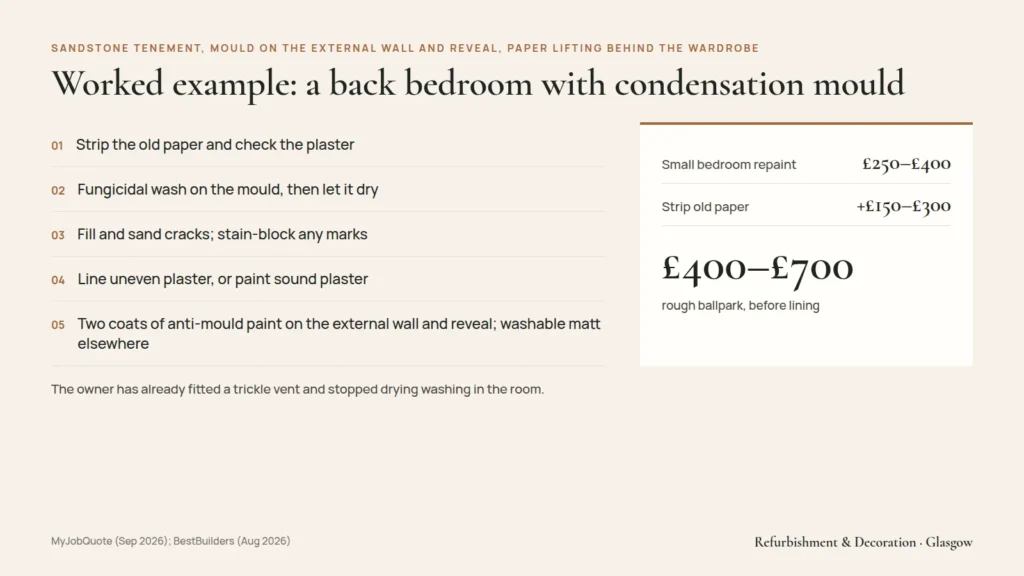
A small bedroom in a sandstone tenement has black mould in the corner of the external wall and along the window reveal, and the paper has lifted behind the wardrobe. The owner has already fitted a trickle vent and stopped drying washing in the room. A typical job would run like this:
- Strip the old paper and check the plaster behind it.
- Treat the mould with a fungicidal wash, then let it dry.
- Fill and sand any cracks, and stain-block any marks.
- Line the walls if the plaster is uneven, or paint straight onto sound plaster.
- Finish the external wall and reveal with two coats of anti-mould paint, and the other walls in a washable matt in the same colour.
Using the ranges above, a small bedroom repaint at £250–£400 plus stripping at £150–£300 gives a ballpark of roughly £400–£700, before lining. Your own price depends on the room and its condition.
Mistakes to avoid
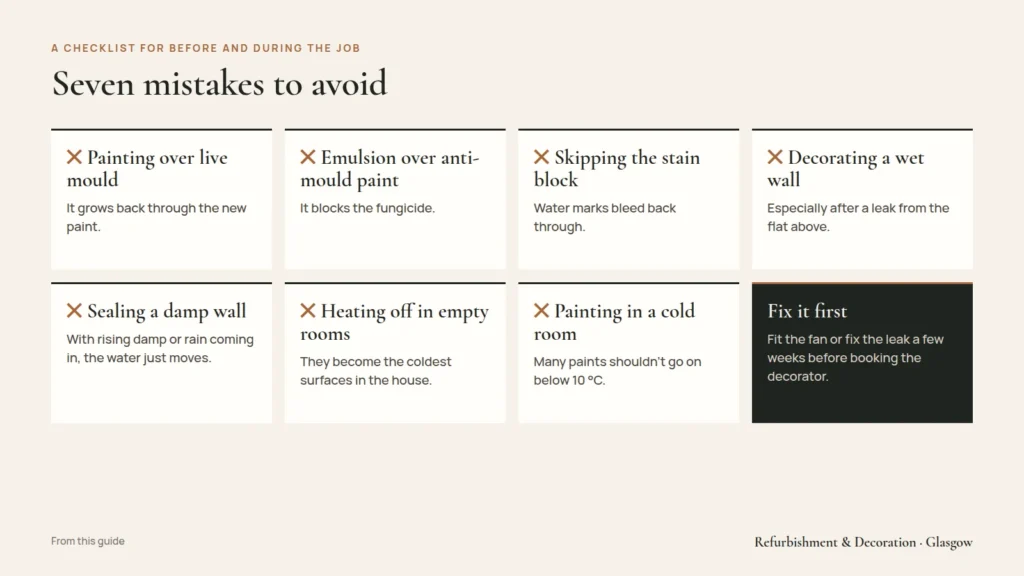
- Painting over mould without killing it. It grows back through the new paint.
- Putting ordinary emulsion over anti-mould paint. It blocks the fungicide.
- Skipping the stain block on water marks.
- Decorating before the wall is dry, especially after a leak from the flat above.
- Sealing a wall that has rising damp or rain coming in. The water just moves.
- Turning the heating off in empty rooms in winter, which makes them the coldest surfaces in the house.
- Painting in a cold room. Many paints shouldn’t be applied below 10 °C, and paint dries slowly in cold, damp air. See our guide to painting in winter in Scotland.
Choosing a colour for a damp-prone room
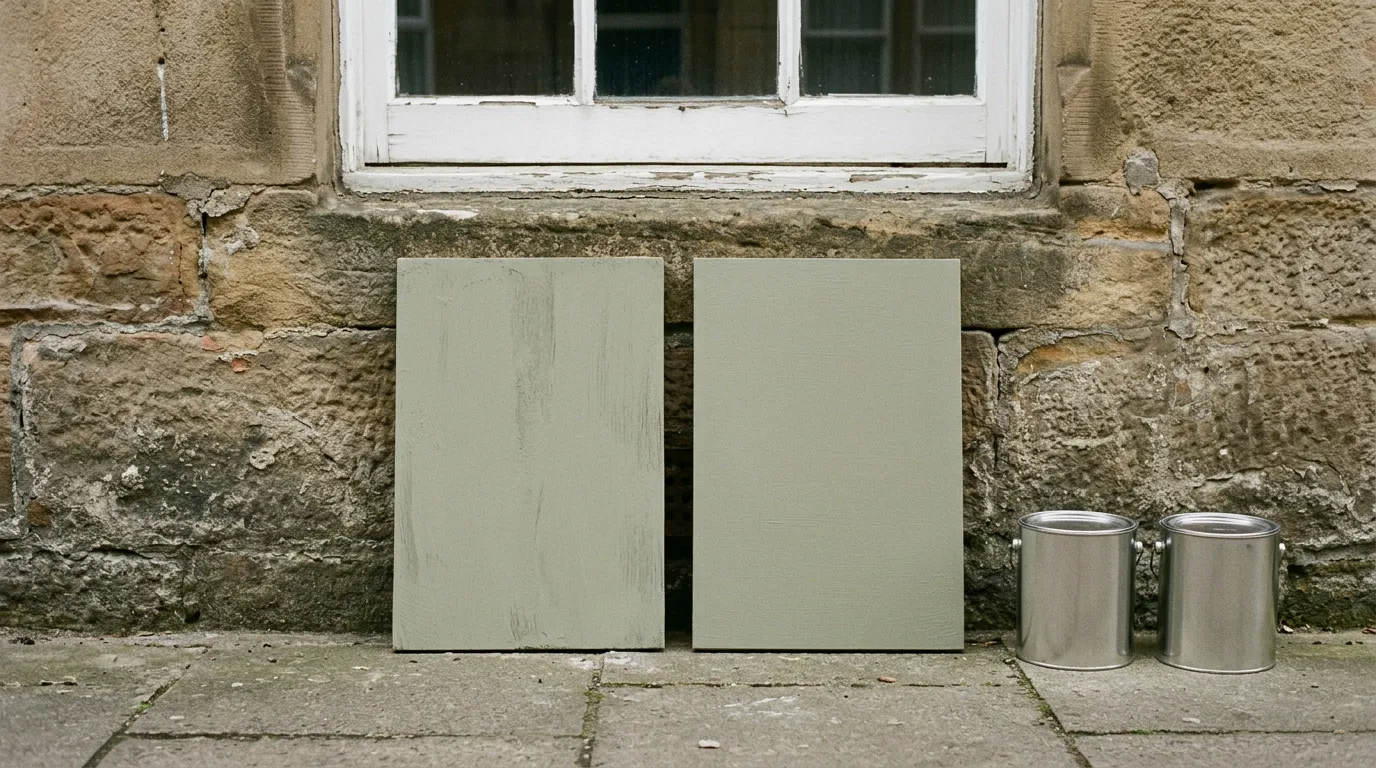
Anti-mould paints come in a smaller range of colours than standard emulsions, though many can be tinted. Rooms that suffer condensation are often cold, north-facing rooms too, so colour choice needs care. Our cornerstone guide to choosing paint colours for Scottish light explains which colours work in those rooms. If you are weighing up a designer paint against a trade one for a kitchen or bathroom, see Farrow & Ball vs Dulux Trade.
If the problem won’t go away
If you live in Glasgow and can’t resolve a damp problem, the council says to contact its Environmental Health Public Health Team on 0141 287 1059. Check the current contact details on the council website before calling.
Getting a price for your home
We look at the cause before we quote, and if the problem needs a roofer or plumber first, we will tell you. We give a guide price on the phone and a fixed written quote after a free visit. Call 07777 780557 or book a free visit. Read more about our interior painting and the areas we cover across Glasgow.
Questions people ask
How do I know if it's condensation or rising damp?
Condensation usually shows as black spotty mould in corners, on window reveals and behind furniture, and gets worse in winter. Rising damp only affects ground-floor walls and leaves a tidemark up to about a metre high, often with salts. Glasgow City Council notes black mould is not generally a sign of rising or penetrating damp. Brown stains that grow in wet weather point to rain getting in.
Can you paint over mould?
Not without treating it first, or it grows back through the new paint. Glasgow City Council suggests washing mould with 5 parts water to 1 part bleach, drying it off and repeating as needed, or using a fungicidal wash. Wear gloves and eye protection and keep a window open. Once the wall is dry, finish with an anti-mould paint, and fix the ventilation too.
Does anti-mould paint really work?
It helps, as long as the cause is dealt with. Glasgow City Council's damp guide says anti-mould paint should stay effective for longer than a mould wash, and is particularly useful in kitchens and bathrooms. It must be the top coat: painting ordinary emulsion over it stops the fungicide working. In a cold, badly ventilated room, mould can still return.
Can I wallpaper a wall that has had damp?
Yes, once the cause is fixed and the wall has dried out. Strip any old paper, treat mould underneath and use a paste containing fungicide. Avoid vinyl on cold external walls, because it can trap moisture and let mould grow unseen behind the paper. A breathable non-woven paper or paint is safer on a wall that runs cold.
Why does a water stain come back through new paint?
Water stains contain residues that bleed through ordinary water-based emulsion, sometimes after two or three coats. The cure is to let the area dry fully, then seal it with a stain-blocking primer before painting. Check the leak has really stopped first, especially if it came from the flat above. Skipping this step is the most common reason ceilings show a ring again.
Who do I contact in Glasgow about a damp problem I can't fix?
If you rent, report it to your landlord in writing. For shared repairs in a tenement, such as the roof or gutters, speak to your factor or the other owners. Glasgow City Council says residents who can't resolve dampness can contact its Environmental Health Public Health Team on 0141 287 1059. Check the current details on the council website first.

Painters and decorators working across Glasgow & Central Scotland, specialising in interior painting and wallpaper hanging. Prices in our guides are reviewed every year.
 Farrow & Ball vs Dulux Trade for a Glasgow Home
 Choosing Paint Colours for Scottish Light: the Complete Guide