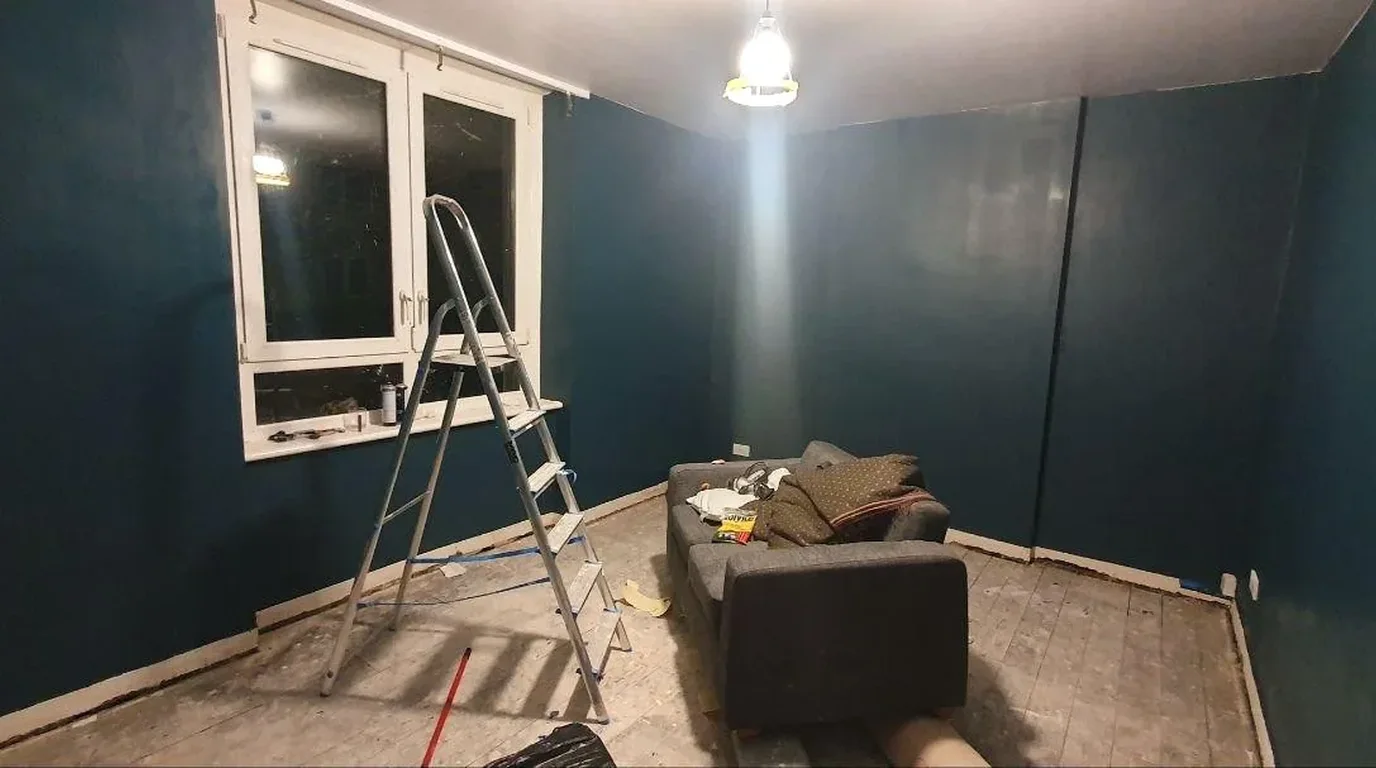
Yes. Interior painting works well in a Scottish winter if the room is heated. Trade emulsions we checked need the air and wall above 8–10 °C (Crown Trade 8 °C, Johnstone's and Farrow & Ball 10 °C) and humidity below about 80%. Heat the room a day ahead, keep it warm overnight, ventilate and allow longer between coats.
Winter is when a lot of Glasgow homeowners decide the hall or the living room cannot face another year, and it is also when they wonder whether the cold and damp will ruin the paint. The weather outside matters less than you might think. What matters is the temperature and humidity inside the room, and on the surface of the wall, while the paint goes on and dries. This guide gives the figures from paint manufacturers’ own data sheets and explains how we manage a room in a Scottish winter.
Can you paint indoors in a Scottish winter?
Yes. Interior painting works well in winter in a heated home. Paint does not know what month it is; it responds to the conditions in the room. A living room kept at a normal 18–21 °C with sensible ventilation is well inside every interior paint’s working range, whether it is July or January.
Problems come from three situations that are more common in winter:
- Unheated rooms or empty properties, such as a flat between tenancies with the heating off, or a spare room with the radiator turned down.
- Cold external walls, especially solid sandstone walls in tenements, where the wall surface can be several degrees colder than the air in the middle of the room.
- High humidity from drying washing indoors, cooking, showers, or a portable gas heater, which slows drying and can cause condensation on cold walls.
Deal with those and winter painting is no different in quality from summer painting. It is mainly a matter of planning the heating.
What temperature and humidity does paint need?
Every trade paint has a technical data sheet that sets out the conditions it needs. These are the figures we found for some widely used products, checked in October 2026.
| Product | Minimum temperature | Other conditions | Recoat time (normal conditions) | Source |
|---|---|---|---|---|
| Crown Trade Matt Vinyl emulsion | Air or surface likely to stay above 8 °C | Relative humidity below 80% during application and drying | Dry in about 4 hours | Crown Trade product data, via Wood Finishes Direct |
| Johnstone’s Jonmat Premium Contract Matt | Do not apply below 10 °C | Not in damp conditions | Touch dry 2–3 hours, recoat after 2–4 hours | Johnstone’s data sheet |
| Farrow & Ball Estate Emulsion | 10 °C (maximum 30 °C) | Longer drying in cool or humid rooms | 2–4 hours depending on colour | Retailer product specifications (B&Q, Wood Finishes Direct) |
| Dulux Trade Vinyl Matt | Not stated on product page; protect from frost | Drying depends on temperature and humidity | 2–4 hours | Dulux Trade |
| Dulux Trade Diamond Matt | Not stated on FAQ page | Cooler temperatures or higher humidity extend drying | 4–6 hours | Dulux Trade |
| Dulux Trade solvent-based gloss | See data sheet | Slow to dry in cold rooms | Touch dry 4–6 hours, recoat 16–24 hours | Screwfix product listing |
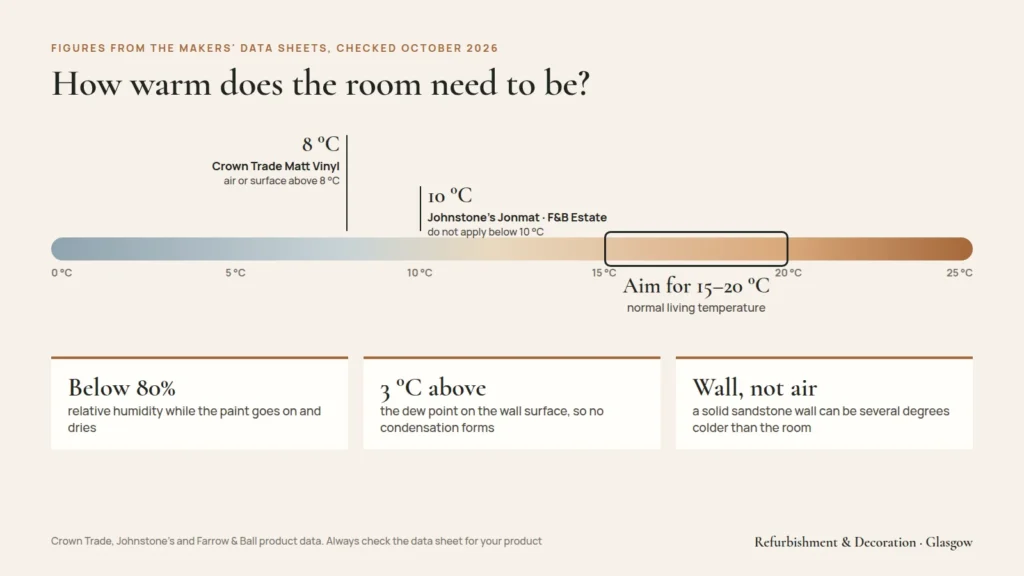
The pattern is clear: the trade emulsions we checked want the room and the wall at 8–10 °C or above, and humidity below about 80%. Those are minimums, not targets. At 10 °C paint will dry, but slowly. In practice we aim for a room at normal living temperature, roughly 15–20 °C, before, during and after painting. Always check the data sheet for the exact product being used, because figures vary between ranges and manufacturers update them.
Air temperature is not wall temperature
A thermostat in the hall reading 19 °C tells you nothing about the back wall of a north-facing bedroom in a sandstone tenement. Solid stone walls with no insulation lose heat to the outside, and their inner surface can sit well below room temperature on a frosty morning. That is the surface the paint is drying on.
The other risk on a cold wall is condensation. When warm, moist air meets a surface below its dew point, water forms on that surface. Paint applied onto a film of condensation, or one that gets condensation on it while wet, can dry patchy, lose adhesion, or show streaks and “surfactant leaching”, where sticky brown or shiny marks appear on the surface. Many manufacturers ask for the surface to be at least 3 °C above the dew point for this reason.
Decorator’s tip: A cheap digital thermometer and hygrometer (often under £15) tells you the room’s temperature and humidity. If the humidity reads above 70% before you start, ventilate and run the heating for a few hours first. Touch the coldest wall with the back of your hand: if it feels cold and slightly clammy, it is not ready.
How does cold weather change drying and recoat times?
The drying and recoat times printed on a tin are measured in standard conditions, usually around 20 °C and 50–65% humidity. Colder or damper rooms stretch them. Water-based paint dries as the water evaporates, and evaporation slows in cool, humid air. Solvent-based paint dries by reacting with oxygen, and that reaction slows in the cold too.
| What you are painting | Tin says | What to expect in a cool winter room |
|---|---|---|
| Walls and ceilings, water-based matt emulsion | Recoat 2–4 hours | Allow the longer end or more. Two coats in a day is still realistic if the room is warm. |
| Durable or scrubbable matt | Recoat 4–6 hours | Often one coat in the morning and one late afternoon, or the next day. |
| Woodwork, water-based satin or gloss | Usually a few hours | Fine in winter. Slightly longer between coats. |
| Woodwork, solvent-based gloss | Recoat 16–24 hours | Plan on a full day between coats. Keep it warm and well lit while drying. |
| Mist coat on new plaster | Depends on plaster dryness | New plaster dries far more slowly in winter. Do not rush it. |
Drying is not the same as curing. A wall can be touch dry in an hour and recoatable in four, but the paint film keeps hardening for days or weeks. In a cool room that takes longer, so treat newly painted walls gently for the first couple of weeks: no scrubbing, and do not push furniture tight against them.
Why winter suits water-based woodwork paint
Traditional solvent-based (oil-based) gloss is slower to dry in the cold, and it tends to yellow, especially where it dries without much daylight. A Glasgow hallway in December, with under seven hours of daylight on the shortest day, is exactly that situation. Modern water-based satins and glosses dry faster, smell less (useful when windows are only open a crack), and resist yellowing. For most winter interior jobs, they are our default for skirtings, doors and facings.
Dark colours take longer
Deep, strong colours carry more tint and often need an extra coat. Retailer guidance on Farrow & Ball Estate Emulsion notes that some darker colours can take much longer to dry fully. In a cold room, add more time again and avoid judging the colour until it is completely dry, because many dark paints look patchy while still drying.

How do you balance heating and ventilation?
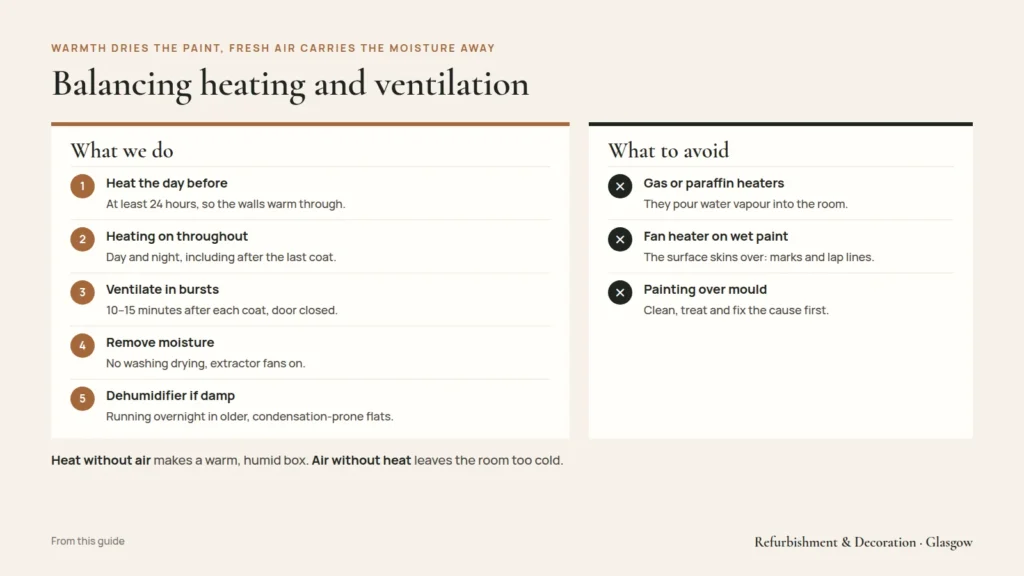
This is the part that makes or breaks a winter paint job. You need warmth to dry the paint, and you need fresh air to carry the moisture away. Heat without ventilation turns the room into a warm, humid box. Ventilation without heat leaves the room too cold.
What we do
- Heat the room the day before. Run the central heating normally for at least a day before work starts, so the walls warm through, not just the air. In an empty flat this is the step most often skipped.
- Keep the heating on throughout. Leave radiators on during the day and overnight, including the night after the last coat. Do not turn everything off at night to save money during the job; the walls cool and drying stalls.
- Ventilate in short bursts. Open a window for 10–15 minutes after each coat and at the end of the day, with the door closed to the rest of the house. Trickle vents on modern windows can be left open throughout.
- Remove moisture sources. No drying washing in the room, kitchen doors closed while cooking, extractor fans on in bathrooms and kitchens.
- Use a dehumidifier if needed. In a damp room or an older flat that suffers from condensation, a dehumidifier running overnight can bring humidity down noticeably.
What to avoid
- Portable gas or paraffin heaters. They give off a lot of water vapour as they burn, which raises humidity at exactly the wrong moment. Electric heaters or the central heating are better.
- Blasting a fan heater directly at wet paint. It can make the surface skin over too fast, which can leave marks and lap lines.
- Painting over mould. Winter is when condensation mould appears on cold corners and behind furniture. It needs cleaning off and treating, and the cause addressing, before any paint goes on. Glasgow City Council’s “A Guide to Dampness” explains the different types of damp; our article on damp, condensation and mould covers which paints to use.
What works well in winter, and what should wait for spring?
| Job | Winter? | Why |
|---|---|---|
| Repainting walls and ceilings in a heated home | Yes | Normal room temperatures are well inside the products’ range. |
| Woodwork, doors, skirtings | Yes | Water-based products dry well; allow longer for solvent-based gloss. |
| Wallpaper hanging | Yes, with care | Paste needs to dry steadily. Keep the room warm but avoid fierce heat on a freshly papered wall, which can open seams. |
| Painting new plaster | Often slower | Plaster dries more slowly in a cold house. Wait until it is evenly pale and dry before the mist coat. |
| An empty, unheated property | Only once heated | Turn the heating on at least a day ahead and keep it on until the paint has dried. |
| Tenement close or common stair | Depends | Closes are often cold and draughty. Check the surface temperature against the product’s minimum before committing to winter dates. |
| Sash windows | Inside faces only | Paint on the outside of the sashes needs dry, mild weather. Inside faces are fine if the room is warm. |
| Exterior walls, harling, render, fascias | Wait | Needs dry weather and surfaces above the minimum temperature through drying. In the west of Scotland, plan for late spring to early autumn. |
For tenement-specific advice, including high ceilings and solid stone walls, see our guide to painting a Glasgow tenement flat. For outdoor work, our exterior painting guide covers the weather window.

A worked example: a cold north-facing bedroom
Take a typical second-floor tenement bedroom in January: one external sandstone wall, a single radiator under a sash window, heating usually off during the day because the owner is at work. Here is how a decorator would plan it:
- Ask the owner to leave the heating on for 24 hours before the start date.
- On arrival, check room temperature and humidity, and feel the external wall. If it is cold and clammy, delay the external wall until later in the day.
- Prepare and paint the ceiling and the three internal walls first, while the external wall warms up.
- Ventilate for 15 minutes after the first coat, then close the window and let the heating work.
- Second coats in the afternoon, external wall last.
- Heating left on overnight; woodwork in water-based satin the next morning.
The result is no different from a summer job. It just takes a little more thought about the order.

Is winter a good time to book a decorator?
For interior work, often yes. Tradespeople on the Decorators Forum describe waiting lists of two to three months as normal, and the busiest periods are spring and the weeks before Christmas. Exterior work also stops for most decorators over winter, so January to March is often the easiest time to get an interior start date. If you want a room done for Christmas, ask for quotes by early October.
There are a few things to plan around:
- Short days. In Glasgow the shortest day has under seven hours of daylight. Good decorators bring proper work lights, but you should check colours in daylight. Paint a large sample and look at it at midday and again under your own lamps in the evening. Our guide to colours for Scottish light explains why grey winter light changes colours so much.
- Heating cost. Running the heating for an extra day or two is part of the job in winter. It is a small cost next to a finish that has to be redone.
- Weather and access. In a tenement, wet and icy closes mean extra care carrying materials and towers. That is a decorator’s problem to manage, but it is worth agreeing where things can be stored.
Prices do not usually change with the season. Published market ranges put a Glasgow or Scottish decorator at £150–£290 a day (BestBuilders Glasgow, Aug 2026; Trade2Base Scotland, Jun 2026), a small bedroom repaint at £250–£400 and a large bedroom at £350–£660 (MyJobQuote, Sep 2026), and an average Glasgow room including materials at £350–£600 (BestBuilders Glasgow, Aug 2026). Our Glasgow prices guide has the full table, and our guide to planning a redecoration and choosing a decorator covers timings, quotes and preparing your home.

Getting a price for your home
Winter is a good time to get interior decorating done, as long as the room is warm, the walls are dry and the moisture has somewhere to go. We plan the heating and the order of work around your home so the paint dries as it should.
We give a guide price on the phone and a fixed written quote after a free visit. Call 07777 780557, or book a free visit online. You can read more about our interior painting service in Glasgow.
Questions people ask
What is the minimum temperature for painting interior walls?
It depends on the product, so check its data sheet. Crown Trade Matt Vinyl asks for air and surface temperatures above 8 °C with humidity below 80%. Johnstone's Jonmat says not to apply below 10 °C, and retailer specifications for Farrow & Ball Estate Emulsion give 10 °C. In practice, aim for normal room temperature, around 15–20 °C.
How long does paint take to dry in a cold room?
Longer than the tin says. Tin times assume warm, standard conditions. Dulux Trade lists Vinyl Matt as recoatable in 2–4 hours and Diamond Matt in 4–6 hours, and says cooler temperatures or higher humidity extend drying. In a cool winter room, use the longer figure or more, and allow a full day between coats of solvent-based gloss.
Should I leave the heating on after painting?
Yes. Keep the heating on during the day and overnight, including the night after the last coat. Switching it off lets walls cool, which slows drying and raises the risk of condensation on the fresh paint. In an empty or rarely used room, turn the heating on at least a day before the decorator starts.
Can I open the windows while paint dries in winter?
Yes, in short bursts. Open a window for 10–15 minutes after each coat and at the end of the day, with the door to the rest of the house closed, then shut it and let the heating work. Leaving a window wide open for hours in winter cools the walls too much and slows drying.
Can you paint over condensation mould in winter?
No. Mould comes back through ordinary paint. Clean and treat it first, deal with the cause by improving ventilation and heating, and only then repaint, ideally with a mould-resistant paint in kitchens and bathrooms. Council damp guidance notes that anti-mould paint stops working if it is covered with ordinary paint or wallpaper.
Can exterior painting be done in a Scottish winter?
Generally not. Masonry paint and exterior woodwork need dry weather and surfaces that stay above the product's minimum temperature while the paint dries. In the west of Scotland that usually means late spring to early autumn. Book exterior work for summer and use the winter months for interior rooms.

Painters and decorators working across Glasgow & Central Scotland, specialising in interior painting and wallpaper hanging. Prices in our guides are reviewed every year.
 How Long Does It Take to Paint a House? Room-by-Room Timings
 Landlord & End-of-Tenancy Painting in Glasgow
 Redecorating in Glasgow: Planning, Timings & Choosing a Decorator