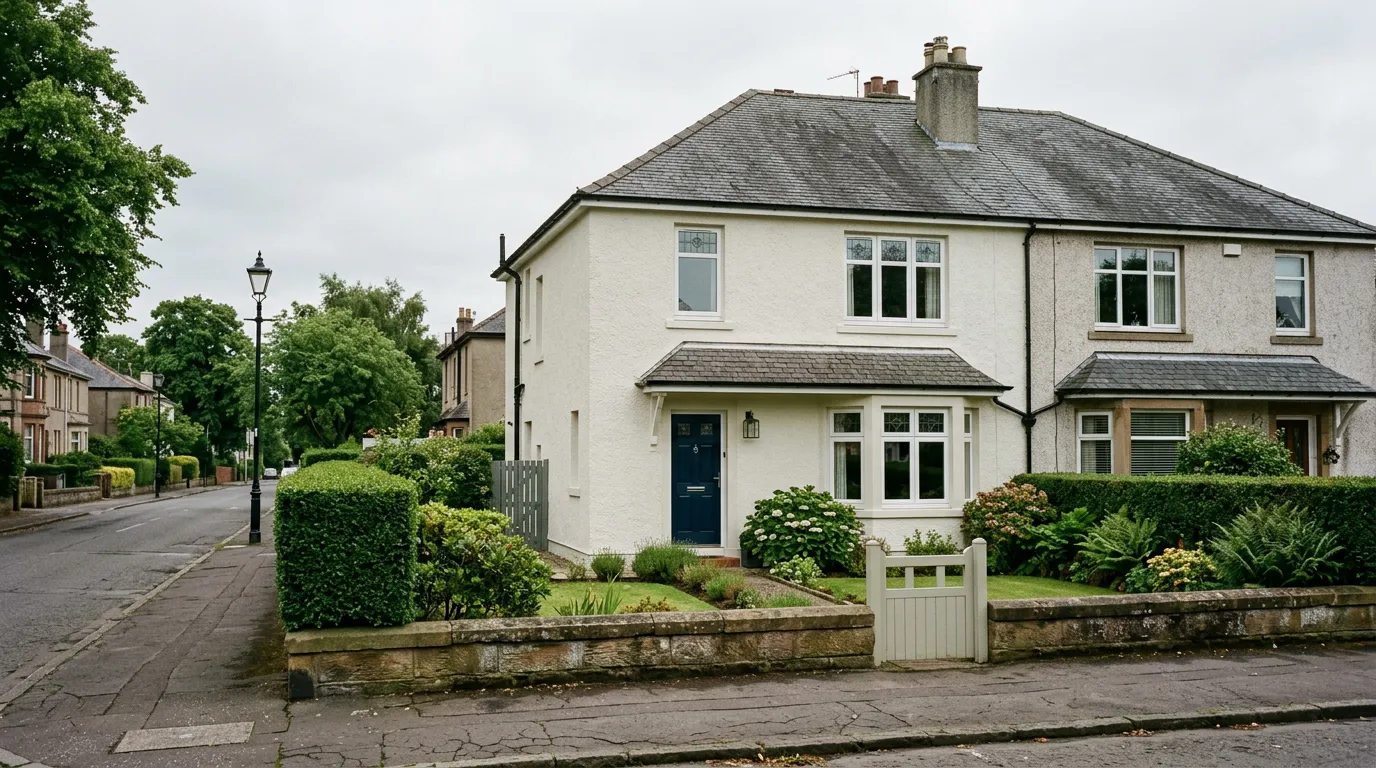
Painting a Glasgow house exterior typically costs £1,650–£4,150 (BestBuilders Glasgow, Aug 2026), with textured harl or pebbledash taking about twice as long as smooth render. Cement harl and render take good masonry paint; lime harl needs a breathable finish; unpainted sandstone should not be painted, and listed or conservation-area buildings may need consent.
Most exterior painting advice online is written for smooth-rendered houses in drier parts of England. Glasgow is different: harled semis and bungalows, roughcast four-in-a-blocks, and whole streets of blond and red sandstone, all under some of the wettest skies in the UK. This guide explains what each wall finish needs, which surfaces should not be painted at all, when permission is required, and what exterior painting costs, with sources named for every figure.
What is your house actually finished in?
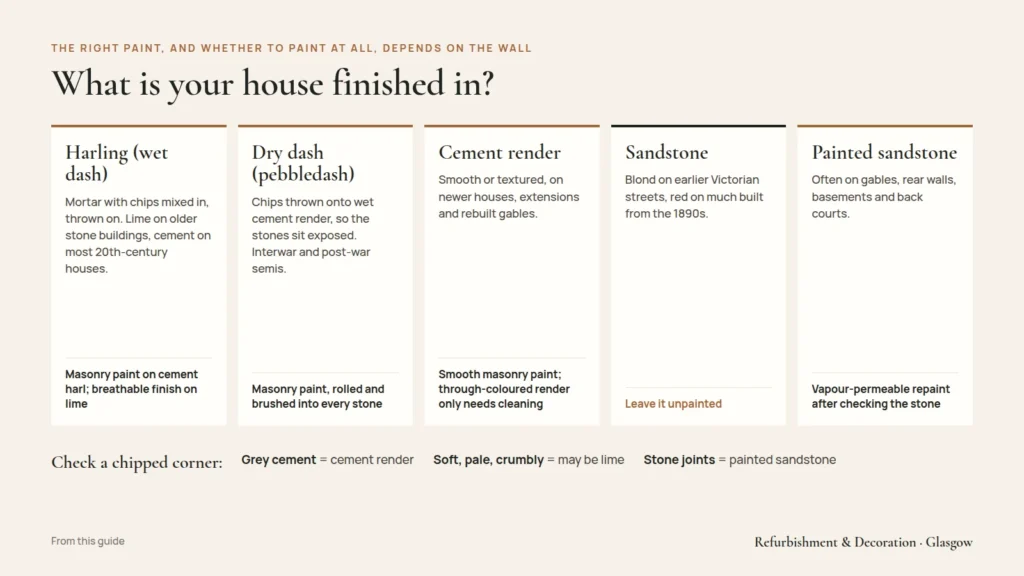
The right paint, and whether to paint at all, depends on what the wall is made of. These are the surfaces we see most around Glasgow and Central Scotland:
- Harling (wet dash). Mortar with the stone chips mixed in, thrown onto the wall. Traditional harling on older stone buildings was lime-based; the harl on most 20th-century houses and council-built semis is cement-based. It has a rough, lumpy texture with the chips coated in mortar.
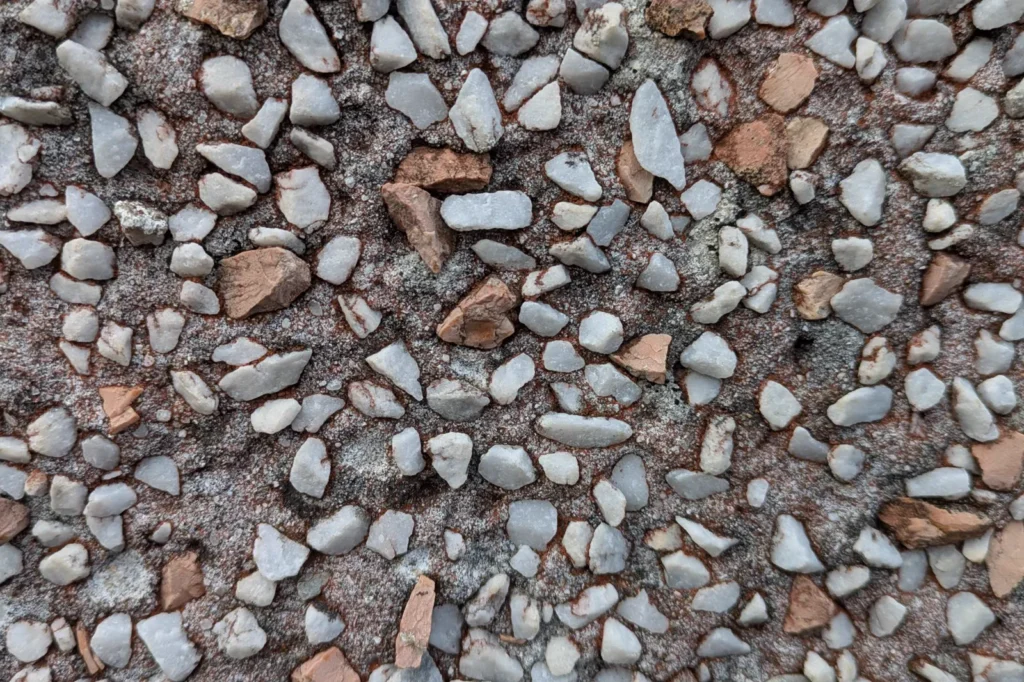
- Dry dash (pebbledash). A cement render with chips thrown onto it while wet, so the stones sit exposed on the surface. Common on interwar and post-war semis and four-in-a-blocks.
- Smooth or textured cement render. On newer houses, extensions and rebuilt gables, sometimes with a modern through-coloured render that was never meant to be painted.
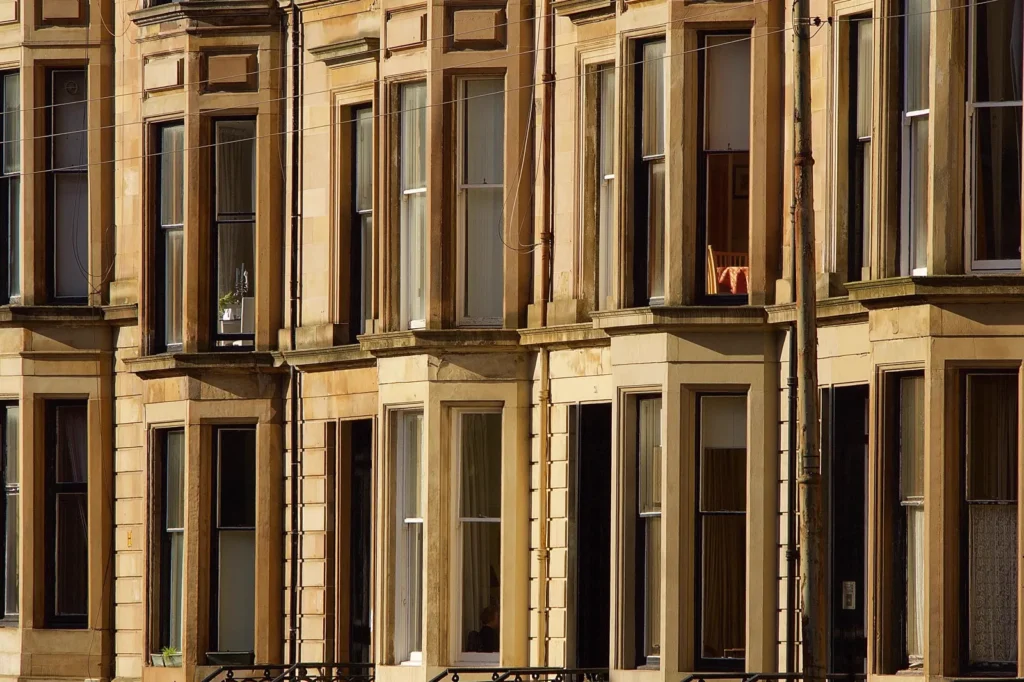
- Sandstone. The face of most Glasgow tenements and many villas: blond sandstone on the earlier Victorian streets and red sandstone on much of what was built from the 1890s.
- Painted sandstone. Stone that someone has already painted, often on gables, rear elevations, basements and back courts.
| Surface | Usually suitable | Avoid |
|---|---|---|
| Cement harl or roughcast, previously painted | Good-quality masonry paint, matching the existing system; mineral (silicate) paint where compatible | Painting over loose or hollow render without repair |
| Dry dash (pebbledash), previously painted | Masonry paint applied by roller and brush to cover every face of the stones | Spraying alone, which misses the undersides of the chips |
| Lime harl on an older stone building | Limewash, or a breathable mineral paint after advice | Plastic or acrylic masonry paint that seals the surface |
| Smooth cement render | Smooth masonry paint | Painting through-coloured render that only needs cleaning |
| Unpainted sandstone | Nothing. Leave it unpainted | Any paint or sealer, without specialist and planning advice |
| Already-painted sandstone | Repaint with a vapour-permeable system after checking the stone; consult the council in a conservation area | Another thick coat of plastic paint over flaking, damp stone |
If you are not sure which you have, look at a corner where the finish is chipped. Grey cement under the paint means cement render. Soft, pale, crumbly mortar may be lime. Stone joints showing through the paint mean painted sandstone.
Why does breathability matter on a Scottish wall?
Traditional Scottish walls were built to get wet and dry out again. Historic Environment Scotland’s Technical Paper 31, Historic External Lime Finishes in Scotland (2019), describes how lime harls and limewash protected masonry from driving rain, wind and frost, and needed regular renewal in exposed places. HES’s Engine Shed guidance on lime says lime mortars “are able to hold and evaporate moisture”, while modern cement mortars “are less permeable” and can trap water that gets in, which speeds up stone decay.
Paint works the same way. A coating that lets water vapour pass (often called breathable, vapour-permeable or microporous) lets a wall dry outward between showers. A dense acrylic or plastic coating sheds rain at first, but water still gets in through cracks, joints and the top of the wall, and then cannot get out. The signs are blistering and peeling paint, damp patches inside, and on stone, a crumbling face behind the paint.
In practice:
- Cement harl and render on a 20th-century house is already fairly impermeable, so a good masonry paint is normally fine, provided the render itself is sound and well detailed at the top and bottom.
- Lime harl and stone on older buildings need a finish that stays breathable: limewash, or a mineral silicate paint where the specification allows it.
- Don’t mix systems blindly. Mineral paints bond chemically to mineral surfaces, and most will not take on top of an existing acrylic coating without a specific primer or product. Ask the manufacturer before switching.
Decorator’s tip: most paint failures on harled houses start at the same places: under leaking gutters, behind downpipes, at cracked sills and at the bottom of the wall where splashback keeps it wet. Fixing those before painting does more for the finish than any paint brand.

Should you paint sandstone?
Generally, no. The Engine Shed’s guidance on sandstone advises that oil paints “should be avoided, as they are likely to trap in any water that enters the stone”, and that water-repellent treatments should be approached with caution “as they may have the reverse effect”. The Dennistoun conservation area advice booklet, prepared with Glasgow City Council, is blunter: “Natural stonework and brickwork should not be painted.”
Trapped water is what destroys sandstone. It carries salts into the stone, freezes in the pores, and pushes the face off in flakes and layers. Paint does not stop this; it hides it until large pieces come away.
If your sandstone is already painted
Removing paint from stone is a specialist job and can damage the surface, so it is not always the right answer. The Dennistoun booklet says that where stone has been painted before and “the paint cannot be removed successfully, it may be acceptable to repaint using a colour agreed with the Planning Authority”, and that the condition of the stone must be checked first. Our approach:
- Check for damp, flaking stone and failed pointing behind the paint. Stone damage is a job for a stonemason, not a decorator.
- Find out what is on the wall. Many painted gables carry layers of plastic masonry paint that already trap moisture.
- Where the paint is sound and the stone dry, repaint with a vapour-permeable system that is compatible with what is there.
- Where the paint is failing badly, get advice on removal before adding another coat.
- In a conservation area or on a listed building, agree the colour and approach with the council first.
Stone cleaning is a separate question with its own risks. The Engine Shed says that in the worst cases, cleaning “has sped up natural stone decay and erosion by 6 to 10 times”, and Historic Environment Scotland lists cleaning stonework among works that may need consent on a listed building.

Do you need permission to paint the outside of your house in Glasgow?
It depends on whether the building is listed, whether it is in a conservation area, and whether you are changing its appearance.
- Repainting in the same colour on an ordinary house outside a conservation area is maintenance and does not normally need permission.
- Listed buildings. Historic Environment Scotland’s consents guidance lists changing the colour of external paintwork and cleaning stonework among works that might need listed building consent, applied for through the planning authority.
- Conservation areas. Glasgow has many, including Dennistoun, Pollokshields, Park and much of the West End. The Dennistoun booklet lists “stone cleaning or painting of the exterior” among works that need planning permission there. Some areas also have Article 4 Directions that remove permitted development rights for minor works.
- Tenements. Painting part of a shared elevation is also a matter for the other owners and your title deeds, before it is a planning matter.
The rules depend on the building and change over time. Check the current position with Glasgow City Council’s planning service before acting, especially before painting any stone or changing a colour. For a wider checklist on planning a job and choosing a firm, see our guide to planning a redecoration and choosing a decorator in Glasgow.

When can you paint outside in the west of Scotland?
Exterior paint needs a dry wall, a dry forecast and enough warmth to cure. Dulux Trade’s datasheet for its standard Weathershield Smooth Masonry paint is typical: do not apply below 7 °C, during rain or fog, or when relative humidity is above 80%. It also notes that drying will be “significantly longer in cold, damp conditions”. Other products have their own limits, printed on the tin.
In Glasgow that usually means:
- Season: roughly May to September for most work. April and October are possible in a settled spell, with short days.
- Daily window: start after the dew has dried off the wall, and stop early enough for the paint to skin before evening damp. North walls dry slowly and may not be workable until late morning.
- The wall itself: harl and render soak up rain and hold it. After a wet week, a wall needs at least a dry day or two before painting, longer in spring.
- Booking: good exterior firms fill the summer early. If you want work done in June or July, ask in winter or early spring.
Because the weather window is short, a good quote allows for rain days. A three-day job can easily run over two weeks of calendar time in a broken summer.

How the job is done
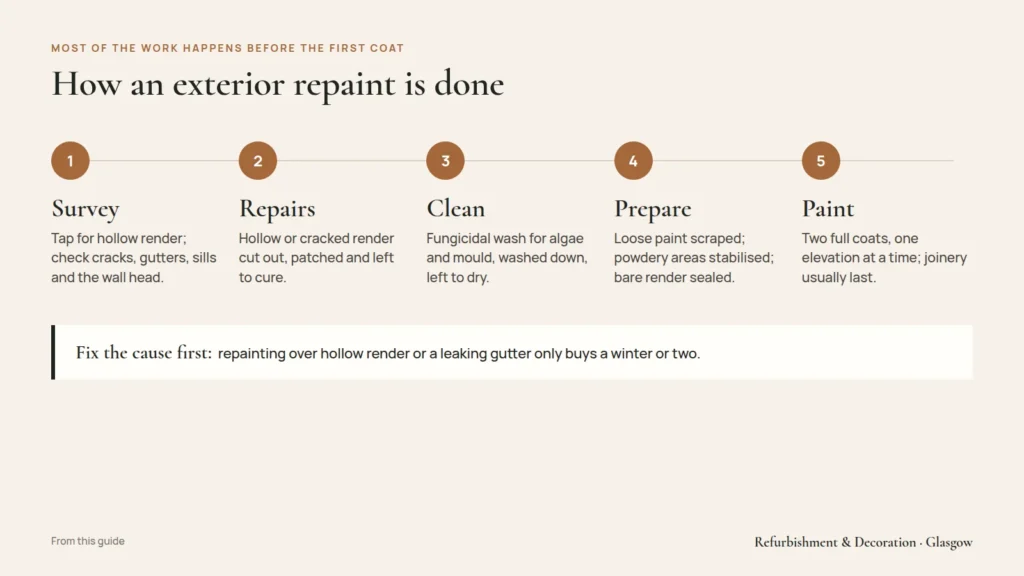
- Survey. Tap the render for hollow patches, check cracks, gutters, sills and the wall head.
- Repairs. Hollow or cracked render cut out and patched by a plasterer or renderer, and left to cure.
- Clean. Algae and mould treated with a fungicidal wash, then washed down and left to dry.
- Prepare. Loose paint scraped off. Powdery surfaces sealed with a stabilising primer; sound bare render sealed with a thinned first coat, as the maker specifies.
- Paint. Two full coats, working one elevation at a time to wet edges, with joinery (fascias, soffits, sills, doors) usually last.
Mistakes to avoid
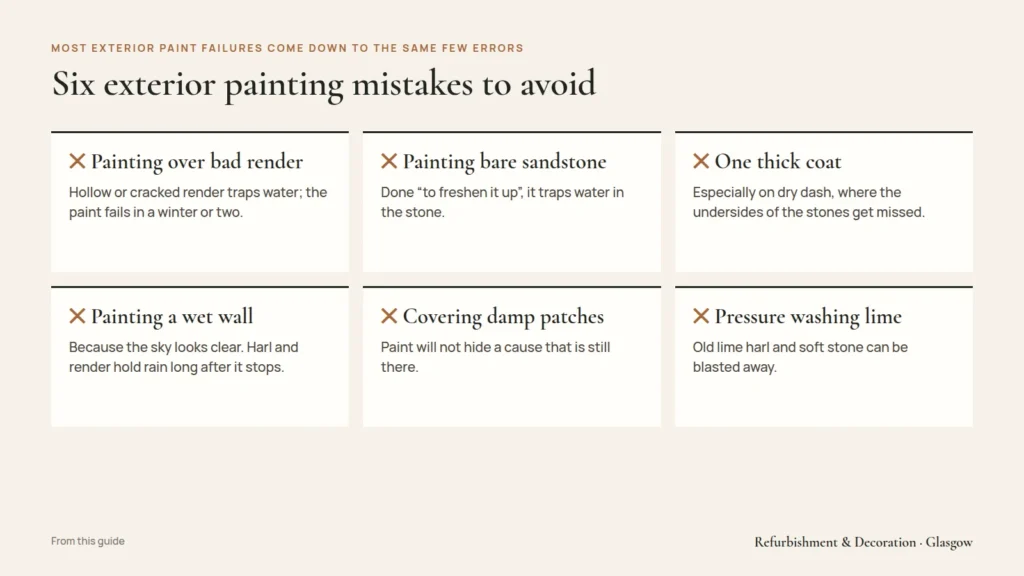
- Painting over hollow or cracked render. It traps water and the paint fails within a winter or two.
- Painting unpainted sandstone “to freshen it up”.
- One thick coat instead of two, especially on dry dash, where the undersides of the stones get missed.
- Painting a wet wall because the sky looks clear.
- Ignoring the cause of damp patches and expecting paint to cover them.
- Pressure washing old lime harl or soft stone, which can blast away the surface.
What does exterior painting cost in Glasgow?
Exterior work is priced higher than interior work because of access, weather risk and surface preparation. Trade2Base (June 2026) puts the exterior premium at 15–25% over an interior day rate. The ranges below are market figures from named sources, not R&D’s prices.
| Item | Market range | Source |
|---|---|---|
| Glasgow house exterior, walls and woodwork | £1,650–£4,150 | BestBuilders Glasgow (Aug 2026) |
| Terraced house (UK) | £1,500–£3,100 | MyJobQuote (Oct 2026) |
| Semi-detached house (UK) | £2,600–£5,700 | MyJobQuote (Oct 2026) |
| Detached house (UK) | £3,400–£7,700 | MyJobQuote (Oct 2026) |
| Masonry painting, labour per m² | £6–£14 | Trade2Base (Jun 2026) |
| Fascias, soffits and frames, labour per m² | £8–£16 | Trade2Base (Jun 2026) |
| Decorator day rate, Glasgow and Scotland (interior basis) | £150–£290 | BestBuilders Glasgow (Aug 2026); Trade2Base (Jun 2026) |

Texture makes a big difference to time and paint. MyJobQuote (October 2026) gives labour durations of 3–4 days for a smooth-rendered semi, 6–7 days for a textured semi and 7–8 days for a textured detached house. Paint use rises too: Dulux Trade’s datasheet gives up to 16 m² per litre on smooth, low-porosity render but only 4–6 m² per litre on pebbledash. Which? (May 2026) notes that scaffolding is extra on its exterior figures. We found no reliable published per-m² price specifically for harled houses in Glasgow, so we have not given one.

Worked example: a typical harled semi
Take a typical 1930s Glasgow semi with a previously painted dry-dash finish: front, side and rear elevations totalling about 110 m² of wall, plus fascias, soffits, sills and a front door.
- Masonry labour: 110 m² at £6–£14 per m² (Trade2Base) is £660–£1,540.
- Paint: at 4–6 m² per litre, two coats over 110 m² need roughly 37–55 litres, so plan on about eight to eleven 5-litre tubs.
- Time: 6–7 working days for a textured semi (MyJobQuote), plus rain days.
- Extras: render repairs, fungicidal wash, woodwork and any scaffold or tower for the gable.
Add woodwork, materials, preparation and access, and the total moves towards or into the MyJobQuote semi range of £2,600–£5,700. It also shows why textured houses cost more than the headline masonry rate suggests. For interior costs and how quotes are built up, see our Glasgow painting and decorating price guide.

Getting a price for your home
An exterior quote depends on the wall finish, the condition of the render or stone, the access and the weather window, so we look at the house before we put a figure in writing. We give a guide price on the phone, then a fixed written quote after a free visit, and tell you plainly if a surface should not be painted. Find out more about our exterior painting across Glasgow and Central Scotland, call 07777 780557, or book a free visit.
Questions people ask
Can I paint the sandstone front of my Glasgow house?
Generally no. Historic Environment Scotland's Engine Shed guidance warns that paints are likely to trap water that enters the stone, and trapped water is what makes sandstone flake and crumble. The Dennistoun conservation booklet, written with Glasgow City Council, says natural stonework should not be painted. In a conservation area or on a listed building, painting stone may also need permission.
What paint should I use on harling or wet dash render?
Most 20th-century harl in Glasgow is cement-based, and a good masonry paint suits it once cracks and hollow patches are repaired. Traditional lime harl on older stone buildings needs a breathable finish, such as limewash or a compatible mineral silicate paint. Check what is already on the wall, because mineral paints will not bond to most acrylic coatings without a specific primer.
When is the best time to paint a house exterior in Glasgow?
Roughly May to September. Paint makers set minimum conditions; Dulux Trade's standard Weathershield masonry paint, for example, should not be applied below 7 °C, in rain or fog, or above 80% humidity. Harl soaks up rain, so the wall needs a dry day or two first. Book early, because exterior decorators fill their summer diaries in winter and spring.
Do I need permission to paint the outside of my house in Glasgow?
Repainting in the same colour outside a conservation area normally needs none. On a listed building, Historic Environment Scotland lists changing the colour of external paintwork and cleaning stonework as works that may need listed building consent. In conservation areas such as Dennistoun, painting the exterior can need planning permission. Check the current position with Glasgow City Council's planning service before acting.
Why does pebbledash cost more to paint than smooth render?
Every stone has to be coated on all sides, which takes more time and more paint. MyJobQuote (Oct 2026) gives 3–4 days of labour for a smooth semi but 6–7 days for a textured one. Dulux Trade's datasheet gives up to 16 m² per litre on smooth render but only 4–6 m² per litre on pebbledash, so you can need three times the paint.
Why is the paint peeling off my harled walls?
Usually water getting behind it. Common causes are leaking gutters and downpipes, cracked sills, hollow or cracked render, and splashback at the bottom of the wall. On older stone buildings, an impermeable paint that stops the wall drying can also be to blame. Fix the cause and repair the render first; repainting over the problem only buys a winter or two.

Painters and decorators working across Glasgow & Central Scotland, specialising in interior painting and wallpaper hanging. Prices in our guides are reviewed every year.