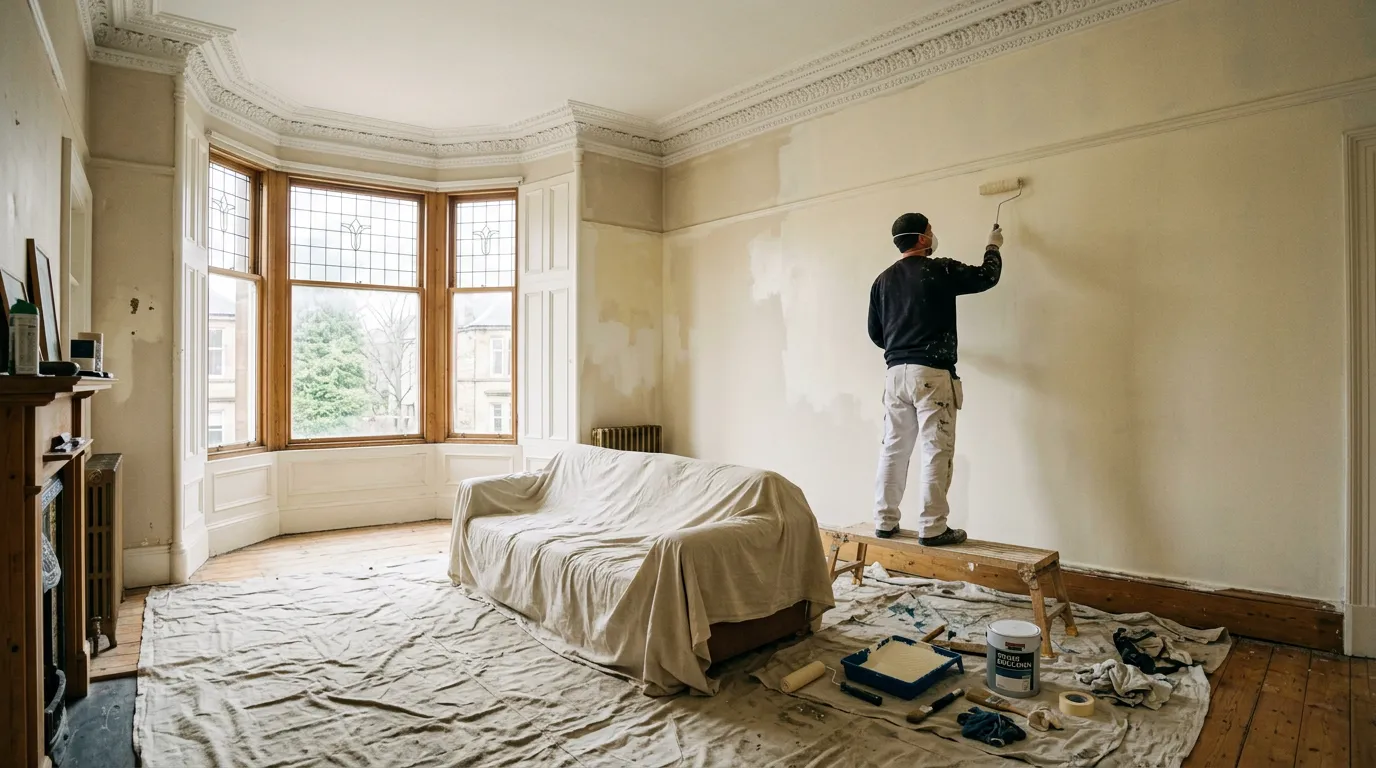
In Glasgow, an average room costs about £350–£600 to paint with materials (BestBuilders, Aug 2026), a 3-bedroom interior £1,400–£3,200, and decorators charge roughly £150–£290 a day. Wallpaper hanging runs about £30–£60 a roll, and tenement flats with high ceilings and cornices usually sit at the top of each range.
Most price guides for painting and decorating are written for England, use figures that are years old, or contradict themselves halfway down the page. This guide pulls together the current published market ranges for Glasgow and Scotland, names where every figure comes from and when it was published, and explains what moves a price up or down in a Glasgow home. Prices checked: October 2026.
What does painting and decorating cost in Glasgow in 2026?
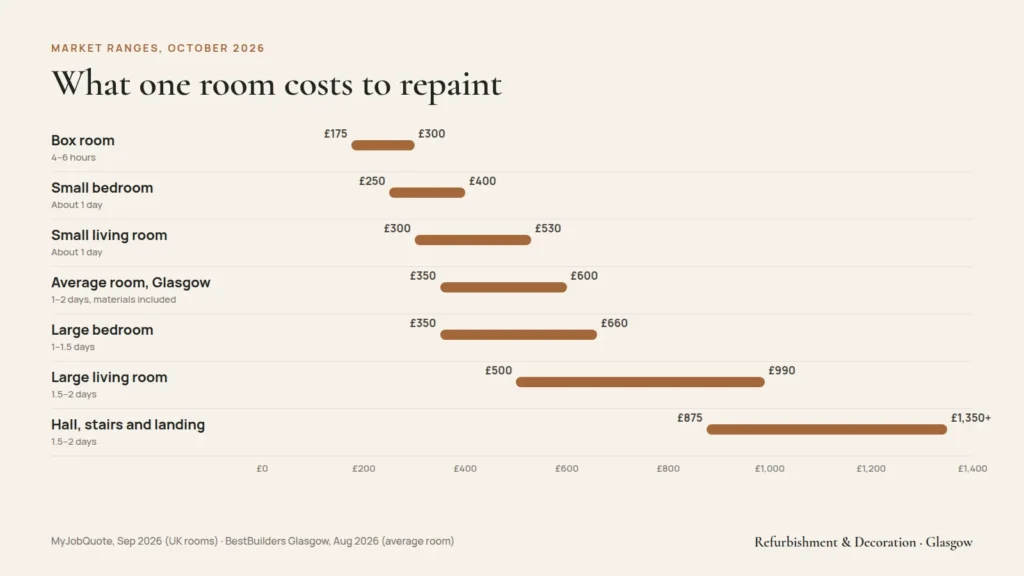
The table below is the set of market ranges we use across all of our guides, so the figures never contradict each other from one article to the next. Each one comes from a named price guide, with the month it was published. Where a figure is for the UK as a whole rather than Glasgow, the table says so.
| Job | Market range | Typical time | Source |
|---|---|---|---|
| Box room repaint | £175–£300 | 4–6 hours | MyJobQuote, Sep 2026 (UK) |
| Small bedroom repaint | £250–£400 | About 1 day | MyJobQuote, Sep 2026 (UK) |
| Large bedroom repaint | £350–£660 | 1–1.5 days | MyJobQuote, Sep 2026 (UK) |
| Average room, materials included | £350–£600 | 1–2 days | BestBuilders Glasgow, Aug 2026 |
| Small living room | £300–£530 | About 1 day | MyJobQuote, Sep 2026 (UK) |
| Large living room | £500–£990 | 1.5–2 days | MyJobQuote, Sep 2026 (UK) |
| Hall, stairs and landing | £875–£1,350+ | 1.5–2 days | MyJobQuote, Sep 2026 (UK) |
| 3-bed interior repaint | £1,400–£3,200 | See worked example | BestBuilders Glasgow, Aug 2026 |
| Wallpaper a room, including stripping | £325–£775 | 1–4 days | BestBuilders Glasgow, Aug 2026 |
| Feature wall | £120–£250 | 4–6 hours | MyJobQuote £120–£180, Oct 2026; BestBuilders £140–£250, Aug 2026 |
| Exterior, Glasgow house | £1,650–£4,150 | 3–5 days | BestBuilders Glasgow, Aug 2026 |
| Decorator day rate, Glasgow / Scotland | £150–£290 a day | n/a | BestBuilders Glasgow, Aug 2026; Trade2Base Scotland, Jun 2026 |
Two things are worth knowing before you use these numbers.
First, most of the national guides have no Scotland row at all. MyJobQuote, the most detailed of them, only splits London from the rest of the UK. BestBuilders and Trade2Base are the only ones we found that publish a Glasgow or Scotland figure. Where we use a UK figure for a single room, it sits comfortably inside the Glasgow ranges, so it is a fair guide, but it is not a Glasgow survey.
Second, the room prices assume an ordinary room with ordinary walls: about 2.4 m ceilings, sound plaster, two coats in a similar colour. A Glasgow tenement bedroom with a 3.2 m ceiling and a cornice is a different job, and we cover what that does to the price further down.
Painting just the ceiling or the woodwork
Ceilings and woodwork are often priced separately. Fantastic Services, in an undated 2026 guide, puts a ceiling on its own at £120–£250 and the woodwork in a room at £80–£200. Which? (May 2026, from a survey of nine Trusted Traders) gives a far wider spread for woodwork in one room: £70–£650 when it is in good condition and £90–£1,200 when it is not. That gap is almost entirely preparation. Glossy skirtings that only need a key and a coat are quick. Doors with chipped, sagging layers of old gloss that need filling, sanding and an undercoat can take as long as the walls.
How much does a painter and decorator charge per day in Glasgow?
The market range for a self-employed decorator in Glasgow and across Scotland is about £150–£290 a day. The lower end comes from BestBuilders’ Glasgow page (updated August 2026), which gives £150–£250. The upper end comes from Trade2Base’s decorator day rate guide (June 2026), which gives £170–£290 for Scotland and says Edinburgh and Glasgow sit at the top of that band.
For comparison, Checkatrade’s UK average of about £325 a day, as reported by Whito in September 2026, is the top-of-market reference point. Figures like that are why two people searching the same question can come away with quite different expectations.
Three things explain most of the gap:
- What the day includes. Some figures are labour only. Others assume the decorator buys the paint, dust sheets, filler and tape.
- Who the figure is for. A sole trader with a van and a ladder rack has lower overheads than a firm with staff, vehicles and an office.
- When it was gathered. The BCIS trade estimating index recorded painting and decorating rates rising 4.1% in the year to the first quarter of 2026. A figure from 2023 or 2024 is now low.
Day rates matter less than people expect, because few homeowners are billed by the day. Most decorators work out how many days a job needs, add materials and give you a fixed price. We go through the arithmetic, the specialist rates and how to sanity-check a day-rate quote in our separate guide to painter and decorator day rates in Glasgow.
Decorator’s tip: if a quote is given as “so many days at so much a day”, ask what happens if the job runs over. A fixed price for a defined scope protects you. An open day rate protects the decorator.
What does it cost to paint a whole flat or house?
BestBuilders’ Glasgow page (August 2026) puts a whole-house interior repaint for a 3-bedroom home at £1,400–£3,200. That is a wide band, and the easiest way to see where your home falls is to build it up room by room. Here are two worked examples using the market figures above. Neither is a quote. They show how the totals are put together.
Worked example: a typical 3-bedroom semi
Picture a 1960s or 1970s semi in the suburbs, with 2.4 m ceilings, walls and ceilings in decent condition, and a straightforward colour change from one pale shade to another. Using the time each room typically takes:
| Room | Typical time | Market range |
|---|---|---|
| Box room | 4–6 hours | £175–£300 |
| Second bedroom (small) | About 1 day | £250–£400 |
| Main bedroom (large) | 1–1.5 days | £350–£660 |
| Living room (large) | 1.5–2 days | £500–£990 |
| Hall, stairs and landing | 1.5–2 days | £875–£1,350+ |
| Total | About 5.5–7.5 days | £2,150–£3,700 |
Add a kitchen and bathroom and the total grows again. MyJobQuote (September 2026) puts a kitchen at £250–£500 and a bathroom at £150–£300. Adding single-room prices together like this tends to overstate the total, though, because a decorator working through a whole house is not packing up and setting up again every morning. That is why BestBuilders’ whole-house figure of £1,400–£3,200 sits below the sum of the room prices. Working by time gives a similar answer: with a kitchen and bathroom included, about seven to nine days at £150–£290 a day is about £1,050–£2,600 in labour, before paint.
Worked example: a typical 2-bedroom tenement flat
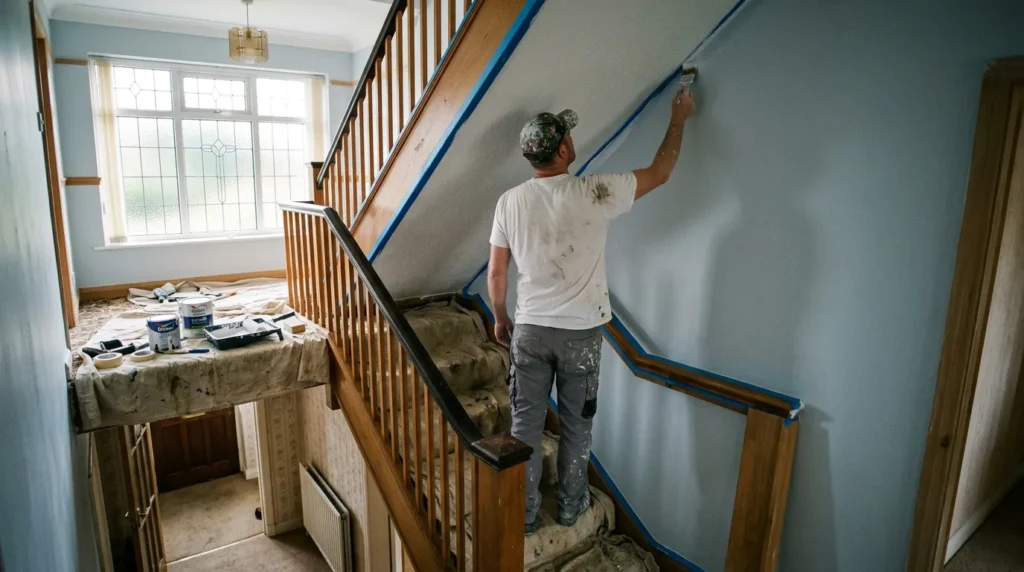
Now picture a West End or Southside tenement flat: two bedrooms, a big front room with a bay window, a long internal hall, a kitchen and a bathroom. Ceilings are about 3.2 m, there is a cornice in the front room and the hall, and the plaster has the hairline cracks you get on old lime plaster.
On paper this has fewer rooms than the semi. In practice it often costs about the same, or more, because:
- A 3.2 m wall has a third more area than a 2.4 m wall, and it needs a platform or a tower rather than a step ladder.
- The hall in a tenement flat is long, tall and full of doors. It takes far longer than its floor area suggests.
- Cornices are cut in by hand, slowly, and many have decades of paint clogging the detail.
- Old plaster needs more filling, and sometimes lining paper, before it will take a smooth finish.
Using the room ranges as a starting point, a large front room (£500–£990), a large and a small bedroom (£350–£660 and £250–£400), a kitchen (£250–£500), a bathroom (£150–£300) and a hall priced like a small living room (£300–£530) add up to roughly £1,800–£3,380. In a flat like this, expect to land in the upper half of that band. The full picture of what changes in an older flat is in our guide to painting a Glasgow tenement flat, and there is a room-by-room breakdown for larger homes in how much to paint a 3-bedroom house in Glasgow.
How much does wallpapering cost in Glasgow?
Wallpaper hanging is usually priced per roll, because the time it takes depends on the number of drops, the pattern and the paper rather than just the wall area. BestBuilders (August 2026) publishes the clearest figures:
| Item | Market range | Source |
|---|---|---|
| Plain or random-match paper, hung | £30 a roll | BestBuilders, Aug 2026 |
| Patterned paper, hung | £45 a roll | BestBuilders, Aug 2026 |
| Heavy, textured or grasscloth paper, hung | £60 a roll | BestBuilders, Aug 2026 |
| Wallpaper a bedroom, Wales & Scotland | £336–£624 | BestBuilders, Aug 2026 |
| Wallpaper a room including stripping, Glasgow | £325–£775 | BestBuilders Glasgow, Aug 2026 |
| Strip old paper | +£150–£300 a room | BestBuilders, Aug 2026 |
| Lining paper | +£80–£150 a room | BestBuilders, Aug 2026 |
| Feature wall | £120–£250 | MyJobQuote, Oct 2026; BestBuilders, Aug 2026 |
The paper itself is normally on top of these figures. Most people choose their own paper and the decorator tells them how many rolls to order.
Worked example: why a tenement bedroom needs more rolls
A standard UK roll is 10.05 m long and 53 cm wide. In a room with 2.4 m walls, allowing a little for trimming at top and bottom, you get four full drops from a roll. With 3.2 m walls you only get three, so roughly a quarter more rolls for the same width of wall.
Take a bedroom about 4 m by 3 m. That is 14 m of wall, or about 26 drops of paper, say 22 once the door and window are allowed for. With a plain paper:
- At 2.4 m: 22 drops ÷ 4 per roll = 6 rolls, about £180 to hang at £30 a roll.
- At 3.2 m: 22 drops ÷ 3 per roll = 8 rolls, about £240 to hang.
A large pattern repeat can cut you down to two usable drops a roll in a high room, which pushes the count up again. Add stripping (£150–£300) and lining (£80–£150), which most old Glasgow walls need, and a tenement bedroom lands in the upper part of the £325–£775 Glasgow range.

Is painting cheaper than papering? Usually, yes. A small bedroom repaint is £250–£400 on MyJobQuote’s figures, against £336–£624 to paper a bedroom in Scotland on BestBuilders’ figures, before you buy the paper. A single papered feature wall with the other three walls painted is the common middle ground. For the full breakdown see wallpaper hanging cost in Glasgow, and for papers, lining and pattern matching see our wallpaper hanging service.
What does exterior painting cost in Glasgow?
BestBuilders’ Glasgow page (August 2026) gives £1,650–£4,150 to paint the outside of a Glasgow house. MyJobQuote’s UK figures (October 2026), broken down by house type, show how much the type of home matters:
| House type | Market range (UK) | Source |
|---|---|---|
| Terraced | £1,500–£3,100 | MyJobQuote, Oct 2026 |
| Semi-detached | £2,600–£5,700 | MyJobQuote, Oct 2026 |
| Detached | £3,400–£7,700 | MyJobQuote, Oct 2026 |
| Glasgow house (all types) | £1,650–£4,150 | BestBuilders Glasgow, Aug 2026 |
Exterior work costs more per day than interior work. Trade2Base (June 2026) puts the premium at 15–25%, which on the Scottish day-rate range works out at roughly £170–£365 a day. The extra covers weather days, access equipment and slower work on rough surfaces. MyJobQuote’s guide says a textured semi takes 6–7 days against 3–4 for a smooth one.
Several things in Glasgow move the price more than the house type does:
- Harling and wet-dash render. Rough, absorbent and slow to coat, and it needs a breathable masonry paint. Any loose or hollow patches must be repaired first.
- Access. Scaffolding is normally priced on top. Which?’s May 2026 guide makes the same point for its exterior figures.
- Sandstone. Bare sandstone generally should not be painted at all. In a conservation area or on a listed building you may need consent to paint walls, windows or doors. Check the current position with Glasgow City Council planning before booking any work.
- The weather window. In the west of Scotland the reliable season for exterior painting is short. Dry, mild weeks in late spring and summer book up first.
For more on render, harling and paints that let old walls breathe, see exterior painting in Glasgow: harling, render and sandstone, or our exterior painting service.

Why do tenement flats and older homes cost more to decorate?
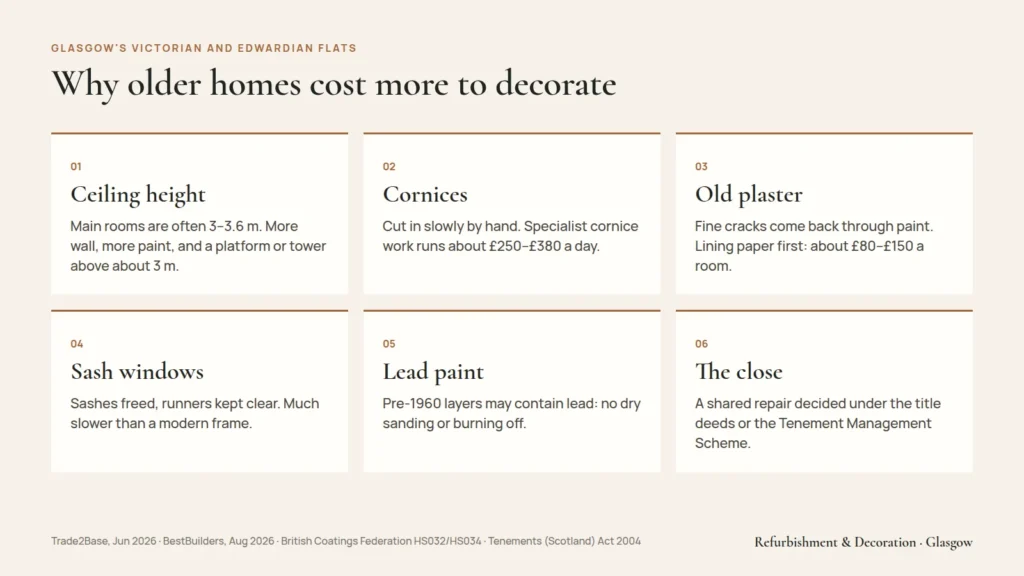
Glasgow is a city of Victorian and Edwardian tenements, and most national price guides take no account of them. These are the features that change the time a job takes, and therefore the price.
Ceiling height
A tenement main room is often 3–3.6 m high. More wall area means more paint and more time, and above about 3 m the decorator needs a stable platform or a small tower rather than steps. On wallpaper, BestBuilders adds £80–£400 for tall rooms and stairwells.
Cornices and ceiling roses
Cutting in a straight line under a deep cornice is slow, careful work. Many cornices have so many coats of old paint and distemper that the detail has disappeared, and bringing it back is restoration rather than decorating. Trade2Base (June 2026) gives a specialist day rate of £250–£380 for coving and cornice work. We could not find a reliable published per-metre price for cornice restoration in Scotland, so treat any figure you see online with care and get it priced after a visit. Our guide to restoring and painting cornicing and ceiling roses covers the process.
Old plaster
Lath-and-plaster and old lime plaster move and crack. A crack that is filled and painted over will often come back within a year. Hanging lining paper first, at £80–£150 a room on BestBuilders’ figures, is the usual fix for walls with a lot of fine cracking.
Sash windows and lead paint
Painting sash windows properly means freeing the sashes, painting the parts that show and leaving the runners clear so the window still opens. It is much slower than painting a modern frame. In homes built before about 1960, some of the older paint layers may contain lead. Guidance from the British Coatings Federation (its HS032 and HS034 notes) says not to dry sand or burn off paint that may contain lead. A careful decorator will test old paint before rubbing it down, and wet-sand or use other low-dust methods where needed. That takes longer, and it is worth paying for. Our guide to painting sash windows in a Scottish flat explains more.
The close
Painting the common stair is a shared repair, not a job for one flat. No published guide gives a reliable per-close price, so any figure has to come from a quote for your building. Your title deeds come first. Where the deeds are silent, the Tenement Management Scheme under the Tenements (Scotland) Act 2004 lets owners decide by majority, with one vote per flat, and there is a 28-day window for objection and appeal. Many closes run this through a factor. The detail is in painting a tenement close: factors, owners and costs.
What is included in a decorating quote, and what costs extra?
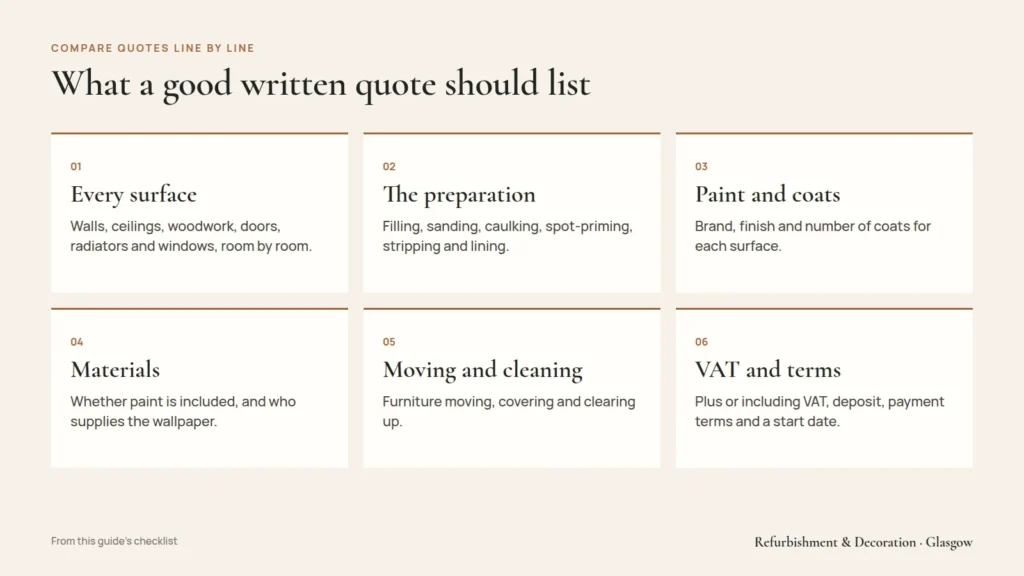
The quickest way to compare quotes is to know what should be on them. A good written quote lists:
- Every room and surface: walls, ceilings, woodwork, doors, radiators, windows.
- The preparation: filling, sanding, caulking, spot-priming, stripping, lining.
- The paint, by brand and finish, and the number of coats.
- Whether materials are included, and who supplies wallpaper.
- Whether furniture moving, covering and clearing up are included.
- VAT, deposit and payment terms, and a likely start date.
Does the price include paint?
Most fixed quotes include paint and sundries such as filler, caulk, tape and sanding paper. Wallpaper almost never is, because you will want to choose it yourself. If you want a premium paint brand, say so at the start, because it changes the price.
Here is how the paint side works out for a typical bedroom of about 4 m by 3 m with 2.6 m walls. That is roughly 30 m² of wall once the door and window are allowed for, so 60 m² for two coats, plus about 24 m² for two coats on the ceiling.
- Dulux Trade Vinyl Matt is listed by trade merchants at up to 17 m² a litre, so the walls need about 3.5 litres.
- Farrow & Ball Estate Emulsion covers up to 35 m² per 2.5 litre tin, according to B&Q’s listing, which priced a 2.5 litre tin at £61 in October 2026. The walls need about two tins, so roughly £120 in wall paint alone.
Deep or strong colours often need a third coat, and fresh plaster needs a mist coat first. In both cases more paint is used.
Decorator’s tip: if you supply your own designer paint, ask the decorator to order it for you, or check the quantity with them first. Running out halfway across a wall and waiting days for another tin in the same batch costs more than the saving.
VAT
Many sole-trader decorators are not VAT registered, because their turnover is below the registration threshold. That threshold was £90,000 a year at the time of writing, so check GOV.UK for the current figure. Larger firms usually are registered, and add 20%. Always ask whether a quote is “plus VAT” or “including VAT”, because it is the single easiest way for two quotes to look further apart, or closer together, than they really are.
Deposits
On a large job it is common to be asked for a deposit, often to cover materials. Be cautious about paying a large share of the price before any work starts, and always get the payment terms in writing.
Why do decorating quotes vary so much?
On Mumsnet you will find homeowners who were quoted £1,500 and ended up paying £3,000. A jump like that almost always comes down to a quote that was vague about the scope, followed by “extras” once the work started. Big differences between quotes for the same job usually come from one of these:
- Preparation. One decorator plans to fill, sand and caulk properly. Another plans to roll straight over what is there. They will look the same for a month.
- Number of coats. Two full coats, or one coat and “touch-ups”.
- Paint quality. Contract matt is cheaper but marks easily. Trade and premium paints cost more and last longer.
- Scope. Is the ceiling included? The skirtings? The inside of the door frames? The radiator?
- Who does the work. A firm may send subcontractors. Which? suggests asking about this directly.
- How busy they are. Good decorators often have a waiting list. Decorators on the Decorators Forum describe two to three months as common. A very low price with a start date tomorrow is worth a second look.
Mistakes to avoid when comparing quotes
- Comparing a verbal price with a written one.
- Comparing a price that includes VAT with one that does not.
- Assuming the cheapest quote covers the same preparation.
- Choosing on day rate alone. A faster, more experienced decorator at a higher rate can cost less overall.
- Not checking insurance. Ask for proof of public liability cover, and ask about training such as City & Guilds or an NVQ, and membership of bodies like the PDA or TrustMark.
Is a local decorator cheaper than a national company?
Often, but not always. Sites like Checkatrade, MyBuilder and MyJobQuote are directories and quote services. The decorator you hire through them still sets the price. A local sole trader has lower overheads than a firm with staff and an office, and does not lose a day travelling. A larger firm can bring more people and finish faster, which matters for a rental between tenants or a house you are about to sell.
How can you keep the cost down without cutting corners?
There are honest ways to reduce a decorating bill that do not involve a worse finish:
- Clear the room yourself. Empty shelves, take down curtains and pictures, and move small furniture out. Time spent shifting your belongings is time you are paying for.
- Keep to a similar colour. Going from magnolia to a pale grey is two coats. Going from dark red to white can be three or four.
- Do several rooms at once. A decorator who is already set up in your home works more efficiently than one who comes back three times.
- Book interiors in winter. Exterior work stops in the colder months, so some decorators have more interior availability then. With heating on and good ventilation, interior paint dries well.
- Be clear about what you want. A written list of rooms, surfaces and colours gets you sharper, comparable quotes.
Here are the places we would not save money:
- Preparation. It is most of what makes a paint job last.
- Lining paper on cracked old plaster. Without it, cracks come back through new paper or paint.
- Safe handling of old paint in pre-1960s homes.

Decorator’s tip: take a photo of every room before the decorator visits, and note what you want done on each wall. It speeds up the visit, and it means everyone is pricing the same job.
What does an end-of-tenancy repaint cost for a Glasgow landlord?
Landlords need the same room figures as homeowners, with one difference: speed matters as much as price, because every empty week costs rent. A typical one-bedroom flat between tenants, done in a single neutral colour with walls, ceilings and woodwork, is usually two to four days of work, depending on condition. The room ranges in the first table are a fair guide.
Two Scottish rules are worth knowing before you plan the work:
- Deposits and fair wear and tear. You cannot charge a tenant the full cost of redecorating just because a flat needs painting. Housing and Property Chamber decisions have treated decoration as having a working life, for example 60 months, and look at how much of that life was left. Talk to your tenancy deposit scheme before making a claim.
- Tenants and decorating. The Housing (Scotland) Act 2025 received Royal Assent on 6 November 2025 and includes a right for tenants to ask to decorate. At the time of writing this part was not yet in force. Check the current position with the Scottish Government or your letting agent before relying on it.
Durable, wipeable finishes and a single colour throughout make future touch-ups quick and cheap. The detail, including turnaround times, is in our guide to landlord and end-of-tenancy painting in Glasgow.
Getting a price for your home
The ranges in this guide tell you what the market charges. The price for your home depends on its rooms, their height, the state of the walls and what finish you want. We give a guide price over the phone once we know the basics, and a fixed written quote after a free visit, listing every room, the preparation, the paint and the number of coats.
We work across Glasgow and Central Scotland, mainly on interior painting and wallpaper hanging, with exterior work as well. If you would like a price, call 07777 780557 or book a free visit. You can also see the areas we cover: Glasgow, Paisley, Clydebank, East Kilbride, Hamilton, Motherwell and Milngavie.
Questions people ask
How much does it cost to paint a room in Glasgow?
BestBuilders' Glasgow page (August 2026) puts an average room at £350–£600 including materials. MyJobQuote's UK figures (September 2026) run from £175–£300 for a box room to £500–£990 for a large living room. A tenement room with a high ceiling and a cornice will usually sit towards the top of those ranges because it takes longer.
How much does it cost to paint just a ceiling?
Fantastic Services, in an undated 2026 guide, puts painting a ceiling on its own at £120–£250. The price depends on the height, whether there is a cornice or ceiling rose to cut in around, and whether cracks need filling first. A 3.2 m tenement ceiling needs a platform or tower, which adds time compared with a 2.4 m ceiling in a modern home.
Do painters and decorators charge VAT?
Only if they are VAT registered. Many sole traders are not, because their turnover is below the registration threshold, which was £90,000 a year at the time of writing (check GOV.UK for the current figure). Registered firms add 20%. Always ask whether a quote is plus VAT or including VAT before comparing it with another.
Do decorators ask for a deposit?
On larger jobs a deposit is common, usually to cover materials. Be cautious about paying a large share of the price before any work starts, and make sure the deposit, stage payments and final payment are written on the quote. On a small job such as a single room, many decorators simply ask for payment on completion.
Who buys the wallpaper, me or the decorator?
Usually you do. Wallpaper is a personal choice and prices range widely, so most decorators price the hanging and let you buy the paper. Ask the decorator to measure and tell you how many rolls to order, with the same batch number on every roll. High tenement ceilings and large pattern repeats both increase the number of rolls needed.
Is it cheaper to paint a room than to wallpaper it?
Usually, yes. A small bedroom repaint is £250–£400 on MyJobQuote's September 2026 figures, while BestBuilders (August 2026) puts papering a bedroom in Scotland at £336–£624, before you buy the paper. Stripping old paper and lining add more. A single papered feature wall at £120–£250, with the other walls painted, is a common middle ground.
How long does it take a decorator to paint a room?
A standard room repaint takes one to two days. MyJobQuote (September 2026) gives four to six hours for a box room, about a day for a small bedroom and 1.5–2 days for a large living room or a hall, stairs and landing. Wallpapering a room takes one to four days, depending on stripping and size.
Should I get three quotes for decorating?
Getting more than one quote is sensible, but compare them properly. Check that each lists the same rooms and surfaces, the preparation, the paint brand and number of coats, whether materials and VAT are included, and the payment terms. Two well-written quotes for the same scope tell you more than five vague prices given over the phone.

Painters and decorators working across Glasgow & Central Scotland, specialising in interior painting and wallpaper hanging. Prices in our guides are reviewed every year.
 How Much to Paint a 3-Bedroom House in Glasgow?
 Painter & Decorator Day Rates in Glasgow Explained