Plan a Glasgow redecoration by listing every room and surface, finishing plastering and joinery first, and booking two to three months ahead. A room takes 1–2 days and a 3-bed interior about 10 days to 2 weeks. Get three written quotes naming preparation, products and coats; Glasgow decorators charge about £150–£290 a day (BestBuilders, Trade2Base, 2026).
Most redecorating jobs that go wrong in Glasgow go wrong before anyone opens a tin. The quote was vague, the dates clashed with the plasterer, or nobody asked what “two coats” meant. This guide walks through the planning in the order a decorator thinks about it: what to decide first, how long each stage takes, what it costs, how to pick the right person and how to get your home ready.
Where should you start when planning a redecoration?
Start with a list, not a colour chart. Walk round the home with a notebook and write down every room you want done, and for each one, which surfaces: ceiling, walls, woodwork (skirtings, facings, doors, window boards), radiators and any feature such as a cornice or a fireplace surround. A decorator prices surfaces, so a list like this is what makes three quotes comparable later.
Next, note the condition of each room honestly. Hairline cracks, flaking paint on a ceiling, old wallpaper that has been painted over, a patch of mould behind a wardrobe: these are the things that turn a one-day job into a two-day job. If you mention them up front, the quote will include them. If they are found on the day, they become an extra.
Decide paint or paper for each wall
Paint is quicker and cheaper per room. Wallpaper costs more to hang but lasts well and hides a lot on uneven walls. Many Glasgow homes end up with a mix: emulsion on most walls, a patterned paper on one wall of the living room or bedroom. If you are weighing it up, our wallpaper hanging guide covers paper types and lining, and the feature wall guide covers which wall to choose.
Get the order of trades right
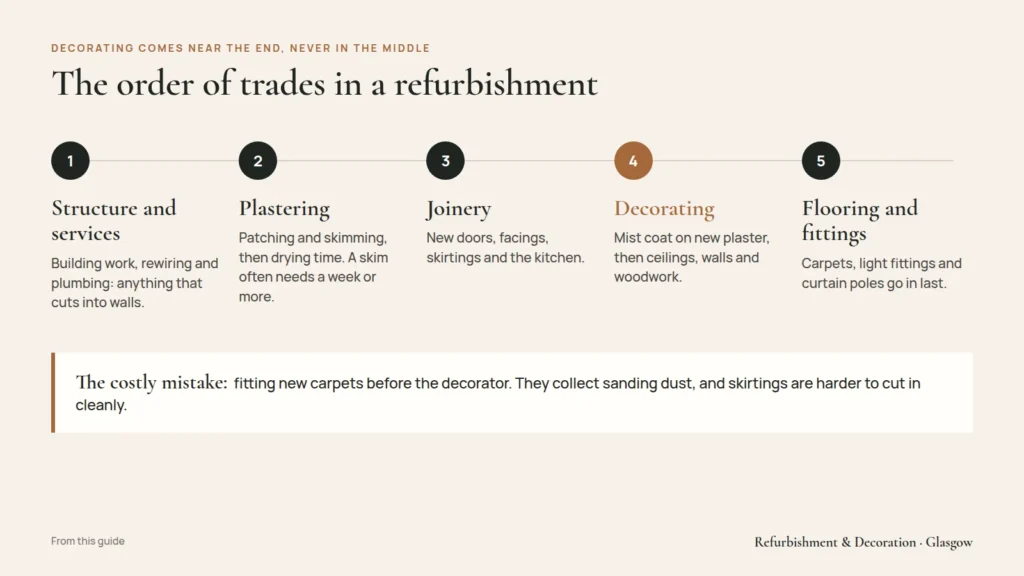
Decorating comes near the end of any refurbishment, never in the middle. The usual order is:
- Structural work, rewiring and plumbing (anything that cuts into walls).
- Plastering and patching, then drying time for the new plaster.
- Joinery: new doors, facings, skirtings, kitchen fitting.
- Decorating.
- Flooring, carpets and final fitting of light fittings and curtain poles.
Fitting new carpets before the decorator is the most common and most expensive mistake on this list. Dust sheets protect floors well, but a fresh carpet will still collect sanding dust, and skirting paint is easier to cut in cleanly before a carpet is tight against it.
Set a budget with a contingency
Once you have a rough price (the cost section below gives market ranges), add 10–15% for the unknowns. In older Glasgow homes the usual surprises are blown plaster that sounds hollow when tapped, old paper hiding under several coats of paint, and cracks that reopen once filler goes in. A decorator with a fixed written price will usually absorb small surprises, but anything that changes the scope, such as a ceiling that needs replastering, is a fair extra. Having the contingency means you can say yes without derailing the rest of the plan.
If money is tight, prioritise the rooms that get the most wear and the most daylight: the hall and the living room. A freshly decorated hall changes how the whole home feels, and it is the first thing a buyer or a new tenant sees.
Decorator’s tip: New plaster needs to dry before it is painted, and it needs a thinned “mist coat” first. A skim coat often needs a week or more in a heated house before it is ready, longer in winter or on thick patches. Ask your plasterer when the walls will be dry and book the decorator after that date, not on it.
How long does redecorating take?
Time is the part most people underestimate. A painter rolls a wall in minutes; the hours go on preparation, cutting in by hand, and waiting for coats to dry. Published market guides agree on the rough durations below.
| Job | Typical time | Source |
|---|---|---|
| Box room repaint | 4–6 hours | MyJobQuote (Sep 2026) |
| Small bedroom repaint | About 1 day | MyJobQuote (Sep 2026) |
| Large bedroom repaint | 1–1.5 days | MyJobQuote (Sep 2026) |
| Standard room repaint | 1–2 days (1–3 days for larger rooms) | Fantastic Services (2026); Which? (May 2026) |
| Hall, stairs and landing | 1.5–2 days, up to 3 | MyJobQuote (Sep 2026); Which? (May 2026) |
| Wallpapering a room | 1–4 days, depending on stripping and size | MyJobQuote (Oct 2026) |
| Whole 3-bed interior | About 10 days to 2 weeks | HomeBuilding (2022); Bookabuilder (2026) |
Those figures assume walls in fair condition and standard ceiling heights. In a Glasgow tenement with ceilings of 3 metres or more, every surface is bigger, the ceiling needs a platform or tower, and there is often a cornice to cut in around. Allow roughly a third more time for a high-ceilinged room than for the same floor area in a modern semi. Our guide to painting a tenement flat goes into the detail.
A day-by-day schedule for a typical 3-bed
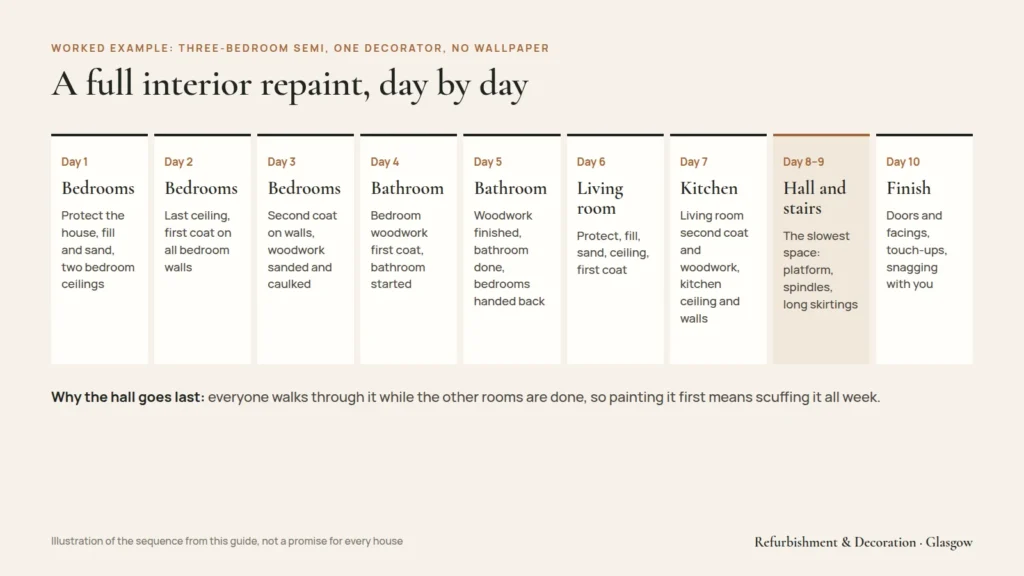
Here is a worked example of how a full interior repaint of a typical three-bedroom semi might run with one decorator, walls and woodwork in fair order, no wallpaper. It is an illustration of the sequence, not a promise for every house.
| Day | Work |
|---|---|
| 1 | Protect floors and furniture throughout. Fill and sand all three bedrooms. Ceilings in bedrooms 1 and 2. |
| 2 | Ceiling in bedroom 3. First coat on walls in all bedrooms. |
| 3 | Second coat on bedroom walls. Woodwork prepared (sanded, gaps caulked). |
| 4 | Bedroom woodwork: undercoat or first coat. Bathroom ceiling and walls started. |
| 5 | Bedroom woodwork second coat. Bathroom finished. Bedrooms cleared and handed back. |
| 6 | Living room: protect, fill, sand, ceiling, first coat on walls. |
| 7 | Living room second coat and woodwork. Kitchen ceiling and walls. |
| 8–9 | Hall, stairs and landing: the slowest space, with a stair platform or ladders, long runs of spindles and skirting. |
| 10 | Remaining doors and facings, touch-ups, snagging walk-round with you, final clean. |
Notice that the hall comes last. Everyone walks through it while the other rooms are being done, so painting it first means scuffing it all week. Working room by room also means you only lose one or two rooms at a time, which matters if you are living in the house throughout.

When is the best time of year to redecorate in Glasgow?
For interior work, any time of year is fine as long as the house is heated. Paint manufacturers set minimum temperatures on their data sheets, and in a Scottish winter it is the inside of the house that has to meet them, not the weather outside. Our article on painting a house interior in winter in Scotland explains the temperature and humidity figures and how to keep drying times under control.
Exterior work is different. Masonry paint and exterior woodwork need dry weather and surfaces that stay above the product’s minimum temperature through the drying period, so in the west of Scotland the realistic window is late spring to early autumn. If you want both done, book the outside for summer and the inside for autumn or winter. See our exterior painting guide for harling, render and sandstone.
Waiting lists
Good decorators are booked ahead. Tradespeople on the Decorators Forum describe waiting lists of two to three months as common, and spring and the run-up to Christmas are the busiest periods. Practical timings:
- Before Christmas: ask for quotes in September or early October.
- Before a house sale: allow at least six to eight weeks from first call to finished job, plus the job itself.
- Between tenancies: book as soon as notice is given. Our landlord and end-of-tenancy guide covers void-period planning.
- January to March: often the easiest time to get a start date for interior work.
How much does redecorating cost in Glasgow?
We cover prices fully in the Glasgow painting and decorating prices guide, but you need ballpark figures to plan a budget. These are published market ranges, with the source and the date each was published.
| Item | Market range | Source |
|---|---|---|
| Decorator day rate, Glasgow / Scotland | £150–£290 a day | BestBuilders Glasgow (Aug 2026); Trade2Base Scotland (Jun 2026) |
| UK top-of-market average day rate | About £325 a day | Checkatrade, as reported by Whito (Sep 2026) |
| Small bedroom repaint | £250–£400 | MyJobQuote (Sep 2026) |
| Large bedroom repaint | £350–£660 | MyJobQuote (Sep 2026) |
| Average room, Glasgow, materials included | £350–£600 | BestBuilders Glasgow (Aug 2026) |
| Living room | £300–£530 small / £500–£990 large | MyJobQuote (Sep 2026) |
| Hall, stairs and landing | £875–£1,350+ | MyJobQuote (Sep 2026) |
| 3-bed interior repaint, Glasgow | £1,400–£3,200 | BestBuilders Glasgow (Aug 2026) |
| Wallpaper a room incl. stripping, Glasgow | £325–£775 | BestBuilders Glasgow (Aug 2026) |
| Exterior, Glasgow house | £1,650–£4,150 | BestBuilders Glasgow (Aug 2026) |
If you are planning several rooms, the more useful sum is days. A decorator at £150–£290 a day working for ten days on a three-bed comes to £1,500–£2,900 in labour, before paint. That sits inside the BestBuilders Glasgow range above, which is a good sign the figures hang together. For a deeper look at what a day buys, read decorator day rates in Glasgow explained, and for a room-by-room breakdown, how much it costs to paint a 3-bedroom house in Glasgow.
Why quotes for the same job differ so much
One Mumsnet thread describes a homeowner quoted £1,500 and billed £3,000. Gaps like that usually come from one of these:
- Preparation. One quote allows a morning of filling; another allows a day of raking out cracks, sanding and lining.
- Coats and products. Two coats of contract matt and two coats of a premium scrubbable paint are very different costs in labour and materials.
- Woodwork. Some quotes are “walls and ceilings” only. Doors, facings and skirtings can add a day or more per floor.
- Height and access. High ceilings, stairwells and cornices all take longer.
- Day rate versus fixed price. A day-rate job that overruns costs you more. A fixed written price puts that risk on the decorator.
The fix is a detailed written quote, covered below.
How do you choose a good painter and decorator in Glasgow?
There is no licence needed to work as a decorator in the UK, so anyone can print a van. That makes your own checks more important. Work through this list for every decorator you are considering.
The checklist
- Public liability insurance. Ask for the certificate and check the date and the amount of cover. If a ladder goes through a window or paint lands on a neighbour’s car in a tenement back court, this is what pays.
- Training and memberships. A City & Guilds or NVQ qualification in painting and decorating shows formal training. Membership of the Painting & Decorating Association (PDA) or registration with TrustMark adds a layer of vetting. None is compulsory, and many excellent decorators learned on the job, but ask.
- Photos of their own work. Not stock images. Look at the cutting in where walls meet ceilings and at gloss on woodwork. Ask to see work in homes like yours: a tenement, a 1930s semi, a new-build.
- References or reviews you can check. Recent Google reviews with detail (the area, the type of job) are more useful than a page of five-word testimonials.
- Who will actually do the work. Which? advises asking whether subcontractors will be used. It is fine if they are, but you should know who is coming and who is responsible.
- A visit before pricing. A decorator who quotes a full house from photos alone is guessing. A visit lets them see the plaster, the woodwork and the access.
- A written quote. Never proceed on a verbal price for anything bigger than a single small room.
- How they talk about preparation. Ask “what do you do before the first coat?” A good answer is specific: washing down, filling, sanding, caulking, spot priming, protecting. A vague answer is a warning.
Questions to ask on the visit
- How many coats are you allowing on walls, ceilings and woodwork?
- Which paint will you use, and why that one for this room?
- How will you deal with the cracks, the old paper or the damp patch I have shown you?
- Is this a fixed price or a day rate? What happens if it takes longer?
- When can you start, and will you work on my job continuously or split it with others?
- How will you protect floors, furniture and the close?
- What do you need me to do before you arrive?
A good decorator will answer these without hesitation and will usually ask you questions back: how you use the room, whether you have pets or young children, and whether you want walls that can be wiped.
Should you get three quotes?
Three is a sensible number. One quote gives you nothing to compare. More than three takes a lot of your evenings and rarely changes the picture. Give each decorator the same room list, so you are comparing like with like, and be wary of one quote far below the others. It usually means less preparation, fewer coats or a plan to add extras later.
Red flags
- Cold calling at your door offering to “do the close” or the outside because they are “in the area”.
- Pressure to decide on the spot, or a discount that disappears tomorrow.
- Asking for most or all of the money before starting.
- No address, only a mobile number, and no willingness to put anything in writing.
- Dismissing preparation: “it’ll cover”.

What should a written decorating quote include?
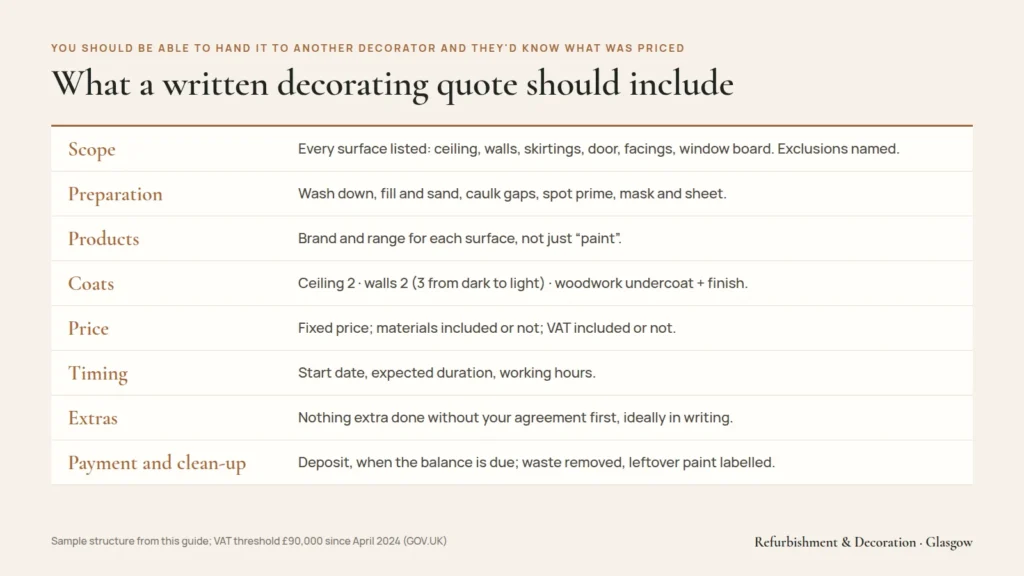
A good quote reads like a specification. You should be able to hand it to another decorator and they would know exactly what was priced. Here is the structure we would expect to see, shown as a sample for one bedroom.
| Section | What it should say (sample: double bedroom) |
|---|---|
| Scope | Ceiling, four walls, skirtings, door and facings, window board. Radiator painted in situ. Built-in wardrobe excluded. |
| Preparation | Wash down woodwork. Fill cracks and holes, sand smooth. Caulk gaps between skirting and wall. Spot prime bare patches. Mask and sheet floor and furniture. |
| Products | Brand and range named for each surface, for example a durable matt emulsion for walls and a water-based satin for woodwork. Colours chosen by customer by a set date. |
| Coats | Ceiling 2 coats. Walls 2 coats (3 if changing from dark to light). Woodwork 1 undercoat + 1 finish, or 2 finish coats. |
| Price | Fixed price for the above, stating whether materials are included and whether VAT applies. |
| Timing | Start date, expected duration, working hours. |
| Exclusions and extras | What is not included (for example plaster repairs, stripping wallpaper) and how extras will be priced and agreed before work starts. |
| Payment terms | Any deposit, when the balance is due, how to pay. |
| Clean-up and waste | Removal of rubbish, leftover paint labelled and left with you. |
Two lines matter more than they look. “Materials included” should name the products, because the gap between a basic contract emulsion and a premium washable paint can be large over a whole house. And the extras line should say that nothing extra is done without your agreement first, ideally in writing or by text.
Who buys the paint and wallpaper?
Either way works. Most decorators supply paint, because they buy it at trade prices and know how much a room takes. Wallpaper is often chosen and bought by the customer, but check the roll count with your decorator before ordering, buy every roll from the same batch, and order one spare. Batch shades can differ enough to show on a wall.
Deposits, VAT and paying a decorator
Do decorators take a deposit?
Some do and some do not. A deposit is reasonable when the decorator has to buy expensive materials for you, such as a designer wallpaper, or when a long job blocks out weeks of their diary. A modest deposit to cover materials is normal practice. Paying most of the price before any work starts is not, and it leaves you with no leverage if things go wrong.
On longer jobs, stage payments are fair to both sides: for example, a payment when the upstairs is finished and the balance when the snagging is done. Pay by bank transfer so there is a record, and get a receipt or invoice for every payment.
Do decorators charge VAT?
Only if they are VAT-registered. A business must register once its taxable turnover goes over the threshold, which has been £90,000 since April 2024 (check the current figure on GOV.UK). Many sole-trader decorators are under it and do not charge VAT. Larger firms will add 20%. Neither is better or worse; just make sure the quote says clearly whether the price includes VAT, so you are comparing like with like.
Your cancellation rights
If you agree a contract at your home rather than at the trader’s premises, consumer law gives you a cooling-off period of at least 14 days to cancel. Citizens Advice Scotland explains how it works. If you want the work to start inside that period, the decorator should ask for your request in writing, and the rules on what you would owe for work already done then change. Check the Citizens Advice Scotland guidance for the current position before relying on this.

How should you prepare your home before the decorators arrive?
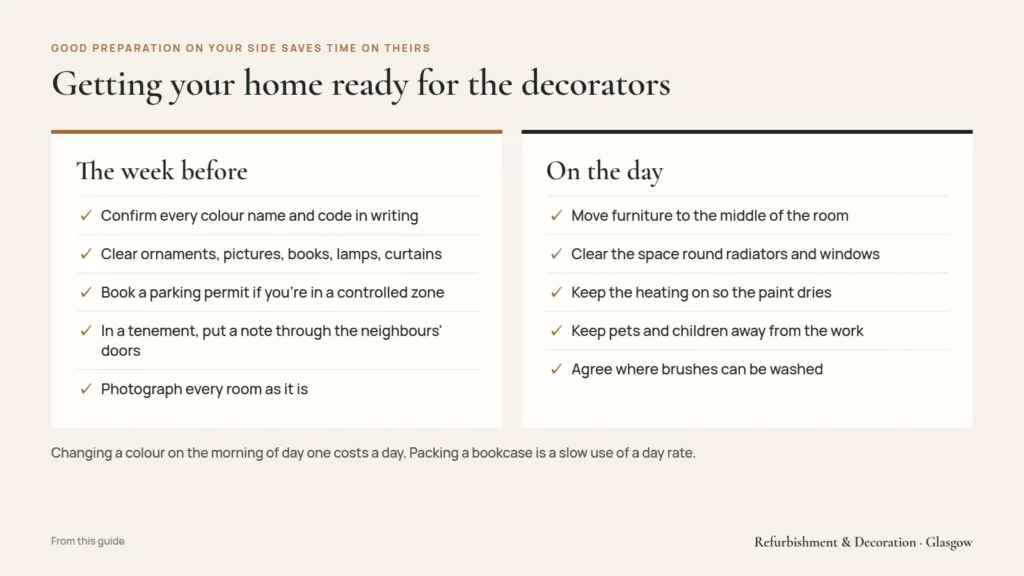
Good preparation on your side saves time on theirs, and on a day rate, that saves you money. Ask your decorator what they expect, but this list covers most jobs.
The week before
- Confirm colours. Final colour names and codes, for every surface, in writing. Changing your mind on the morning of day one costs a day.
- Clear the small things. Ornaments, pictures, books, lamps, curtains and blinds. Decorators will move furniture, but packing a bookcase is a slow and costly use of their time.
- Take down pictures and leave the hooks. Tell the decorator whether you want the holes filled or the fixings left for rehanging.
- Book parking if needed. Much of central Glasgow and the West End is in controlled parking zones. Ask whether the decorator needs a visitor permit and check the rules with Glasgow City Council.
- Tell the neighbours in a tenement. Materials and towers will go up and down the close for a few days. A note through doors goes a long way.
On the day
- Move furniture to the middle of the room, or out of it if you have space. Leave large wardrobes and beds for the decorator if you have agreed that.
- Empty the space around radiators and windows.
- Keep the heating on. Paint needs a warm room to dry properly.
- Keep pets and children away from the work area. Wet paint and open tins do not mix with either.
- Agree where the decorator can wash brushes and which toilet they can use.
A note on old paint
In homes built before about 1960, including most Glasgow tenements and many older houses, lower layers of paint on woodwork can contain lead. The British Coatings Federation advises against dry sanding or burning off old paint that may contain lead. Ask your decorator how they deal with it: wet abrading, careful dust control and good cleaning are standard practice in older homes. This matters especially if there are young children or someone pregnant in the house.
Decorator’s tip: Take a photo of every room before the decorator arrives. It takes two minutes, it settles any question about existing marks or damage, and it is satisfying to look back at afterwards.
What happens during and after the job?
Living with the work
Most interior work happens with the household still at home. Expect some dust during sanding, the smell of paint for a day or two (much less with modern water-based products), and one or two rooms out of action at a time. If you are working from home, ask which days will be noisiest and plan around them.
Can you sleep in a freshly painted room?
With modern water-based emulsions, most people can sleep in a room the same night or the next one, provided it has been well ventilated. Open a window for a few hours after the last coat. Solvent-based gloss on woodwork smells stronger and for longer, so if anyone is sensitive, or for a baby’s room, leave a day or two before moving back in. Paint is touch dry within hours but takes days to weeks to cure fully, so be gentle with walls for the first fortnight: no scrubbing and no heavy furniture pushed against them.
Snagging
Before the final payment, walk round every room with the decorator in good daylight. Look along walls at an angle, at the line where wall meets ceiling, and at the edges of woodwork. Small misses are normal and should be touched up there and then. Agree any remaining items in writing.
Keep a record
Ask for leftover paint to be labelled with the room and left with you, and note the colour name, code, brand and finish for each room. When a chair scuffs a wall in a year’s time, you will be glad of it.
Planning mistakes we see most often
- Choosing colours from a tiny chip. Glasgow’s grey winter light and north-facing rooms change colours a lot. Paint a large sample on two walls and look at it morning and evening. Our guide to paint colours for Scottish light explains why.
- Booking the decorator before the plaster has dried. Paint on damp plaster can blister and flake.
- Painting over mould. It comes back through. The cause, usually condensation, needs dealing with first. See damp, condensation and mould.
- Leaving the hall until it is “worth doing”. It is the room that ties the rest together.
- Agreeing extras verbally. A text message confirming “extra: strip paper in box room, £X” protects both sides.
- Forgetting the close. In a tenement, the common stair is a shared repair. If yours is tired, raise it with the other owners or the factor; our guide to painting a tenement close explains how owners decide.
Getting a price for your home
The best plan is simple: decide your rooms and surfaces, sort the order of trades, book early, and choose a decorator on the strength of a detailed written quote rather than the lowest number. Market figures help you budget, but only a visit can show the condition of your walls and woodwork.
We give a guide price on the phone and a fixed written quote after a free visit, broken down room by room. Call 07777 780557, or book a free visit online. You can also read more about our interior painting and wallpaper hanging services across Glasgow.
Questions people ask
How far ahead should I book a decorator in Glasgow?
Allow two to three months. Tradespeople on the Decorators Forum describe waiting lists of that length as common, and spring and the weeks before Christmas are the busiest. If you want a room finished for Christmas, ask for quotes in September or early October. January to March is often the easiest time to get an interior start date.
How long does it take to decorate a whole house?
A full interior repaint of a typical three-bedroom house takes about 10 days to 2 weeks for one decorator, according to HomeBuilding and Bookabuilder. A single room usually takes 1–2 days and a hall, stairs and landing 1.5–3 days. High tenement ceilings, wallpaper stripping and poor plaster all add time.
What qualifications should a painter and decorator have?
No licence is required in the UK, so check for yourself. A City & Guilds or NVQ qualification shows formal training, and membership of the Painting & Decorating Association or registration with TrustMark adds vetting. Public liability insurance matters most: ask to see the certificate and check its date and the amount of cover.
Do decorators charge VAT?
Only if they are VAT-registered. A business must register once taxable turnover passes the threshold, which has been £90,000 since April 2024; check the current figure on GOV.UK. Many sole-trader decorators are below it and do not charge VAT, while larger firms add 20%. Make sure each quote states clearly whether VAT is included.
Is it normal for a decorator to ask for a deposit?
A modest deposit is normal when a decorator must buy expensive materials for you, such as designer wallpaper, or when a long job blocks out weeks of their diary. Paying most of the price before work starts is not normal. On longer jobs, stage payments tied to finished rooms are fair to both sides. Always pay by bank transfer and keep receipts.
Do I need to move furniture before the decorators arrive?
Clear the small things yourself: ornaments, pictures, books, lamps, curtains and blinds. Move what you can to the middle of the room and clear space round radiators and windows. Most decorators will move and cover large furniture, but agree that in advance. Packing shelves is a slow and expensive use of a decorator's day rate.
Should painting come before or after new carpets?
Before. The usual order is building work and electrics, plastering, joinery, then decorating, then flooring and carpets. Even with dust sheets, a new carpet collects sanding dust, and skirting boards are easier to paint cleanly before a carpet is fitted tight against them. Fit light fittings and curtain poles after the decorator too.
Can I stay in my home while it is being decorated?
Yes, most interior jobs are done with the household at home. Decorators usually work room by room, so you lose one or two rooms at a time. Expect some dust during sanding and a paint smell for a day or two. Ventilate well, and with water-based emulsions most people can sleep in a room the same night or the next.

Painters and decorators working across Glasgow & Central Scotland, specialising in interior painting and wallpaper hanging. Prices in our guides are reviewed every year.
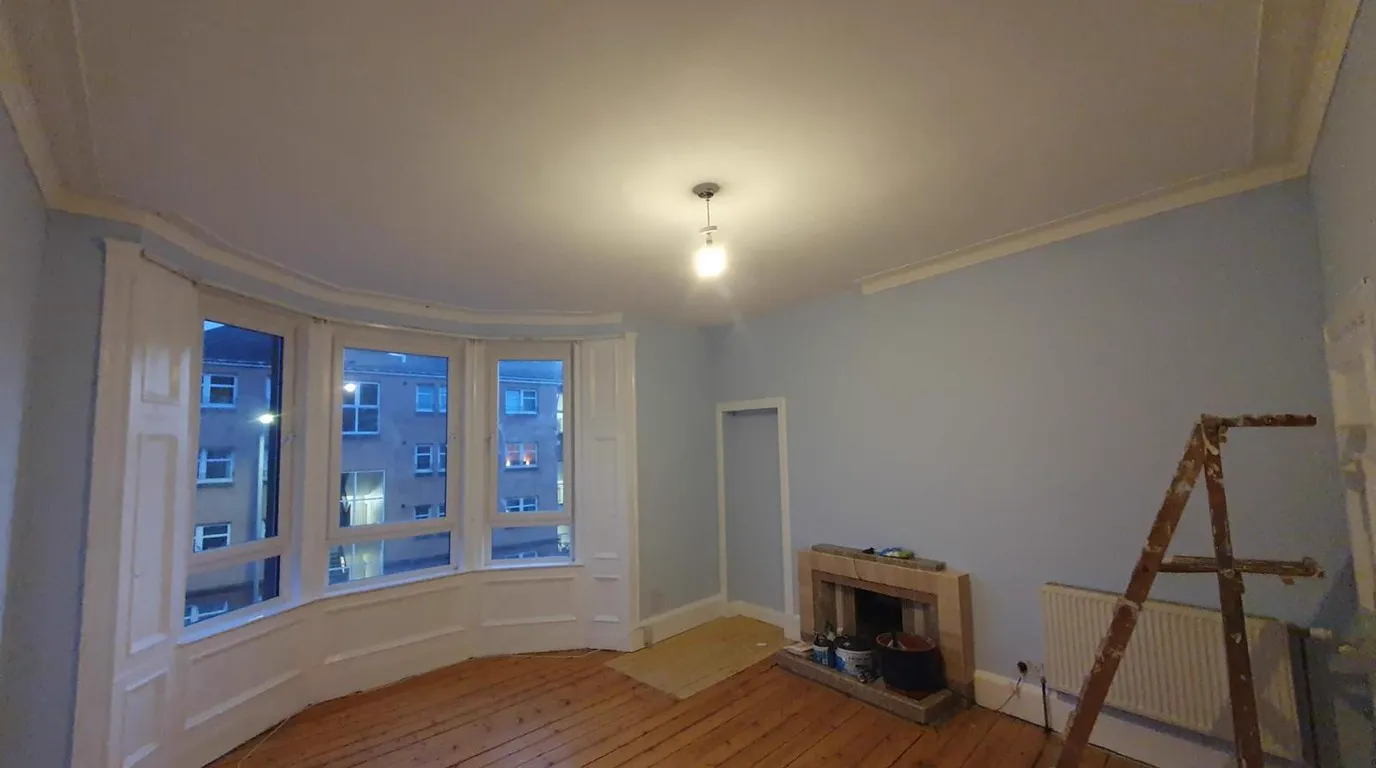 How Long Does It Take to Paint a House? Room-by-Room Timings
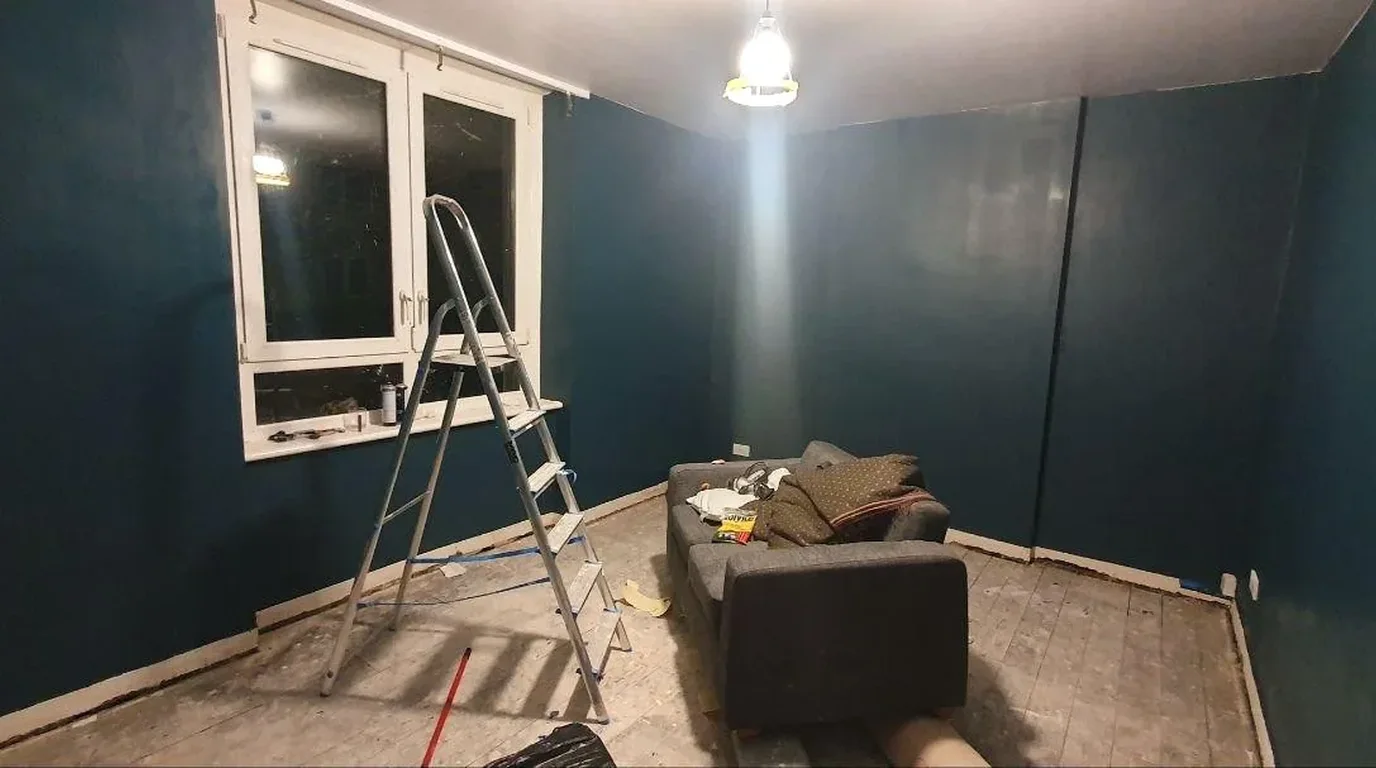 Can You Paint a House Interior in Winter in Scotland?
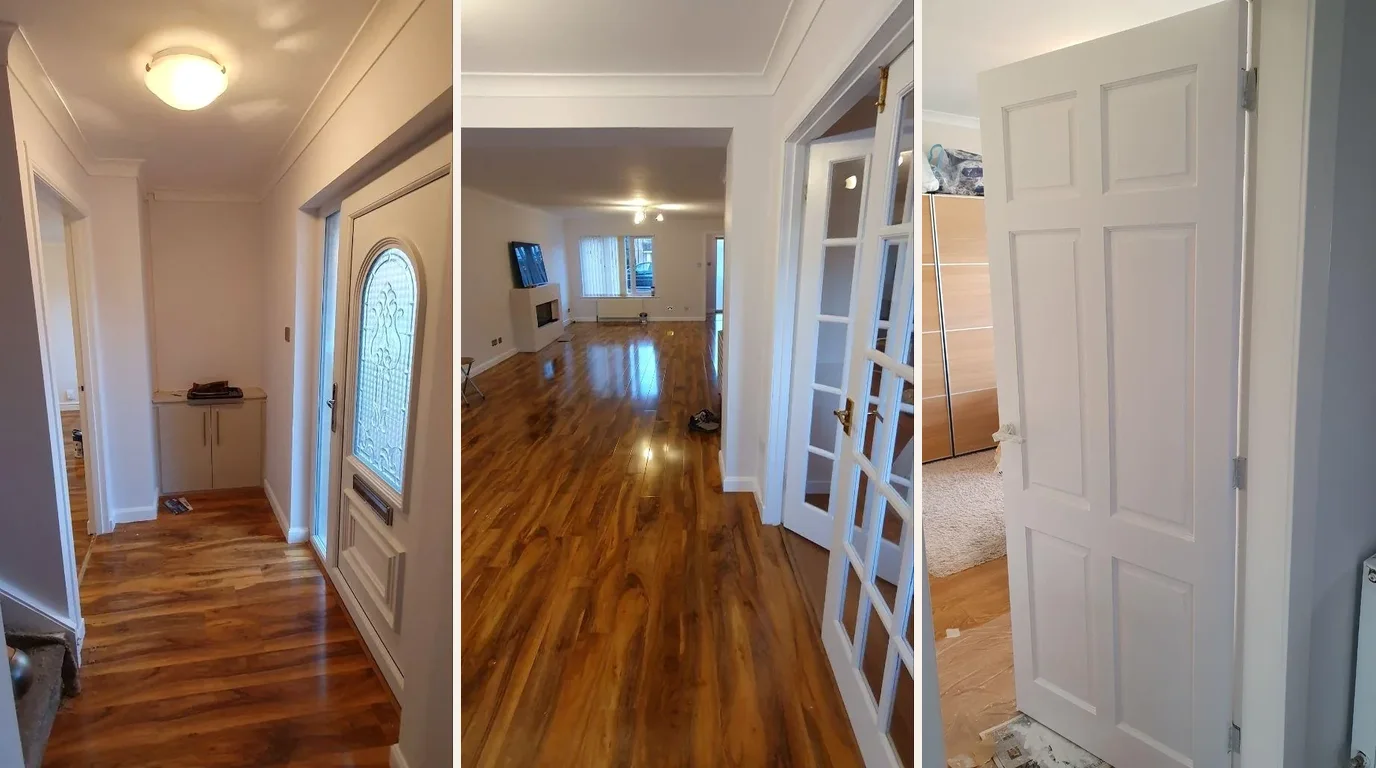 Landlord & End-of-Tenancy Painting in Glasgow