Under the Tenement Management Scheme, painting the close needs a majority of all flats, with one vote each, unless the title deeds say otherwise. Costs are usually split equally. In a worked example, 14–18 decorator days at £150–£290 a day (BestBuilders, Aug 2026; Trade2Base, Jun 2026) comes to about £263–£653 a flat in an eight-flat close, before materials.
Repainting a tenement close is one of the few decorating jobs where the hard part is not the painting. Before anyone opens a tin, the owners have to agree, someone has to collect the money, and everyone needs to know what they are paying for. This guide explains how the law in Scotland handles that, what a close repaint involves, and how the cost is usually shared, with a worked example.
Who owns the close, and who gets a say?
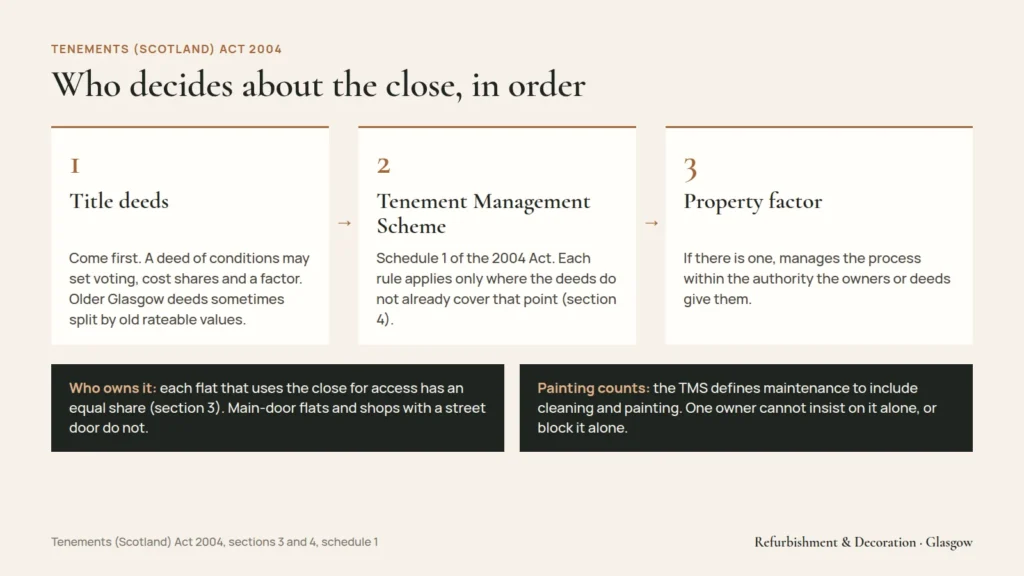
In Scotland, the close and common stair are normally owned jointly by the flats that use them. Under section 3 of the Tenements (Scotland) Act 2004, where the title deeds do not say otherwise, each flat that gets its access through the close has an equal share in it. A flat that does not use the close, such as a ground-floor main-door flat or a shop with its own street door, does not have a share in it.
Decisions about the close follow this order:
- Your title deeds come first. Many Glasgow tenements have a deed of conditions that sets out how decisions are made, how costs are split and whether there is a factor. Older Glasgow deeds sometimes split costs in ways that are not equal, for example by old rateable values.
- The Tenement Management Scheme fills the gaps. The TMS is a set of default rules in schedule 1 of the 2004 Act. Section 4 of the Act says each of its rules applies where the deeds do not already deal with that point. So a building can follow its deeds on cost shares but the TMS on voting, or the other way round.
- A property factor, if there is one, manages the process for the owners, within the authority the owners or the deeds give them.
Painting is clearly covered. The TMS defines “maintenance” to include cleaning and painting, so redecorating the close is a matter the owners can decide on together. One owner cannot insist on it alone, and one owner cannot block it alone either.
Decorator’s tip: before anyone gets quotes, ask a solicitor or the factor for the relevant part of the title deeds. Ten minutes reading the cost-sharing clause saves weeks of argument later.
How do owners agree to paint the close under the Tenement Management Scheme?
Where the deeds are silent, the TMS sets out a simple majority process. These are the key rules, checked against the Act on legislation.gov.uk.
- One vote per flat. Each flat liable for the cost has one vote (rule 2.2). A flat that would not pay, such as a main-door flat with no share in the close, has no vote on it (rule 2.3).
- Majority of all flats, not of those who turn up. A decision needs a majority of all the votes allocated (rule 2.5). In an eight-flat close that is five votes, whoever attends.
- Meeting or no meeting. Owners can meet, with at least 48 hours’ notice of the date, time, place and purpose (rule 2.6). Or the owner proposing the work can consult every other owner and count their votes without a meeting (rule 2.7).
- Tell everyone. Once decided, the decision must be notified to all owners as soon as practicable (rule 2.9).
- Collecting money in advance. Owners can require each flat to pay its share of a reasonable estimate in advance, with at least 28 days’ notice (rule 3.2). The notice must summarise the work, the estimated cost and why it is reasonable, how it is split, and the timetable. Where a deposit is over £100 a flat, or a smaller sum takes that flat’s total for the year above £200, it must go into an interest-bearing maintenance account needing two signatories (rules 3.3 and 3.4). If work has not started by the refund date in the notice, owners can ask for their money back.

The objection windows
There are two safeguards for owners who disagree. They are often confused, so it is worth being precise.
- 21 days (rule 2.10): owners who voted against a maintenance decision, and who between them would pay at least 75% of the cost, can annul it by notice within 21 days. With equal shares this rarely applies, because they would have been the majority anyway. It matters where shares are unequal.
- 28 days (section 5): an owner who voted against the decision, or who bought the flat after it, can apply to the sheriff court to annul it within 28 days of the meeting, or of being notified. The sheriff can annul it if it is not in the owners’ best interests as a group or is unfairly prejudicial to one or more owners. The Act’s explanatory notes say a decision should not be carried out, except for urgent work, until it is known whether an application will be made.
A realistic timeline
| Stage | What happens | Typical time |
|---|---|---|
| 1. Proposal and quotes | An owner or the factor gets two or three written quotes on the same specification | 2–6 weeks |
| 2. Vote | Meeting with 48 hours’ notice, or written consultation; majority of all flats | 1–3 weeks |
| 3. Notification | Decision sent to every owner | a few days |
| 4. Objection period | 28 days for a sheriff court application (21 days for a rule 2.10 annulment) | 4 weeks |
| 5. Deposits | At least 28 days’ notice to pay into the maintenance account (can run alongside stage 4) | 4 weeks |
| 6. The work | Close painted in sections, stair kept open | 1–2 weeks for a typical close |
From first conversation to a freshly painted close, two to three months is normal. Start in winter if you want the work done by summer.
This is a summary of the statutory rules, not legal advice. Your deeds may change some of it, so check the current position with a solicitor or your factor before acting.

How much does it cost to paint a close, and how is it split?
There is no published market price per close. Closes vary too much in height, condition and detail, and the research we use for our pricing found no reliable figure. The honest way to estimate is by labour days, using the Glasgow and Scotland decorator day rate of £150–£290 (BestBuilders Glasgow, Aug 2026; Trade2Base Scotland, Jun 2026), then adding materials and access equipment.
For a sense of scale on a smaller area, MyJobQuote (Sep 2026) puts a house’s hall, stairs and landing at £875–£1,350+, taking 1.5 to 2 days. A tenement close is several times that size, with four storeys of stairwell rather than one.
Worked example: a typical four-storey, eight-flat close
Assumptions for this worked example: ground floor plus three upper landings, eight flats sharing the close, walls and ceilings in fair condition with normal filling, two coats throughout. The scope covers the walls (a hard-wearing dado band below and emulsion above), ceilings and stair soffits, the handrail and balusters, the close windows and the stringers and skirtings. Two decorators, about seven to nine working days.
| Low | High | |
|---|---|---|
| Decorator days | 14 | 18 |
| Labour at £150–£290 a day | £2,100 | £5,220 |
| Share per flat, 8 flats | £262.50 | £652.50 |
| Share per flat, 6 flats (2 main-door flats not sharing) | £350 | £870 |
On top of that labour come materials, stairwell access equipment, and anything the survey turns up: lead-safe preparation of old woodwork, plaster repairs, or washing down years of grime before painting. A written quote should show these as separate lines.

How the TMS splits the bill
- The close itself is common property, so under the TMS (rule 4.2) its cost follows the ownership shares, which are equal under section 3 unless the deeds say otherwise.
- Other shared parts that are not owned in common are split equally too, unless the largest flat is more than one and a half times the floor area of the smallest, in which case the split is by floor area (rule 4.2).
- If an owner cannot be traced or cannot pay, their share is redistributed equally among the other liable owners (rule 5), who can then recover it from that owner.
Glasgow City Council also runs a missing shares scheme under the Housing (Scotland) Act 2006. Where a majority have agreed to common repairs and paid their shares, the council can pay a missing owner’s share and recover it from them later. It has conditions, including applying before the work starts and a minimum share size, so check with the council whether your close work qualifies before relying on it.

What should a factor do when the close is being painted?
Many Glasgow closes are factored. Property factors must be registered and follow the Code of Conduct for Property Factors made under the Property Factors (Scotland) Act 2011. The current Code, in force since 16 August 2021, has a section on repairs and maintenance that is directly relevant to a close repaint. Among other things, it says a factor must:
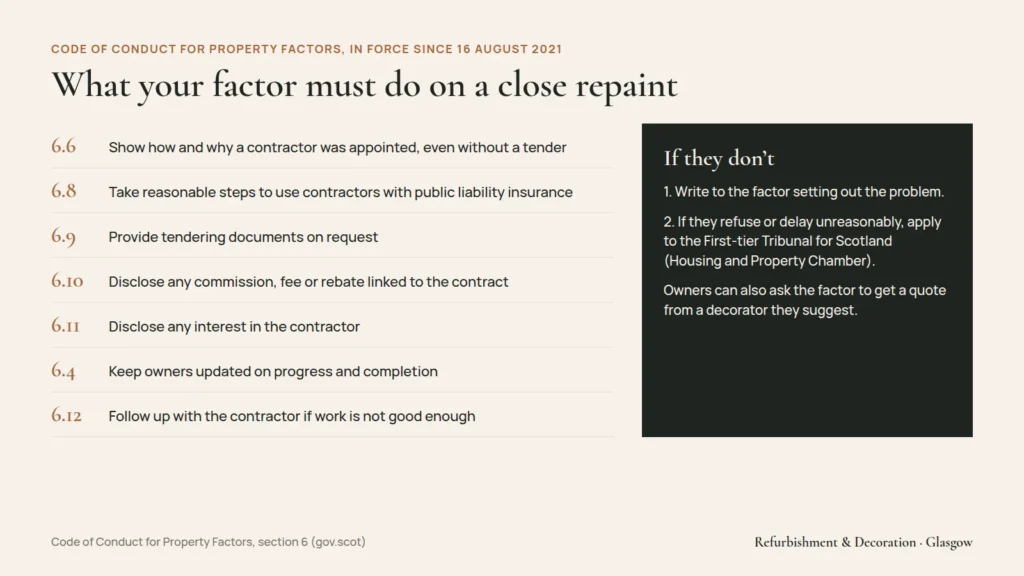
- be able to show how and why they appointed a contractor, including where there was no competitive tender, and give owners that information on request (section 6.6);
- take reasonable steps to use contractors with public liability insurance (6.8);
- provide tendering documents on request, other than commercially sensitive details (6.9);
- disclose in writing any commission, administration fee, rebate or other benefit they receive linked to the contract (6.10), and any interest they have in the contractor (6.11);
- keep owners updated on progress and expected completion (6.4), and follow up with the contractor if the work is not good enough (6.12).
Owners can also put forward their own decorator for the factor to get a quote from. A factor manages the process for the owners; the owners still make the decision unless they or the deeds have given the factor authority to act.
If you think a factor has not followed the Code, the first step is to write to them setting out the problem. If they refuse to fix it or delay unreasonably, owners can apply to the First-tier Tribunal for Scotland (Housing and Property Chamber).
Questions to ask before agreeing to a close quote
- Are all quotes priced on the same written specification: surfaces, coats, products and colours?
- Does the price include washing down, filling, and lead-safe preparation of old woodwork?
- How will the stair be kept usable during the work, and for how many days?
- Is there a factor’s fee or commission on top, and how much?
- What happens if extra repairs, such as loose plaster, are found once work starts?
What does a good close repaint involve?
A close takes more wear than any room in a flat: bikes, prams, shopping, flitting day and damp coats. The specification needs to suit that.
Preparation
- Wash down the walls and woodwork. Closes collect grease and grime that stop new paint gripping.
- Check for loose plaster and damp patches, often near close windows, the back door and under the top landing skylight. Damp needs its cause fixed before painting.
- Treat old woodwork as possibly lead-painted. The British Coatings Federation says many surfaces painted before the 1960s may contain significant lead. Handrails, balusters and close windows in a pre-war tenement often carry those layers. Its guidance (HS034 for professional decorators) is to avoid dry dust, prepare wet, never burn the paint off, and clean up with a HEPA vacuum. In a shared stair with children passing through, this matters.
- Fill and sand cracks and dents, then spot-prime repairs.

Finishes and colours
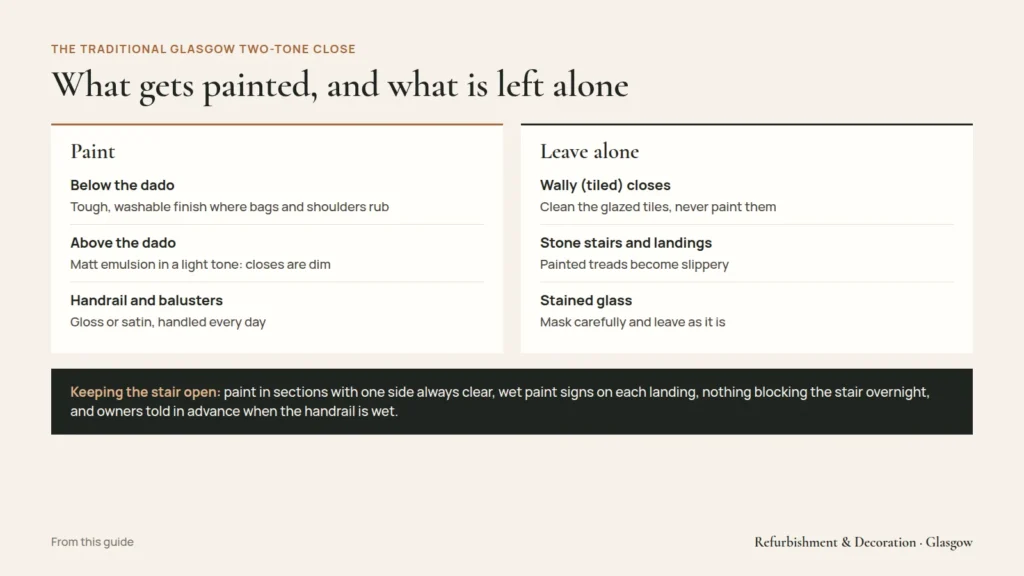
- A tough, washable finish below the dado line, where bags and shoulders rub, and a matt emulsion above. The traditional Glasgow two-tone close, darker below and lighter above, is practical as well as handsome.
- Light colours above the dado, because closes are usually dim. A pale tone lifts the stair without showing every mark the way brilliant white does.
- Gloss or satin on the handrail and balusters, which are handled every day.
Original features to leave alone
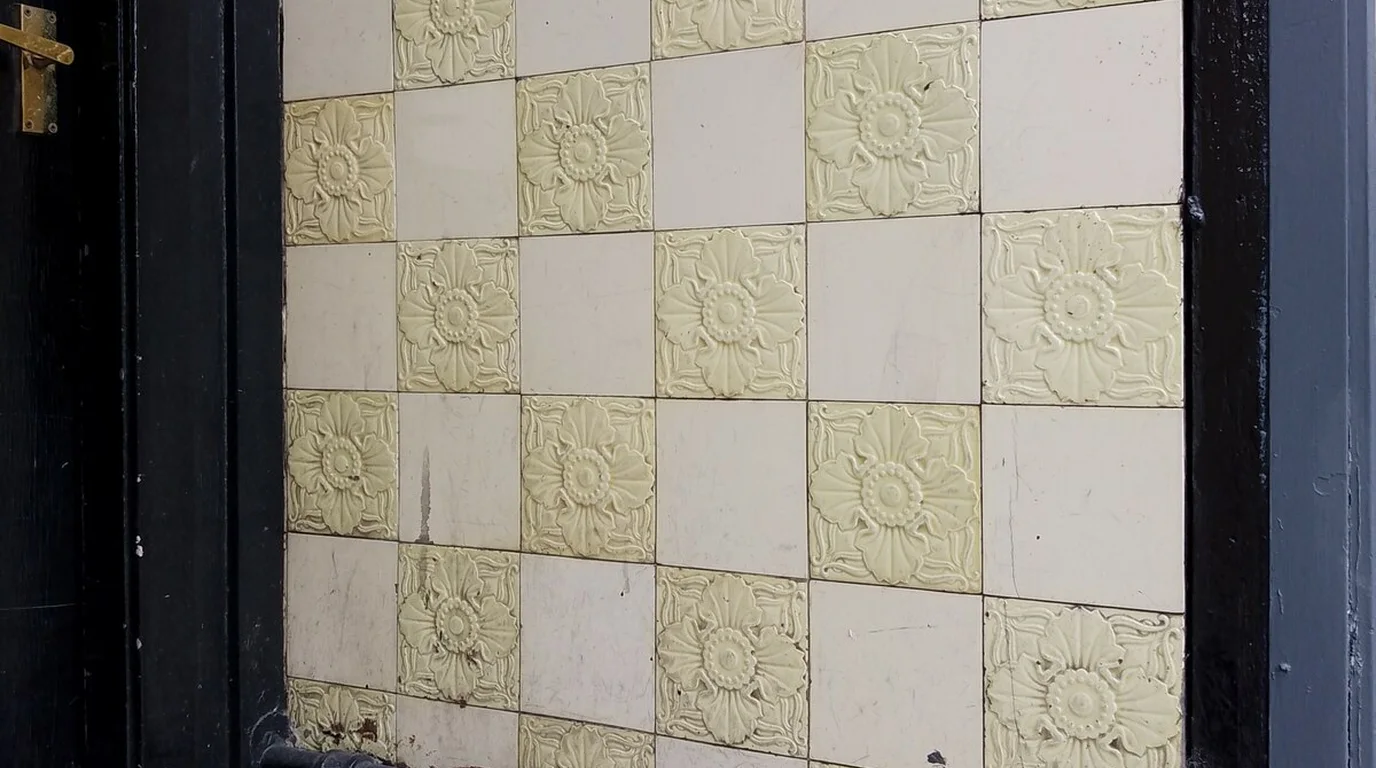
- Wally (tiled) closes. The glazed tiles found in many Glasgow closes should be cleaned, not painted. Paint on tiles looks poor within a year and is very hard to remove.
- Stone stairs and landings are left unpainted. Painted stone treads become slippery.
- Stained glass in close windows is masked carefully and left as it is.
Keeping the close open
Residents need the stair every day, and it is the escape route in a fire. A close should be painted in sections, with one side of the stair always clear, wet paint signs at each landing, and nothing left blocking the stair overnight. Dust sheets are lifted or secured at the end of each day so nobody slips. We give owners the dates for each section in advance so they know when the handrail is wet.
Mistakes to avoid when painting a close
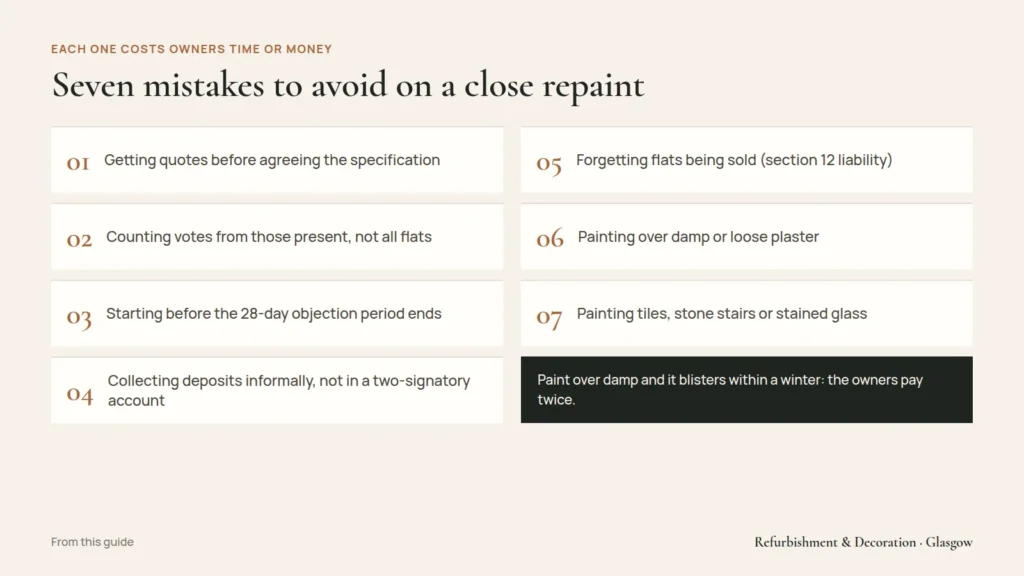
- Getting quotes before agreeing the specification. Three quotes on three different scopes cannot be compared. Agree what is being painted, with what, and in which colours first.
- Counting votes from those present. Under the TMS a decision needs a majority of all flats, not of the meeting.
- Starting before the objection period ends. Wait out the 28 days unless the work is urgent.
- Collecting money informally. Deposits over £100 a flat belong in a proper maintenance account with two signatories. A building’s goodwill does not survive lost money.
- Forgetting flats being sold. Under section 12 of the 2004 Act, a seller stays liable for their share of costs already incurred, and a buyer can be jointly liable. For work carried out before the sale, a buyer is only liable if a notice of potential liability for costs was registered against the flat at least 14 days before they took ownership. Tell your solicitor about agreed close work if you are selling or buying.
- Painting over damp or loose plaster. It will blister within a winter, and the owners pay twice.
- Painting tiles, stone stairs or stained glass. These original features add value to every flat in the close.
Repainting your own flat at the same time? Our complete guide to painting a Glasgow tenement flat covers high ceilings, cornice, sash windows and lead paint inside the home.
Getting a price for your close
We can quote for the owners directly or through your factor. We give a guide price on the phone, then a fixed written quote after a free visit, set out line by line so every owner can see what their share pays for. We can also quote on a specification your factor has already drawn up.
See our interior painting service and the areas we cover across Glasgow. Call 07777 780557 or book a free visit.
Questions people ask
Can one owner refuse to pay for painting the close?
Not if a valid majority decision has been made. Under the Tenement Management Scheme, a decision binds all liable owners. An owner who voted against can apply to the sheriff court within 28 days to annul it, on the grounds that it is not in the owners' interests or is unfairly prejudicial. If an owner simply does not pay, the others can cover the share and recover it from them.
Do ground-floor main-door flats pay for the close?
Usually not, if the title deeds are silent. Section 3 of the Tenements (Scotland) Act 2004 gives a share in the close only to flats that use it for access, so a main-door flat with its own street entrance has no share and no vote on close painting. Many Glasgow deeds set their own rules, though, so check yours before splitting the cost.
Do you work with property factors on close painting?
Yes. We can price a close for the owners directly or quote against a factor's specification. Under the Code of Conduct for Property Factors, a factor must be able to explain how a contractor was chosen and disclose any commission or fee linked to the contract. Owners can also ask their factor to get a quote from a decorator they suggest.
Can the stair stay open while the close is painted?
Yes, and it must, because it is the residents' only access and their fire escape. A close is painted in sections, keeping one side of the stair clear, with wet paint signs on each landing and nothing left blocking the stair overnight. Owners should be told in advance which days the handrail and each landing will be wet.
Is there lead paint in a tenement close?
There may be, especially on handrails, balusters, doors and close windows. The British Coatings Federation says many surfaces painted before the 1960s could contain significant lead. Sound paint can be safely overcoated. Where paint is flaking or needs rubbing down, the BCF says to work wet, avoid dry dust, never burn it off, and clean up with a HEPA-filter vacuum.
What happens to the close bill if I sell my flat?
Selling does not end your liability for costs already incurred. Under section 12 of the Tenements (Scotland) Act 2004, a buyer can also be jointly liable. For work done before the sale, the buyer is only liable if a notice of potential liability for costs was registered against the flat at least 14 days before they took ownership. Tell your solicitor about any agreed close work.

Painters and decorators working across Glasgow & Central Scotland, specialising in interior painting and wallpaper hanging. Prices in our guides are reviewed every year.
 Painting New Plaster: Mist Coats, Drying Times & Mistakes to Avoid
 Cracked Ceiling Repair & Painting: What a Decorator Can Fix
 Restoring & Painting Cornicing and Ceiling Roses