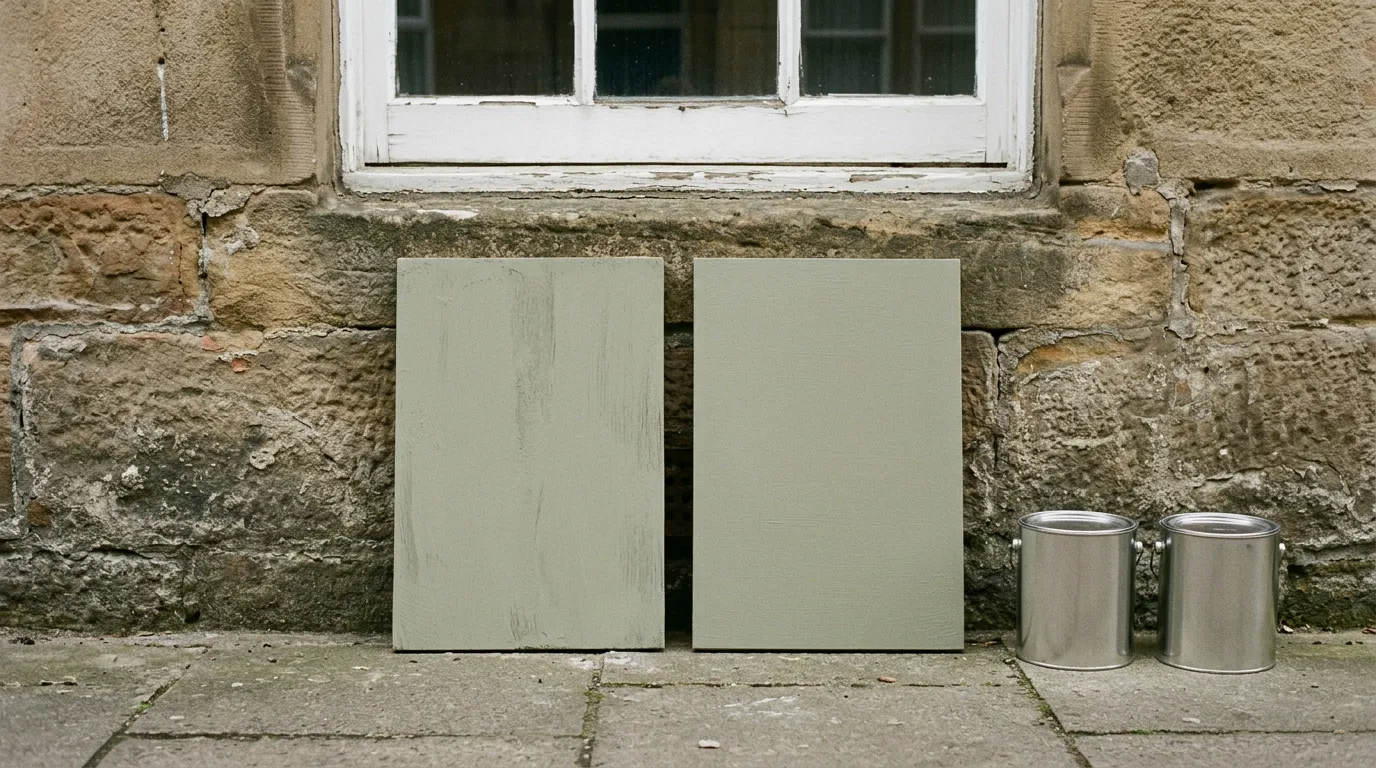
Farrow & Ball Estate Emulsion gives a softer, chalkier 2% sheen finish but is only gently wipeable; Dulux Trade Diamond Matt covers more (up to 16 m² per litre) and is scrubbable. On a large tenement bedroom, Farrow & Ball adds about £100 in materials at October 2026 retail prices, roughly 15–30% on the total.
Farrow & Ball or Dulux Trade is one of the most common questions people ask a decorator, and the online answers are mostly opinion threads. Both make good paint. They are built for different jobs, cost different amounts and behave differently on the wall. This guide compares them on finish, durability, coverage and cost for a typical Glasgow room, explains colour-matching, and sets out which we would use where. Prices checked: October 2026.
What is the difference between Farrow & Ball and Dulux Trade?
Farrow & Ball is a designer brand. It sells a deliberately small palette, 132 colours in its main range according to the brand, in its own finishes, through its showrooms, stockists and website. It is known for very flat, chalky finishes and complex colours that shift with the light.
Dulux Trade is the professional range from Dulux, sold mainly through trade merchants and decorator centres, though anyone can buy it. It is designed for decorators who need paint that covers well, goes on predictably and stands up to cleaning. It can be tinted to thousands of colours, including the Dulux colour ranges, British Standard BS 4800 and RAL colours, and Dulux’s own Heritage collection.
The products that actually compete
Comparing “Farrow & Ball” with “Dulux” in general isn’t very useful, because each makes several wall paints. These are the ones that matter for walls and ceilings in a home:
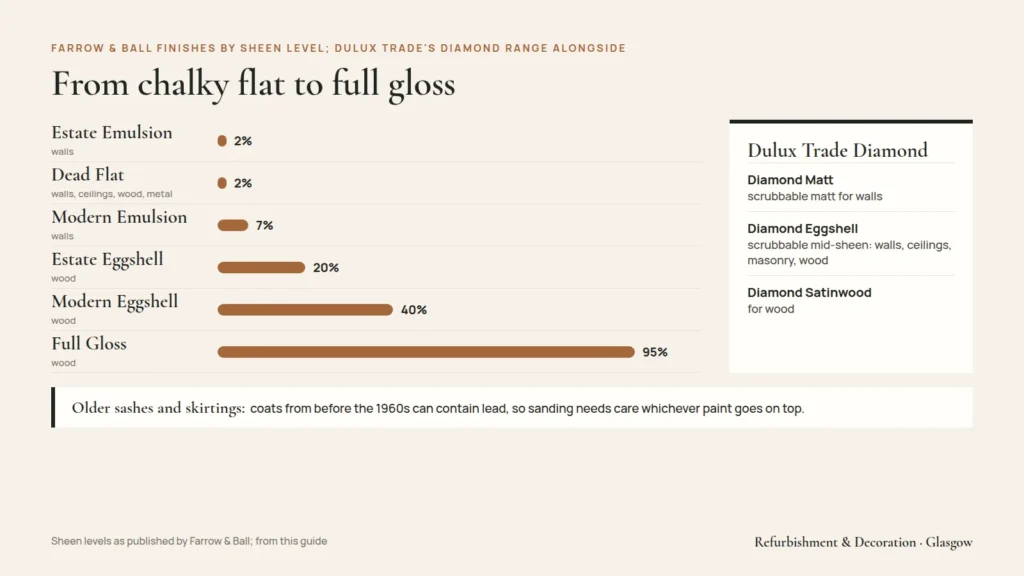
- Farrow & Ball Estate Emulsion: the classic chalky finish, 2% sheen, for low-traffic rooms.
- Farrow & Ball Modern Emulsion: a tougher washable matt, 7% sheen, with mould protection, for kitchens, bathrooms and busy areas.
- Farrow & Ball Dead Flat: an ultra-matt 2% sheen that is washable, for walls, ceilings, wood and metal.
- Dulux Trade Vinyl Matt: the everyday trade matt for walls and ceilings.
- Dulux Trade Diamond Matt: a scrubbable, stain-repellent matt for busy rooms.
- Dulux Trade Supermatt: an economical matt, recommended by Dulux for new plaster that is still drying out.
- Dulux Heritage Velvet Matt: Dulux’s premium washable matt in heritage-style colours, the nearest Dulux equivalent to a designer paint.

How do they compare on coverage, durability and finish?
Here are the published figures side by side. Coverage figures are the makers’ or retailers’ “up to” numbers for one coat; real coverage on old, patched plaster is lower.
| Paint | Finish | Coverage (up to) | Cleaning | Retail price seen, Oct 2026 |
|---|---|---|---|---|
| Farrow & Ball Estate Emulsion | Chalky matt, 2% sheen | 14 m² per litre | Gently wipeable only | From £61 for 2.5 L (Wood Finishes Direct) |
| Farrow & Ball Modern Emulsion | Matt, 7% sheen | 12 m² per litre | Washable; Class 1 scrub rating | From £66 for 2.5 L (Wood Finishes Direct) |
| Dulux Trade Diamond Matt | Smooth uniform matt | 16 m² per litre | Class 1 (ISO 11998) scrub rating, tested to 10,000 scrubs | £50.49 for 2.5 L or £77.95 for 5 L, tinted (Decorating Warehouse) |
| Dulux Trade Vinyl Matt | Matt | 17 m² per litre | Scuffs and marks wipe clean | Usually the cheapest of the group; check your merchant |
| Dulux Heritage Velvet Matt | Velvet matt | 13 m² per litre | Washable | Varies by size; check your stockist |
Sources: Dulux Trade product pages; Farrow & Ball and Dulux Heritage figures and prices from Wood Finishes Direct; Dulux Trade prices from Decorating Warehouse, all checked 14 October 2026. Retail prices change often, and decorators’ trade prices can be lower for both brands.

Finish and colour
This is where Farrow & Ball earns its reputation. Estate Emulsion at 2% sheen absorbs light rather than reflecting it, so colours look soft and deep and change through the day. In the grey, shifting light of a Glasgow room that can look beautiful, especially in deep colours and on uneven old plaster, where a flat finish hides waves and patches. Our guide to choosing paint colours for Scottish light explains why that matters so much here.
Dulux Trade Diamond Matt gives a smooth, even, slightly more uniform look. On a flat modern wall it looks crisp and clean. Side by side in the same colour, most people notice that the Estate Emulsion looks softer and a little chalkier, and the Diamond Matt looks slightly more solid.
Durability
Here the order reverses. Estate Emulsion is only gently wipeable, and retailers advise against it for kitchens, bathrooms and busy hallways. Rub a mark on it and you can leave a shiny patch. Diamond Matt is built to be scrubbed. If you have children, dogs, a bike in the hall or a landlord’s inventory to pass, that difference matters more than any other.
Farrow & Ball’s Modern Emulsion closes much of the gap. It is washable, has a Class 1 scrub rating and mould protection, at the cost of a little more sheen and a slightly higher price.
Application
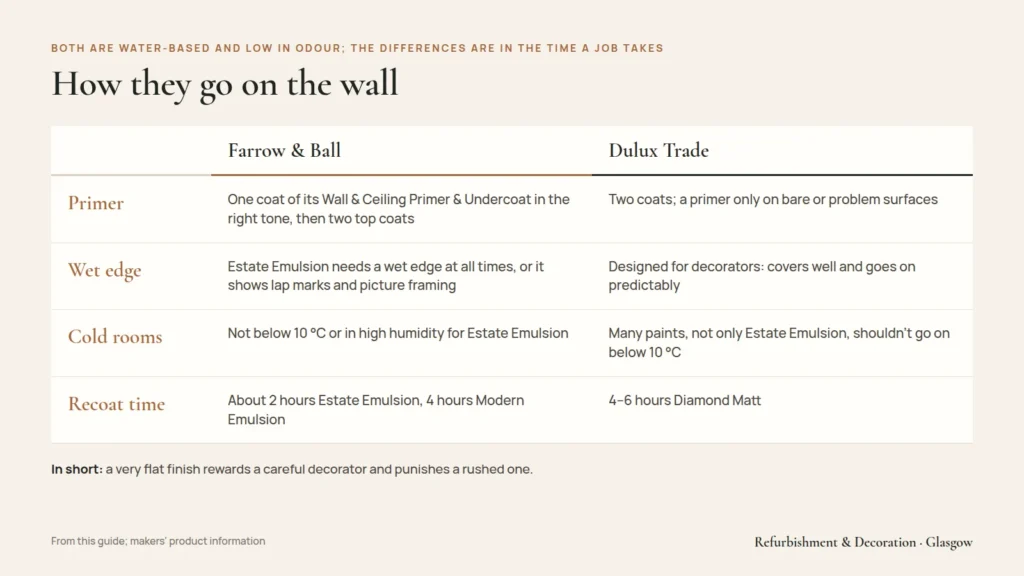
Both brands are water-based and low in odour. A few practical differences affect the time a job takes:
- Farrow & Ball recommends a coat of its Wall & Ceiling Primer & Undercoat, in the right tone for the colour, on previously painted walls before two top coats. Dulux Trade’s normal system is two coats, with a primer only on bare or problem surfaces.
- Estate Emulsion needs a wet edge kept at all times, or it shows lap marks and “picture framing” around the edges. It rewards a careful decorator and punishes a rushed one.
- Farrow & Ball says not to apply Estate Emulsion below 10 °C or in high humidity, which matters in a cold Glasgow flat in winter.
- Recoat times: about 2 hours for Estate Emulsion and 4 hours for Modern Emulsion, against 4–6 hours for Diamond Matt, according to the product information.
What does each cost for a typical Glasgow room?
The paint is a smaller share of the bill than most people expect. Labour is the big cost.
A worked example: a tenement bedroom
Take a typical double bedroom in a tenement flat: 3.6 m by 3.2 m with 3.0 m walls. Allowing for a door and a sash window, that is about 37 m² of wall. Two coats means painting about 74 m². On old plaster we would expect real coverage below the “up to” figure, so allow about 6–7 litres of wall paint either way. The ceiling is left out, as it would usually be white in either case.
| Item | Farrow & Ball Estate Emulsion | Dulux Trade Diamond Matt (tinted) |
|---|---|---|
| Wall paint | 3 × 2.5 L at about £61 = about £183 | 5 L + 2.5 L = about £128 |
| Primer and undercoat | One tin, from about £45 (recommended on previously painted walls) | Not normally needed on sound paint |
| Approximate materials for the walls | About £230 | About £130 |
| Cost per m² per coat, at the “up to” coverage | About £1.74 | About £0.97 |
Prices are the retail figures in the table above, checked October 2026. Trade prices can be lower.
So on the walls of a large bedroom, the designer paint adds roughly £100 in materials, and the primer coat adds some labour time. Against that, MyJobQuote (Sep 2026) puts a large bedroom repaint at £350–£660 including materials, taking 1–1.5 days. In most rooms, choosing Farrow & Ball adds something like 15–30% to the total, not double.
Where the difference grows
- Whole flats and houses. Across a 3-bed interior repaint, which BestBuilders Glasgow (Aug 2026) puts at £1,400–£3,200, the paint difference can run to several hundred pounds.
- Halls, stairs and landings. Big wall areas and tall walls use a lot of paint. MyJobQuote (Sep 2026) puts this job at £875–£1,350+.
- Deep colours. Strong colours in either brand can need a third coat, and that is labour as well as paint.
For the wider picture on decorating costs, see our Glasgow painting and decorating prices guide.

Can a decorator colour-match Farrow & Ball in Dulux Trade?
Yes, and many decorators do it to save money. Trade merchants can scan a painted sample and mix a computer match in a trade paint. The result is usually close. But it is worth knowing what a match does and doesn’t copy.
- It copies the colour, not the paint. The base, pigments and finish are different, so the match reads differently in some lights. That is most obvious in flat Scottish daylight and in complex greys, greens and deep colours.
- The finish changes the colour. A colour mixed in a slightly smoother matt looks a touch lighter and more uniform than the same colour in a chalky 2% finish.
- Matches vary between mixes. Buy enough for the whole job and touch-ups in one go, from the same place, as Dulux itself advises for tinted paint.
- Don’t mix brands on one wall. Touching up an Estate Emulsion wall with a matched trade paint, or the other way round, usually shows.

Decorator’s tip: if you are considering a match, ask for a sample of the matched paint and paint a board next to a board of the original. Look at both on your own wall for a few days, including on a dull afternoon. If you can’t see the difference, the match is good enough for you.
Which is better in each room of a Glasgow home?
Our honest view is that the best result often uses both brands in the same home, each where it suits.
| Room or surface | Our usual choice | Why |
|---|---|---|
| Living room, dining room, main bedroom | Farrow & Ball Estate Emulsion if the budget allows; Diamond Matt otherwise | Low wear; the flat finish and colour depth show best here |
| Children’s rooms | Diamond Matt or Modern Emulsion | Needs scrubbing |
| Hall, stair and landing | Diamond Matt, or Modern Emulsion for a Farrow & Ball colour | Bags, bikes and hands; Estate scuffs too easily |
| Kitchen and bathroom | Modern Emulsion, or a Dulux Trade mould-resistant paint where mould is a risk | Moisture and cleaning; see our damp and mould guide |
| Ceilings | Dulux Trade Vinyl Matt or Supermatt in a white | Ceilings don’t get touched; save the money for walls |
| Rental flats | Dulux Trade Diamond Matt or Vinyl Matt in a standard colour | Easy to clean and easy to touch up between tenants |
| New plaster | A mist coat first; Dulux recommends Supermatt for plaster still drying out | Lets the plaster breathe and dry |

Tenement walls
On old lime plaster and solid sandstone walls, a breathable finish lets moisture escape. Farrow & Ball’s Estate Emulsion is listed in the most vapour-permeable class (Class I). The flat finish also hides the waves and patches of old plaster better than a smoother sheen. Those are two practical reasons it is popular in Glasgow tenements, beyond the colours. Our tenement painting guide covers old plaster in more detail.
Woodwork: skirtings, doors and sashes
Both brands make water-based woodwork paints, and the choice follows the same logic as the walls. Farrow & Ball sells Estate Eggshell at 20% sheen, Modern Eggshell at 40% and Full Gloss at 95%, all in its own colours, so skirtings and doors can match or tone with the walls exactly. Dulux Trade’s Diamond range includes a Satinwood for wood, and Diamond Eggshell, a scrubbable mid-sheen for walls, ceilings, masonry and wood. On a busy family door or a hall skirting that gets kicked, durability usually matters more than the last shade of colour depth. On sash windows in an older flat, the condition of the old paint matters more than the brand: pre-1960s coats can contain lead, so sanding needs care whichever paint goes on top.
How can you compare them yourself, and what should you avoid?
The best way to decide is to see both in your own room. You don’t need to paint a whole wall.
A simple side-by-side test
- Buy a sample pot of your Farrow & Ball colour, and a sample of the nearest Dulux colour or a trade match.
- Paint two A4 boards of each, two coats, with a white border.
- Put one pair on the window wall and one on the darkest wall.
- Look at them morning, afternoon and at night under your own bulbs, for three or four days.
- Rub a corner of each with a damp cloth once dry, to see how they handle cleaning.

Mistakes to avoid
- Estate Emulsion in a busy hall or kitchen. It will mark, and cleaning it can leave shiny patches.
- Skipping Farrow & Ball’s primer on previously painted walls in a big colour change, then needing a third top coat anyway.
- Buying cheap tools for a flat finish. Poor rollers leave texture that a 2% sheen shows clearly.
- Painting in a cold flat. Below 10 °C, many paints, Estate Emulsion included, shouldn’t go on at all. See our guide to painting interiors in a Scottish winter.
- Assuming the dearer paint covers better. Diamond Matt’s published coverage is higher than Estate Emulsion’s.
- Ordering a match without testing it. A close match on a card can look different on a whole wall.

Getting a price for your home
We are happy to use either brand and to price your rooms both ways so you can see the real difference. We give a guide price on the phone and a fixed written quote after a free visit. Call 07777 780557 or book a free visit. Read more about our interior painting service and the areas we cover across Glasgow.
Questions people ask
Is Farrow & Ball paint really better quality than Dulux Trade?
It is different rather than simply better. Estate Emulsion's 2% sheen chalky finish gives colours a soft depth that many people love, especially in changing Scottish light. Dulux Trade Diamond Matt is tougher, with a Class 1 scrub rating, and covers up to 16 m² per litre against Estate's 14. Choose by room: looks in low-wear rooms, durability in busy ones.
How much more does Farrow & Ball cost for a room?
At retail prices checked in October 2026, Estate Emulsion was from £61 for 2.5 litres (Wood Finishes Direct) and tinted Dulux Trade Diamond Matt £77.95 for 5 litres (Decorating Warehouse). For the walls of a large tenement bedroom, that is roughly £230 against £130 in materials, including Farrow & Ball's recommended primer. Labour is still the bigger part of the bill.
Can Farrow & Ball colours be matched in Dulux Trade?
Yes, a trade merchant can scan a sample and mix a computer match. It is usually close, but it copies the colour, not the paint: the base and finish differ, so the match can read differently in some lights, especially complex greys, greens and deep colours. Test a sample board of the match next to the original before ordering, and buy all you need at once.
Is Farrow & Ball Estate Emulsion washable?
Only gently. Estate Emulsion is described as wipeable, and retailers advise against it for kitchens, bathrooms and busy hallways. Rubbing a mark can leave a shiny patch. For those rooms Farrow & Ball makes Modern Emulsion, a washable 7% sheen matt with a Class 1 scrub rating and mould protection, and Dead Flat, a washable 2% sheen finish.
Do I need a primer with Farrow & Ball paint?
On previously painted walls, Farrow & Ball recommends one coat of its Wall & Ceiling Primer & Undercoat in the right tone for your colour, then two top coats. On new plaster it suggests a mist coat of the topcoat diluted with about 25% water. Dulux Trade's normal system is two coats, with a primer only on bare or problem surfaces.
Which paint is best for a rental flat in Glasgow?
A durable trade matt such as Dulux Trade Diamond Matt or Vinyl Matt in a standard colour is the practical choice. It cleans well, covers well and is easy to touch up between tenancies because the same colour is always available. Save designer finishes for your own home's low-wear rooms, where their softer look is appreciated and they won't be scrubbed.

Painters and decorators working across Glasgow & Central Scotland, specialising in interior painting and wallpaper hanging. Prices in our guides are reviewed every year.
 Damp, Condensation & Mould: the Right Paint and Wallpaper for Glasgow Homes
 Choosing Paint Colours for Scottish Light: the Complete Guide