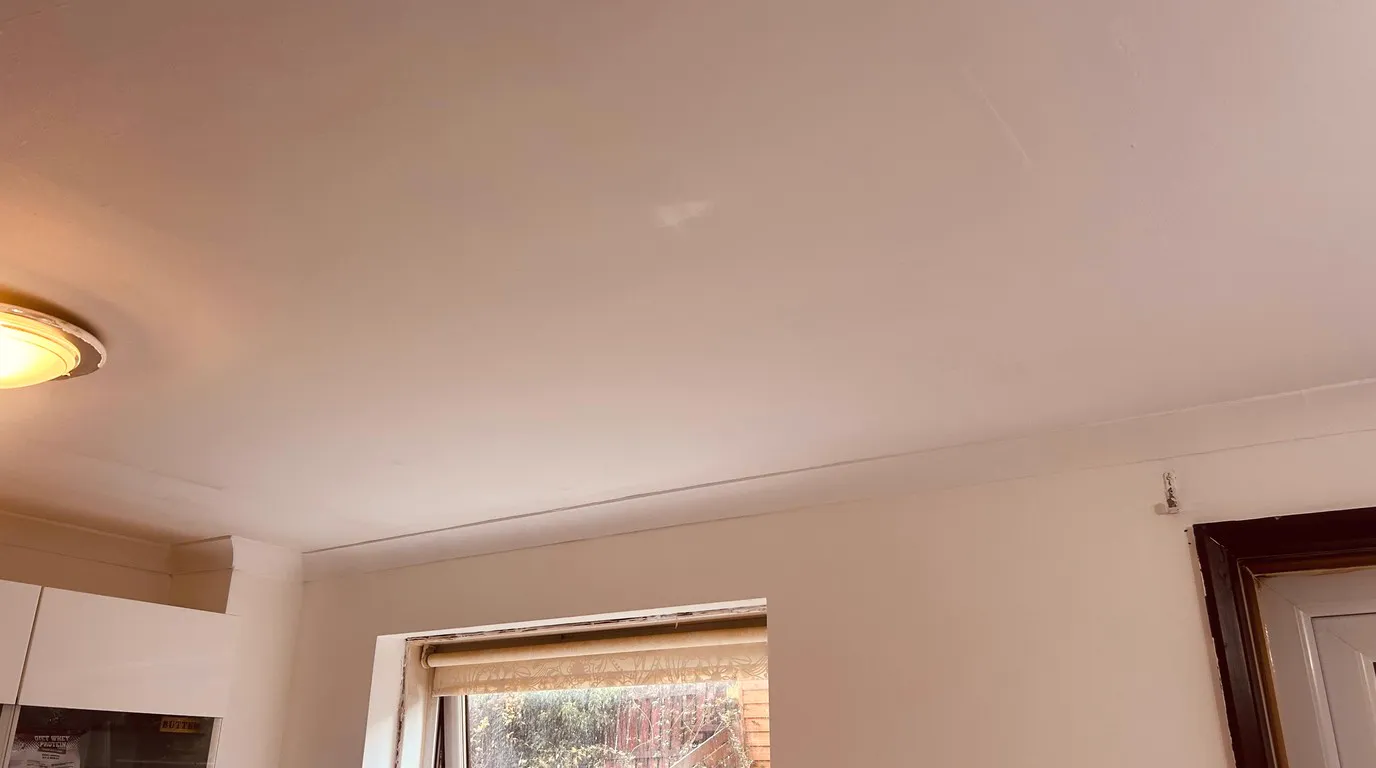
Hairline cracks, failed plasterboard joints and fine crazing are cosmetic, and a decorator can rake, fill, tape, prime and paint them in one to two days. At £150–£290 a day for labour (BestBuilders Glasgow, Aug 2026; Trade2Base, Jun 2026), materials extra. Sagging, bulging, widening cracks or water stains need a plasterer, engineer, factor or insurer first.
A crack across the ceiling is one of the most common reasons people call a decorator in an older Glasgow flat, and one of the most worrying. Most are cosmetic and can be repaired and painted in a day or two. A few are the first sign of something that needs a plasterer, an engineer or your insurer before any paint goes on. This guide explains how to tell the difference, what a decorator does to a ceiling that is sound, and why the cracks sometimes return. It sits alongside our complete guide to painting a Glasgow tenement flat.
Which ceiling cracks are cosmetic?
Most ceilings in Glasgow’s older flats are lath and plaster, with some plasterboard added in later repairs and in newer buildings. The two behave differently, and the pattern of a crack usually tells you which one you have.
Hairline cracks
Fine, straight cracks, no wider than a pencil line, are the most common. They appear as buildings move slightly with the seasons, as heating comes on and off, and as floors above flex when people walk across them. If the crack has not changed in a year, it is almost certainly cosmetic.
Cracks along plasterboard joints
On a plasterboard ceiling, a straight crack running in a line, often with a second line parallel to it a board’s width away, is usually a failed joint. The tape or joint compound has cracked where two boards meet. This is easy to repair properly, and it is one of the most common ceiling jobs a decorator does.
Crazing on old plaster
A network of fine, spidery cracks over a large area is common on old lath and plaster. It is the surface of the plaster ageing and shrinking, not the structure failing, as long as the ceiling is still firm and flat. Crazing is usually dealt with by lining the ceiling rather than by filling every line, which we cover below.
Cracks at the cornice
A thin gap where the ceiling meets the wall or cornice is almost always movement between two different surfaces. It needs a flexible sealant rather than a hard filler. If you have decorative plasterwork, our guide to restoring and painting cornicing and ceiling roses explains how to treat it without losing detail.
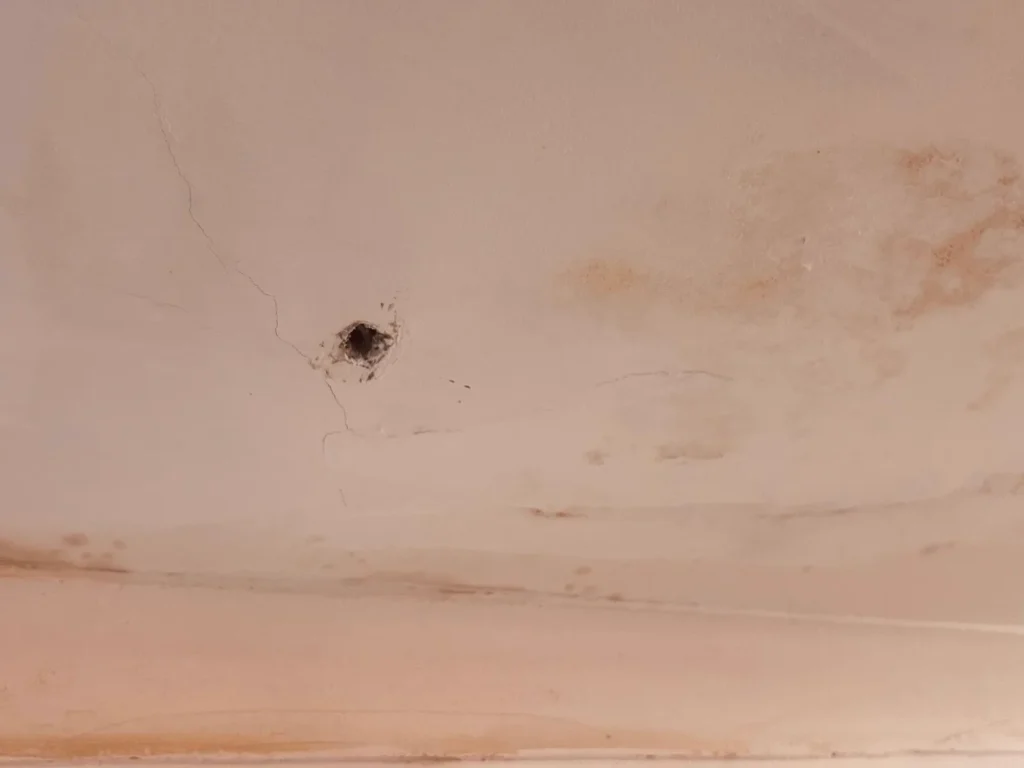
Decorator’s tip: Photograph the crack with a ruler beside it, and date the picture. A second photograph in three or six months shows whether it has moved, which is the most useful thing you can give a decorator, plasterer or surveyor.

When does a crack need a plasterer, an engineer, the factor or your insurer?
A decorator can repair and paint a sound ceiling. A decorator cannot make an unsound one safe, and should tell you so. These are the signs that someone else needs to see the ceiling first.
Signs of a plastering problem
- Sagging or bulging. On lath and plaster, the plaster is held up by “keys”, the lumps of plaster that pushed between the laths when it was applied. When keys break, the plaster drops away from the laths and the ceiling begins to sag.
- A ceiling that moves or feels hollow. If a gentle push with a flat hand makes a section flex, or a tap sounds hollow and loose, the plaster has lost its grip. Do not press hard, and keep furniture and people away from below it.
- Cracks with one edge standing proud, or plaster that crumbles and will not hold filler.
These are jobs for a plasterer. Sections can be re-secured with plaster screws and washers, or cut out and re-boarded, depending on the extent. A decorator will then prepare and paint the result.
Signs of a structural problem
- Wide cracks, or cracks that are getting wider. As a rough guide, a crack wider than about 5 mm, or one that grows when you check it against your dated photographs, should be seen by a chartered surveyor or structural engineer. Treat the figure as a rule of thumb, not a verdict.
- Cracks that continue down the wall or across the next surface.
- Doors and windows that have started to stick as the cracking appeared.
Signs of water
A brown or yellow ring, a damp patch, or bubbling paint on a ceiling means water. In a tenement the water may come from a flat above, from a roof or a gutter, or from condensation in a cold room. Do not paint over it. Find and fix the source first, and let the plaster dry out completely.
- Stains from the flat above. Tell your neighbour and your factor. Who is responsible for the repair depends on the cause and on your title deeds, so check the current position with your factor, your insurer or a solicitor before acting.
- Stains below the roof. Report them to your factor, because the roof is normally a common part of the building.
- Your insurer. If the damage came from a burst pipe or a leak, tell the insurer before you tidy up. Keep photographs.
- Condensation and mould. Dark spotting on a ceiling in a cold corner is often condensation. Our guide to damp, condensation and mould explains the right paints and when ventilation matters more than paint.
Textured coatings and asbestos
If your ceiling has a textured coating, such as stipple or Artex, and the building dates from before 2000, it may contain asbestos. Do not sand, scrape or drill it. Asbestos fibres are only a risk when disturbed. The HSE advises getting a sample tested before any work that disturbs the surface. In practice, painting over an intact textured ceiling is generally safe, but repairing or removing it is not a casual job.

How does a decorator repair a cracked ceiling?
The method varies a little with the kind of crack, but a sound ceiling is repaired in the same order every time. Skipping a step is the usual reason a crack shows through the new paint within months.

The usual sequence
- Protect and light. Floors and furniture are covered. We check the ceiling in raking light from a lamp or window, because that shows every ridge the paint will later exaggerate.
- Remove what is loose. Flaking paint and any loose plaster are scraped away until we reach a firm edge. If a lot of plaster is loose, the job goes back to a plasterer.
- Rake out the crack. The crack is opened slightly with the corner of a scraper or a filling knife, to a shallow V. This gives the filler something to grip. Filling a closed hairline only covers it, and it opens again.
- Vacuum and seal. Dust is vacuumed out. Bare plaster is sealed with a diluted coat of the paint or a suitable primer, so the filler does not dry too fast and shrink.
- Fill with a flexible filler. A hard, brittle filler cracks again as soon as the ceiling moves. We use a flexible or fibre-reinforced filler for cracks that are likely to move, applied in thin layers rather than one deep one.
- Tape wider or recurring cracks. A strip of scrim or self-adhesive fibreglass mesh tape is bedded over the crack with filler, and then skimmed flat. The tape bridges the crack and spreads any movement across a wider area.
- Sand and dust. Once it is dry, the filler is sanded flat with fine paper and the dust is wiped away. Sanding is the step that decides how good the ceiling looks in raking light.
- Prime the patches. Filler is porous and soaks up paint differently from the rest of the ceiling. Primed patches avoid a dull, blotchy “flashing” look.
- Stain-block, if needed. A water mark will bleed through emulsion however many coats go on top. Once the ceiling is fully dry and the leak is fixed, the mark is sealed with a stain-blocking primer. Check the manufacturer’s data sheet for the product and for the drying time before overcoating.
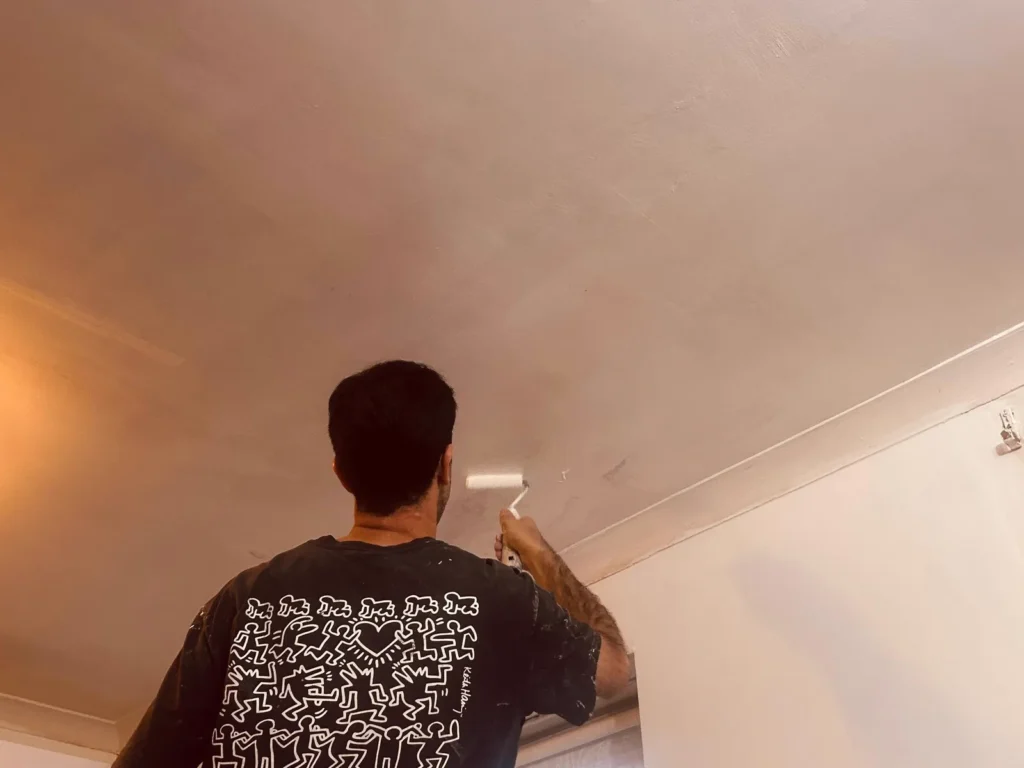
- Paint two coats of ceiling matt. A flat, matt finish hides small imperfections far better than a sheen does. We cut in around the edges first, then roll quickly in one direction towards the main window light, keeping a wet edge to avoid lap marks.
Cracked lath and plaster: lining paper instead of filling
When a lath and plaster ceiling has dozens of fine cracks, filling each one is slow and rarely lasts. A better answer is to hang a lining paper over the whole ceiling. The paper bridges the cracks, gives a smooth, even surface, and can then be painted. It also copes better with the slight movement of an old ceiling than a rigid skim does.
Ceilings are among the hardest surfaces to paper, and the work is best left to a decorator who does it regularly. We would generally use a heavier grade of lining paper and size the ceiling before hanging. The paper is then allowed to dry fully before painting, so the job runs over two visits. BestBuilders (August 2026) gives £80–£150 a room for lining paper as an extra.
Decorator’s tip: Never use a hard, quick-drying powder filler on a ceiling crack that you have already filled once. If it has opened again, the ceiling is moving. Use a flexible product and tape, or consider lining paper.
Joints on plasterboard
A failed joint on plasterboard is repaired by cutting out the old tape and compound back to a firm edge, re-taping and applying two or three thin coats of jointing compound, each wider than the last. This feathers the repair into the ceiling so that it does not show as a ridge. A single heavy coat will be visible in the light and will crack again.
Why do ceiling cracks come back, and how can you slow it?
The honest answer is that an old ceiling is never completely still. Timber floors move with the seasons and the weather. Heating cycles dry out and rewet plaster. Heavy footsteps above flex the floor. Good preparation slows the process, but it cannot stop it. That is why a repair that was done properly can still show a faint line after a few winters.
Common reasons for a repair failing
- The crack was not raked out. Filler sat on the surface and lifted at the edges.
- A hard filler was used. It could not move with the ceiling.
- The ceiling was not fully dry. Moisture trapped under paint opens up again as it escapes.
- The underlying cause was not fixed. A leak, a loose section of plaster or a movement above had not been dealt with.
How to slow it down
- Keep the heating steady. Big swings make plaster and timber expand and contract more.
- Ventilate. Extractor fans in kitchens and bathrooms keep moisture off cold ceilings.
- Use tape or lining paper on cracks that have recurred, and accept that a flexible sealant at the cornice is a better choice than a rigid filler.
Even then, a good decorator will tell you that a very faint line may reappear in a bad winter, and it can be touched in with filler and paint in minutes.

What about high tenement ceilings?
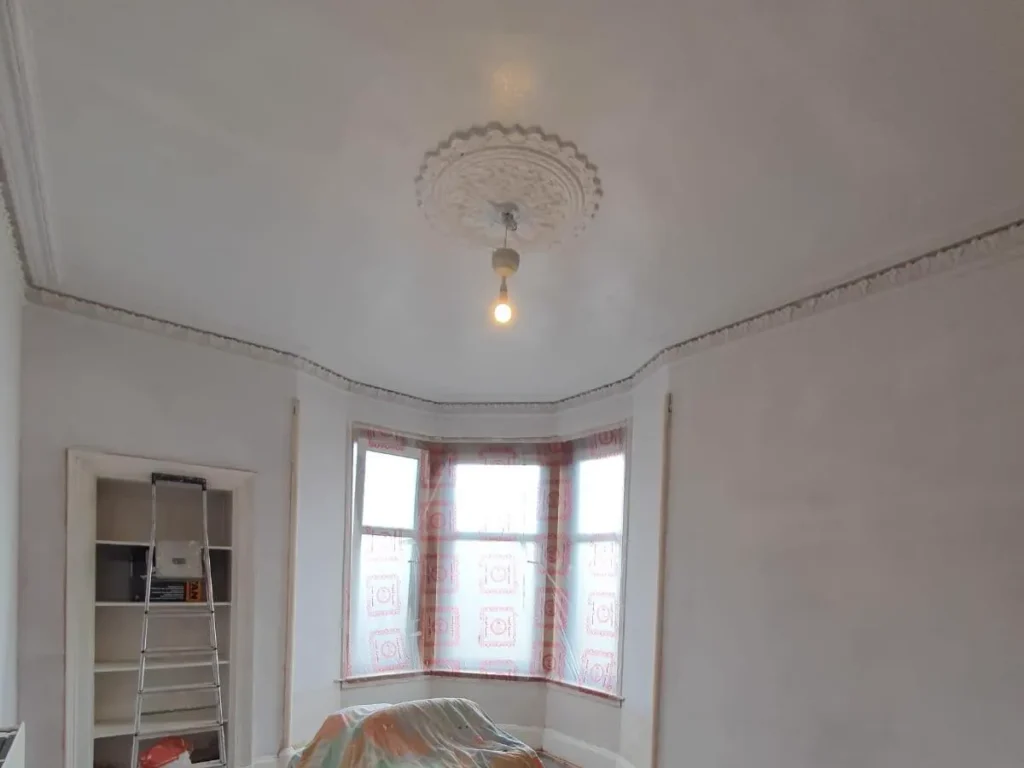
Many Victorian and Edwardian flats in Glasgow have ceilings well over 3 m high, which changes how the work is done. Reaching the middle of a high ceiling with a stepladder is slow, tiring and unsafe. A decorator working at height should use a mobile access tower or a platform that gives a stable, level working surface, in line with the Work at Height Regulations 2005.
What a tower changes
- Setting up takes time. A tower has to be built, moved and taken down, which adds to the day, and it needs a clear floor.
- Better results. A stable platform means better sanding and a better paint finish than reaching from a ladder, and the cornice and rose can be done from the same set-up.
A tall ceiling lit by a large sash window often has strong raking light across it, which shows every flaw. That is why preparation matters more here, and why we prefer a flat matt finish. Our tenement flat guide covers colour and sheen for high ceilings.
How long does it take, and what does it cost?
A ceiling in a typical room is part of a day’s work to paint when it is sound. With repairs it takes longer, because fillers and primers have to dry between stages. A ceiling with a few hairline cracks and joints may be a day. A ceiling that needs taping, stain-blocking or lining paper is usually two visits, so the paint can go onto fully dry surfaces.
Market figures
R&D’s own prices are not published yet. The only market figures we use here are decorators’ day rates, because ceiling repairs vary too much to price by a single number. BestBuilders Glasgow (August 2026) and Trade2Base for Scotland (June 2026) put a decorator’s day rate at £150–£290 a day. Checkatrade, as reported by Whito (September 2026), gives a UK top-of-market average of about £325 a day, so published sources do not agree. Those day rates are for labour, and materials such as filler, tape, primer and paint are extra.
Worked example: a ceiling with a few cracks
This is an illustration, not a quote. A typical living room ceiling has two hairline cracks, a failed joint near the cornice and one old water mark that has been dry for years. The work is rake out, fill, tape the joint, sand, prime, stain-block the mark, and paint two coats. That is realistically one to two days, depending on the height and access.
| Item | Allowance | Based on |
|---|---|---|
| Labour, 1 day | £150–£290 | BestBuilders Glasgow (Aug 2026); Trade2Base Scotland (Jun 2026) |
| Labour, 2 days | £300–£580 | Same day rate, doubled |
| Filler, tape, primer, stain-block, ceiling paint | Extra | Varies with the products and the size of the ceiling |
| Access tower hire, if needed | Extra | No verified market figure, so ask for it in the quote |
The two-day figure is simple multiplication of the day rate, not a published price for ceiling repairs. A plasterer’s work, a surveyor’s fee or an insurer’s excess is separate.

Questions to ask in a quote
- Does the price include the filler, tape, primer and paint, and which ceiling paint?
- Will the work be done from a tower, and is the hire included?
- What happens if the ceiling turns out to be unsound once the paint is removed?
Getting a price for your home
Every ceiling is different, and the honest answer to “how much?” depends on its condition and height. We can give you a guide price over the phone. After a free visit, we will tell you which cracks are cosmetic and which need someone else first, and give you a fixed written quote for the rest. See our interior painting service for what is included. We work across Glasgow and Central Scotland.
Call 07777 780557, or book a free visit.
Questions people ask
Is a crack in my ceiling serious?
Most are not. Hairline cracks, cracks along plasterboard joints and fine crazing on old plaster are cosmetic. Sagging, bulging, a ceiling that flexes when pushed gently, cracks that keep widening, or brown water stains need a plasterer, surveyor or your insurer to look first. Photograph the crack beside a ruler, with the date, to see if it moves.
Can you just paint over a ceiling crack?
Not for long. Paint alone will not bridge a crack, and it will show again within weeks. The crack should be raked out, filled with a flexible filler, taped if it is wider or has opened before, sanded, primed and then painted with two coats of ceiling matt. Water stains also need a stain-blocking primer.
Why does my ceiling crack again after being repaired?
Old ceilings are never completely still. Timber floors above move with the seasons and heating, so a repair can reopen. Common causes of failure are a crack that was not raked out, a hard filler, a ceiling that was not fully dry, or a leak or loose plaster that was never fixed. Tape or lining paper helps slow it.
Should I use lining paper on a cracked lath and plaster ceiling?
Often, yes. When an old ceiling has many fine cracks, filling each one is slow and rarely lasts. Lining paper bridges the cracks, gives an even surface and copes with slight movement. It is extra work, though, and usually means two visits so the paper dries before painting. BestBuilders (Aug 2026) lists lining paper at £80–£150 a room as an extra.
Who pays if the water stain comes from the flat above?
It depends on the cause and on your title deeds, so we cannot give a single answer. Tell your neighbour and your factor, photograph the damage, and contact your insurer before tidying up. Check the current position with your factor, insurer or a solicitor before acting. Do not paint over the stain until the leak is fixed and the plaster is dry.
How long does it take to repair and paint a cracked ceiling?
A sound ceiling with a few hairline cracks and joints is usually one to two days. Taping, stain-blocking or lining paper means two visits, because each stage must dry. At a Glasgow decorator's day rate of £150–£290 (BestBuilders Glasgow, Aug 2026; Trade2Base, Jun 2026), materials extra. Tall tenement ceilings take longer because of the access tower.

Painters and decorators working across Glasgow & Central Scotland, specialising in interior painting and wallpaper hanging. Prices in our guides are reviewed every year.
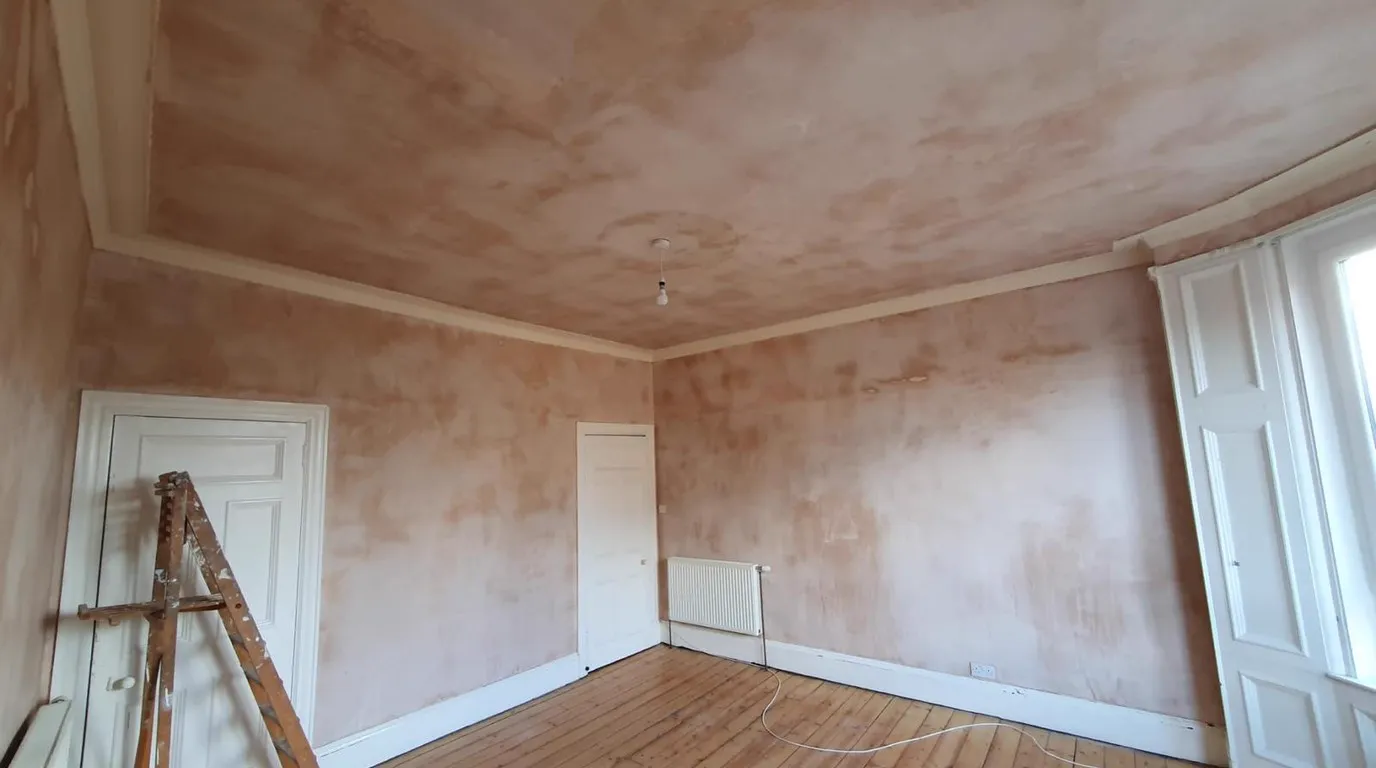 Painting New Plaster: Mist Coats, Drying Times & Mistakes to Avoid
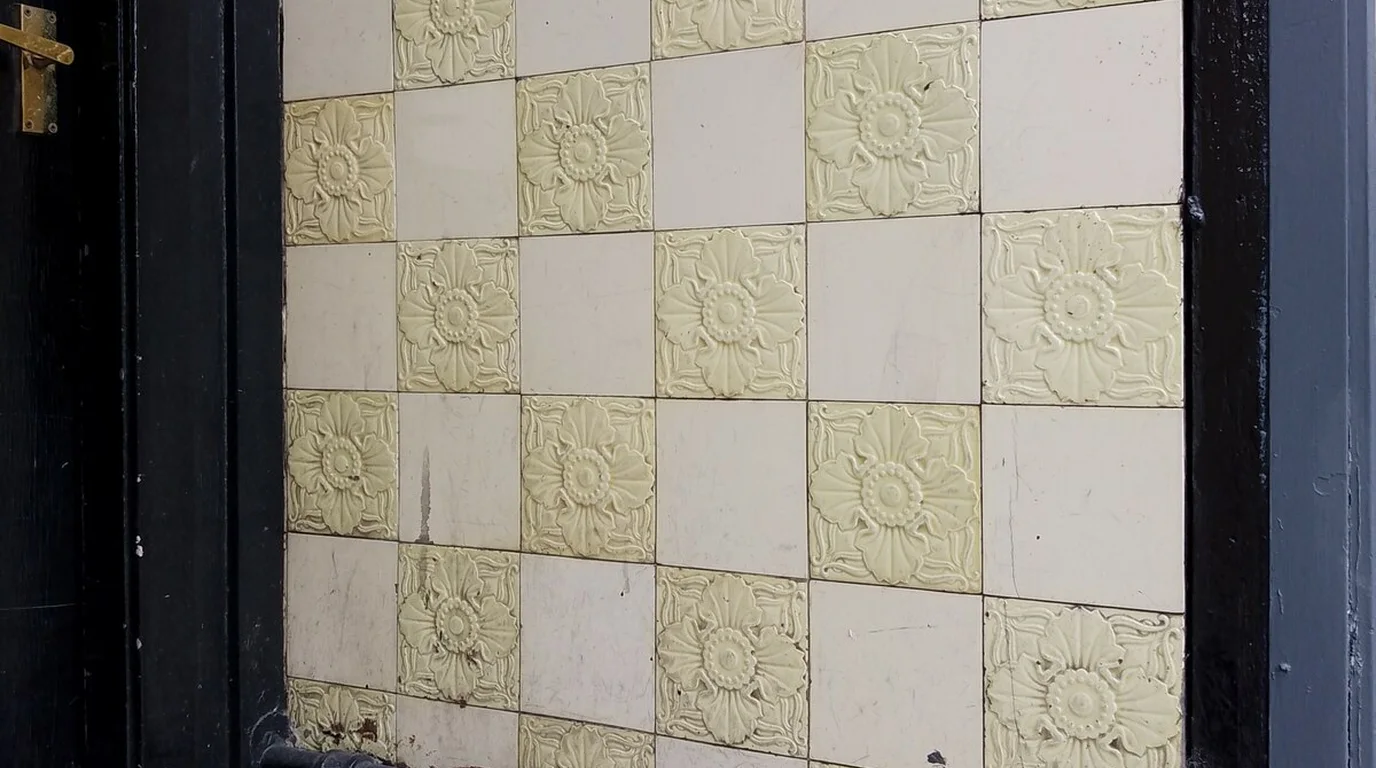 Painting a Tenement Close: Factors, Owners & Costs
 Restoring & Painting Cornicing and Ceiling Roses