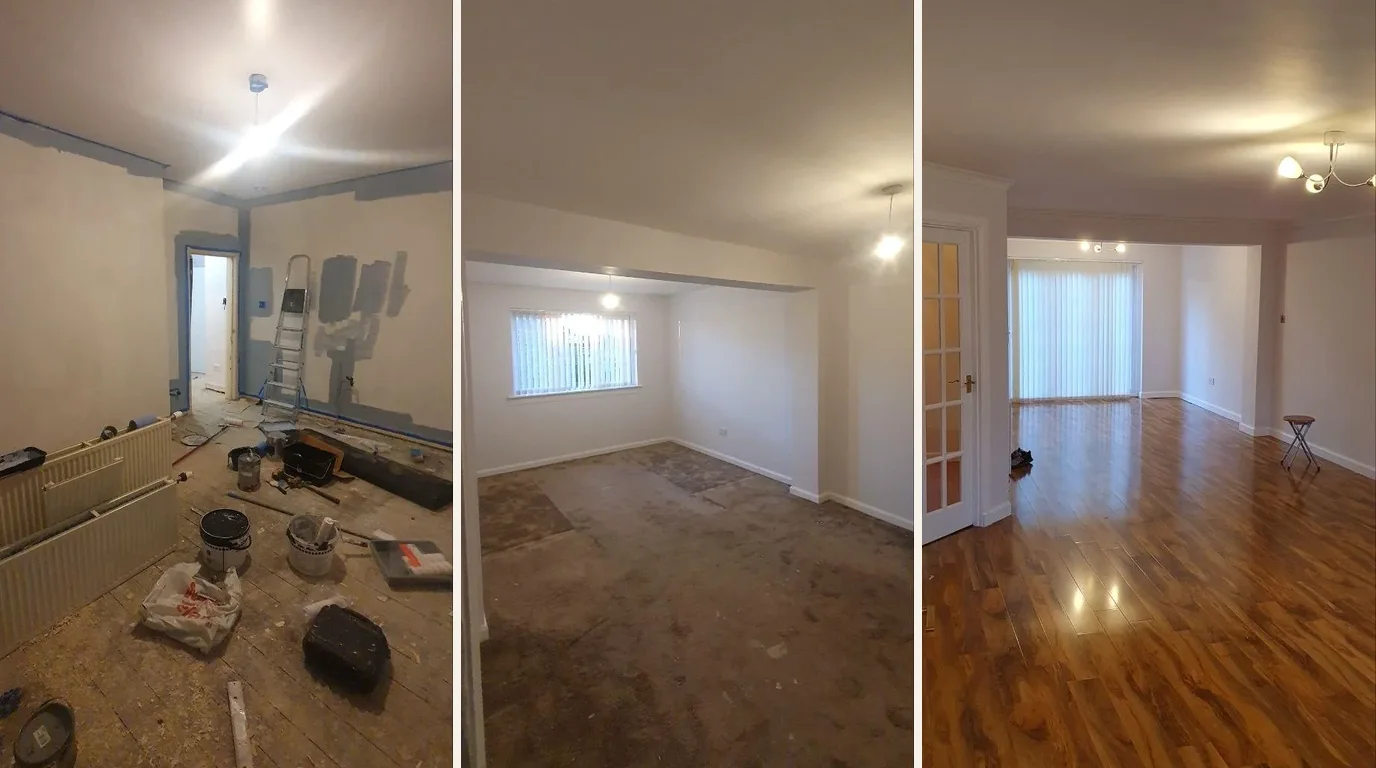
A full interior repaint of a 3-bedroom home in Glasgow typically costs £1,400–£3,200 with paint included (BestBuilders Glasgow, Aug 2026) and takes one decorator about seven to nine working days. Compact ex-council houses sit in the lower half, while tenement flats with 3.2 m ceilings, cornices and cracked plaster usually land in the upper half.
Search for what it costs to paint the inside of a 3-bedroom house and you will find figures from about £1,400 to £7,000, usually with no explanation of what sits behind them. This guide builds the price up room by room for the kinds of 3-bed home most common in Glasgow, using published market figures with their sources and dates, and shows what moves the total up or down. Prices checked: October 2026.
What does a full interior repaint of a 3-bed home cost in Glasgow?
BestBuilders’ Glasgow page (updated August 2026) puts a whole-house interior repaint of a 3-bedroom home at £1,400–£3,200. A note on the same page gives £1,500–£3,500 for walls, ceilings and trim, so treat the band as approximate rather than exact. It is the only published whole-house figure we found that is specific to Glasgow.
National guides spread much wider. One 2026 builders’ blog gives £3,000–£7,000 for a 3-bed, but we could only see that figure in a search snippet, and it does not say what it includes. Older UK guides from 2022 sit around £2,000–£3,000. The differences come from what each figure covers: walls only or walls, ceilings and woodwork, sound plaster or cracked, one colour or several, empty house or full one.
Here is roughly where different 3-bed homes tend to sit within the Glasgow band, based on the worked examples further down. These are our estimates from the market figures, not a survey.
| Type of 3-bed home | Typical position in the £1,400–£3,200 band | Why |
|---|---|---|
| Ex-council terraced house, walls and ceilings only, sound condition | Lower half | Compact rooms, 2.4 m ceilings, simple woodwork |
| 1960s–1990s semi, walls, ceilings and woodwork | Middle | Larger living room and a full hall, stairs and landing |
| Older semi or villa with poor plaster or strong colour changes | Upper half, sometimes above | Filling, lining and extra coats |
| 3-bed tenement flat with 3.2 m ceilings and cornices | Upper half | A third more wall area, towers, slow cutting in |
The figures assume the decorator supplies trade paint and sundries. Wallpaper, if you want any, is extra. For the full set of market ranges we use across our guides, see painting and decorating prices in Glasgow.

Room by room: what does each part of the house cost?
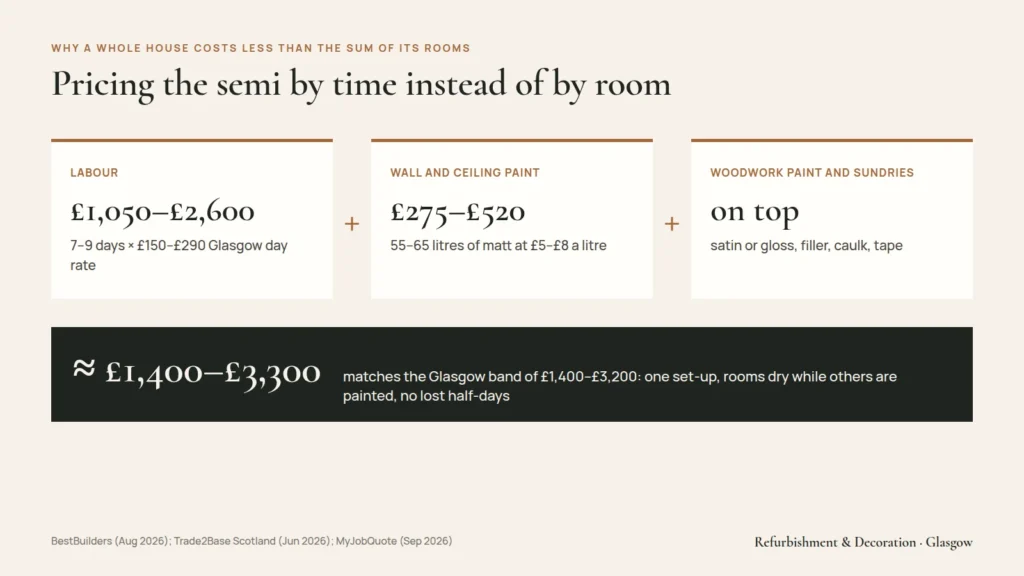
The clearest way to see where the money goes is to price each room. MyJobQuote’s guide (September 2026) is the most detailed published breakdown. Its figures are for the UK outside London and include labour and paint, and each one sits inside BestBuilders’ Glasgow figure of £350–£600 for an average room.
Worked example: a typical 3-bedroom semi
Picture a 1970s semi in the suburbs: a through lounge, a kitchen, a bathroom upstairs, two double bedrooms and a box room, 2.4 m ceilings, and walls in decent condition. The job is two coats on walls and ceilings and a fresh coat on the woodwork, from one pale colour to another.
| Room | Typical time | Market range |
|---|---|---|
| Box room | 4–6 hours | £175–£300 |
| Second bedroom (small) | About 1 day | £250–£400 |
| Main bedroom (large) | 1–1.5 days | £350–£660 |
| Living room (large) | 1.5–2 days | £500–£990 |
| Hall, stairs and landing | 1.5–2 days | £875–£1,350+ |
| Kitchen | 5–7 hours | £250–£500 |
| Bathroom | 5–7 hours | £150–£300 |
| Sum of single-room prices | About 7–9 days | £2,550–£4,500 |
Source for room prices and times: MyJobQuote, September 2026 (UK outside London). The kitchen and bathroom times are our own estimate.
That sum is higher than BestBuilders’ whole-house band, and that is expected. A single-room price carries a full day’s setting up, travel and clearing away. A decorator working through a whole house sets up once, moves from room to room while coats dry, and loses no half-days.
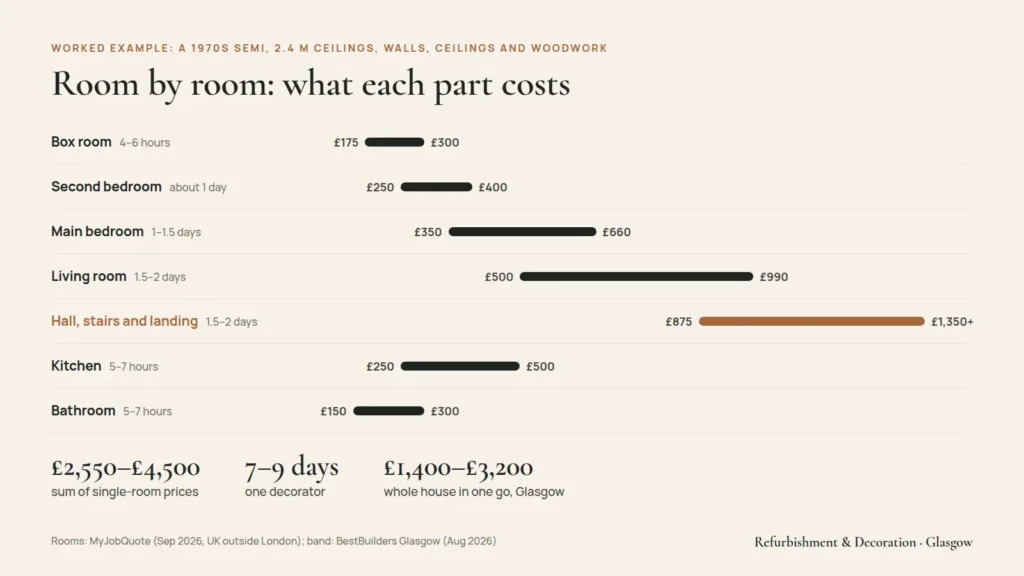
Working by time gives a better total. Seven to nine days at the Glasgow day rate of £150–£290 (BestBuilders, August 2026; Trade2Base Scotland, June 2026) is about £1,050–£2,600 in labour. MyJobQuote’s quantities work out at roughly 55–65 litres of emulsion for a house like this, and its supply prices of £5–£8 a litre for matt put that at about £275–£520, plus satin or gloss for the woodwork and sundries. Add them together and you land at roughly £1,400–£3,300, which matches the Glasgow band.
Worked example: a typical ex-council terraced 3-bed
Many 3-bed homes in Glasgow are ex-council terraced houses or four-in-a-block cottage flats. Rooms are smaller, the living room is usually a single room rather than a through lounge, and the stair is straight and boxed in. Price it with a small living room (£300–£530) instead of a large one and the single-room sum drops to about £2,350–£4,040. If the woodwork is sound and you only want walls and ceilings, the job is often six or seven days, and the total usually sits in the lower half of the £1,400–£3,200 band.
Decorator’s tip: the hall, stairs and landing are often the most expensive single area in a house, at £875–£1,350+ on MyJobQuote’s figures. If budget is tight, this is the area most worth paying a professional for, because the access over the stairwell is awkward and risky with household ladders.
How does a 3-bed tenement flat compare?
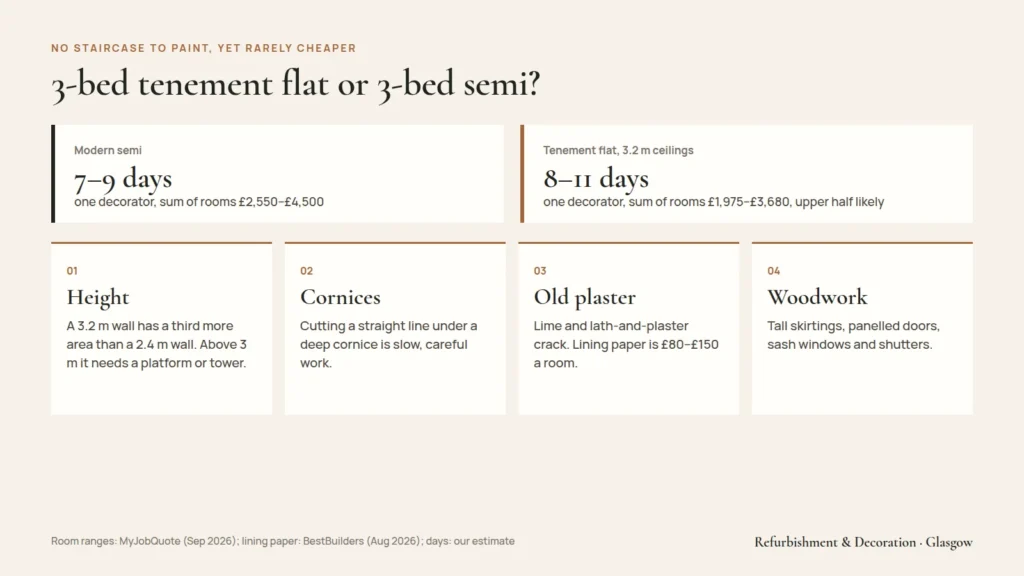
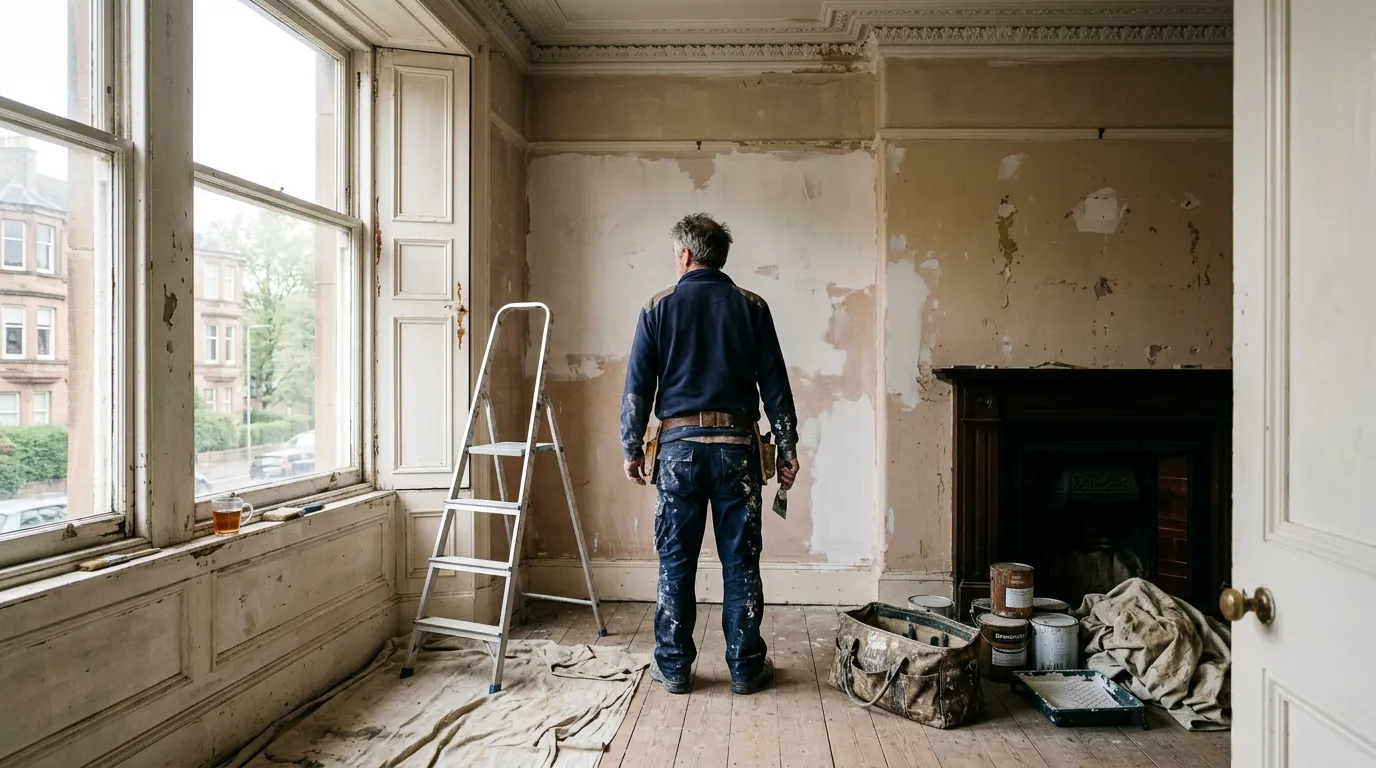
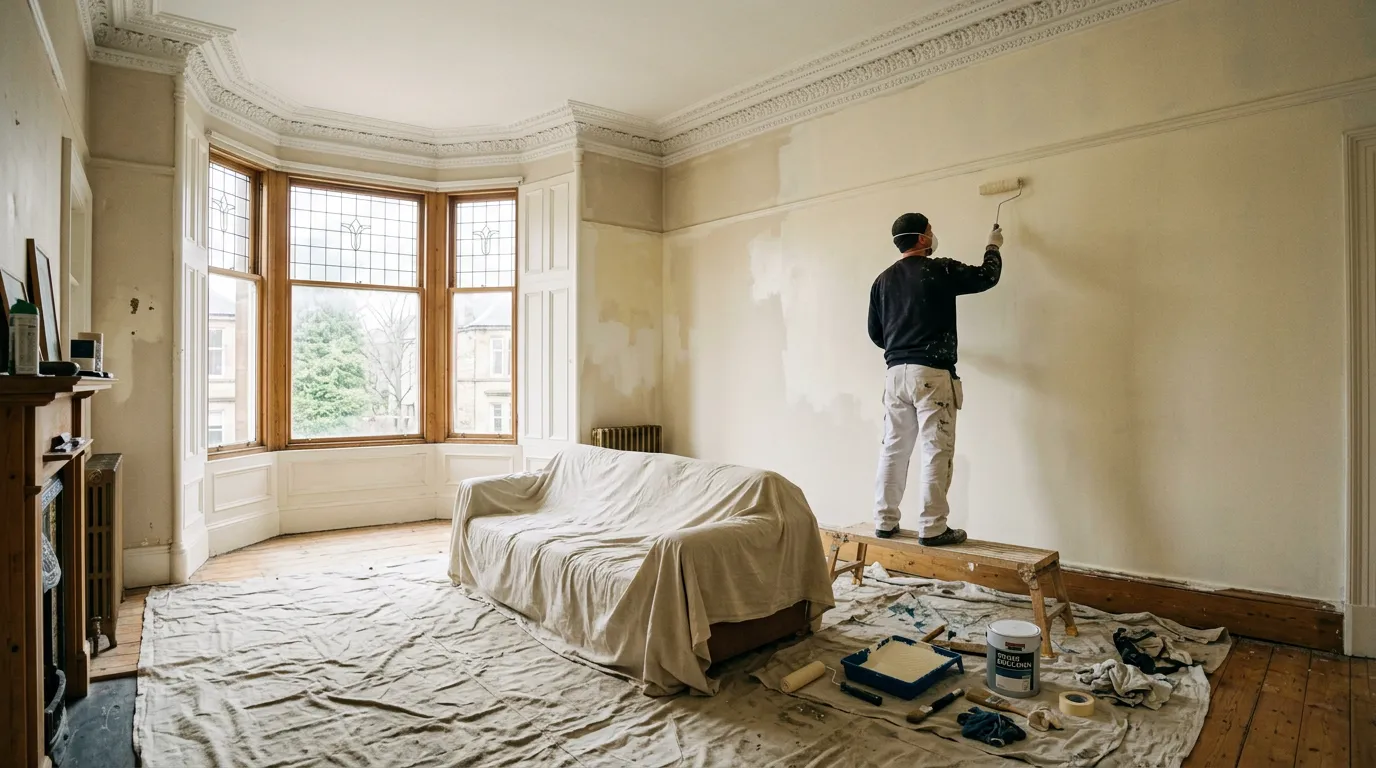
A 3-bed tenement flat has no staircase to paint, so you might expect it to cost less than a house. It rarely does. Picture a Southside or West End flat with a large bay-windowed front room, three bedrooms, a long internal hall, a kitchen and a bathroom. Ceilings are about 3.2 m, and the front room and hall have cornices.
| Room | Market range used |
|---|---|
| Front room (large living room) | £500–£990 |
| Main bedroom (large) | £350–£660 |
| Second bedroom (small) | £250–£400 |
| Third bedroom (box room) | £175–£300 |
| Kitchen | £250–£500 |
| Bathroom | £150–£300 |
| Long hall, priced like a small living room | £300–£530 |
| Sum of single-room prices | £1,975–£3,680 |
Room ranges: MyJobQuote, September 2026. The hall comparison is our own estimate.
In a flat like this, expect the real total to sit in the upper half of that band, for four reasons:
- Height. A 3.2 m wall has a third more area than a 2.4 m wall, so more paint and more rolling. Above about 3 m a decorator needs a platform or small tower rather than steps, and moving it around the room takes time.
- Cornices and ceiling roses. Cutting a straight line under a deep cornice is slow, careful work. If decades of paint have clogged the detail, restoring it is a separate job. See restoring and painting cornicing and ceiling roses.
- Old plaster. Lime plaster and lath-and-plaster crack. Walls with a lot of fine cracking often need lining paper, which BestBuilders (August 2026) puts at £80–£150 a room.
- Woodwork. Tall skirtings, panelled doors, sash windows and sometimes shutters take far longer than modern flat doors and plain skirting.
A 3-bed tenement flat is often eight to eleven days of work for one decorator, against seven to nine for a modern semi. That is our estimate, and the condition of the plaster makes the biggest difference. Our full guide to painting a Glasgow tenement flat covers the detail, including lead paint and sash windows.
What makes the price go up or down?
Two 3-bed houses of the same size can be quoted £1,500 apart. These are the reasons, roughly in order of how much they matter.
Condition of the walls
Preparation is the biggest variable. Walls that need only a light fill and sand are quick. Walls with cracks, old wallpaper or patched plaster are not. BestBuilders (August 2026) puts stripping old paper at £150–£300 a room and lining paper at £80–£150 a room. Strip and line three or four rooms and you have added several hundred pounds before any paint goes on.
Ceilings and woodwork
Check whether a quote covers ceilings and woodwork, because not every price does. Fantastic Services, in an undated 2026 guide, puts a ceiling on its own at £120–£250 and the woodwork in a room at £80–£200. Which? (May 2026, from a survey of nine Trusted Traders) gives £70–£650 for woodwork in one room in good condition and £90–£1,200 in poor condition. A house full of chipped, yellowed gloss on skirtings, doors and frames can add as much as the walls.
Colour changes
Pale to pale is two coats. Dark to light, or a strong colour over white, can take three or more, sometimes with a primer or tinted undercoat first. MyJobQuote notes that paint is usually 10–15% of a standard job, rising to a third or more with premium paint or extra coats. One colour on every ceiling and a single neutral on the walls is the cheapest specification.
Occupied or empty
An empty house is quicker. A full one means moving furniture into the middle of each room, covering it, working around it and putting it back. MyJobQuote’s guide shows a one-day room job stretching to three or four days once wallpaper removal and moving furniture are added. Pets and children at home slow things down as well.
High ceilings and older houses
Victorian and Edwardian villas and tenement flats often have 3–3.6 m ceilings. In homes built before about 1960, some older paint layers may contain lead. Guidance from the British Coatings Federation (notes HS032 and HS034) says not to dry sand or burn off paint that may contain lead, so a careful decorator tests first and uses low-dust methods where needed. That takes longer, and it is worth paying for.
Paint brand
Trade paint is the default in most quotes. If you want a designer brand on every wall, say so at the start. Our comparison of Farrow & Ball and Dulux Trade sets out where the extra cost is worth it.

How long does it take, and should you do it yourself?
For one decorator, a full interior repaint of a typical 3-bed semi is about seven to nine working days, based on MyJobQuote’s room times. Two decorators can finish in about half that. Some older national guides allow up to two weeks, which is closer to what a tenement flat or a house in poor condition needs.
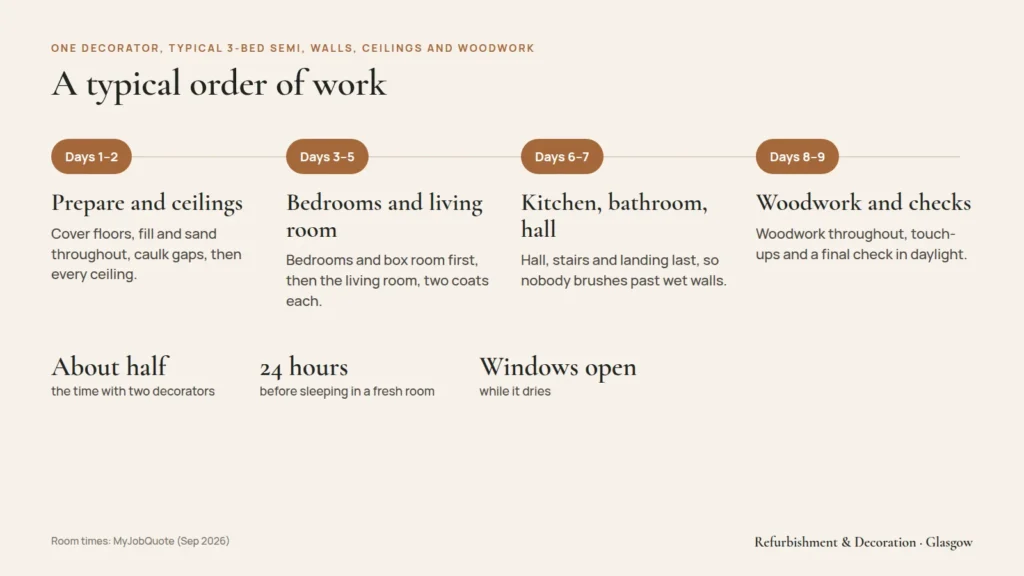
A typical order of work for a semi, one decorator, walls, ceilings and woodwork:
- Days 1–2: cover floors, fill and sand throughout, caulk gaps, then ceilings in every room.
- Days 3–5: walls, bedrooms and box room first, then the living room, two coats each.
- Days 6–7: kitchen and bathroom, then the hall, stairs and landing, usually last so that nobody brushes against wet walls while carrying things through.
- Days 8–9: woodwork throughout, touch-ups and a final check in daylight.
Allow at least 24 hours before sleeping in a freshly painted room, and keep the windows open, as MyJobQuote also advises. If you are planning a repaint over the colder months, see painting a house interior in winter in Scotland.
DIY or decorator: the numbers
Doing it yourself saves most of the labour, which is the larger part of the bill. A 10 litre tub of Dulux Trade Vinyl Matt was £59 at Wickes in October 2026, on offer at £49, and is listed at up to 17 m² a litre. Six tubs cover the walls and ceilings of a typical semi. Add satin or gloss for the woodwork, rollers, brushes, dust sheets, filler, caulk and tape.
| DIY | Decorator | |
|---|---|---|
| Cost, typical 3-bed semi | Materials only, roughly £400–£700 (our estimate) | £1,400–£3,200 (BestBuilders Glasgow, Aug 2026) |
| Time | Several weekends, often longer | About 7–9 working days for one person |
| Hall, stairs and landing | Hard and risky with household ladders | Platforms and stair ladders, priced in |
| Finish | Depends on your preparation and cutting in | Straight lines, even coats, filled cracks |
| Disruption | Spread over weeks | Concentrated into one or two weeks |
The honest answer is that DIY works well for bedrooms in sound condition, especially if you are keeping a similar colour. It works less well for the hall and stairs, high tenement ceilings, cracked plaster and woodwork with old gloss, which is where most of a professional’s time goes anyway.

How to cut the cost without cutting corners
- Clear each room yourself. Empty shelves, take down curtains and pictures, move small furniture out.
- Keep to a similar colour on walls, and one white for all ceilings.
- Leave sound woodwork alone and do it another year.
- Do the whole house in one go rather than one room at a time over months.
- Split the job. Pay a decorator for the hall, stairs and ceilings, and paint the bedrooms yourself.
- Be flexible on dates. Interior work in winter can be easier to book, because exterior work stops.
Do not save money on preparation, on lining paper over cracked old plaster, or on safe handling of old paint.

How do you compare quotes for a whole house?
On a whole-house job, quotes can vary by more than £1,000 for what sounds like the same work. Here is a worked example of two quotes for the same 3-bed semi. They are illustrations, not real quotes.
| Quote A: £1,650 | Quote B: £2,750 | |
|---|---|---|
| Walls | Two coats | Two coats |
| Ceilings | One coat | Two coats |
| Woodwork | Not mentioned | Light sand, one coat of satin, doors both sides |
| Preparation | “Minor filling” | Fill, sand and caulk throughout, cracks raked out |
| Paint | Not stated | Named trade emulsion and satin |
| VAT | Not stated | Not VAT registered, none charged |
| Furniture | Customer to clear | Moved and covered by decorator |
Quote A looks £1,100 cheaper. Add woodwork, a second ceiling coat and VAT if it applies, and the gap mostly disappears. This is how the Mumsnet stories of a £1,500 quote that ended up at £3,000 tend to happen.
When you have quotes in front of you, check each one for:
- Every room listed, including the hall, stairs and landing.
- Walls, ceilings, woodwork, doors and radiators, each stated as in or out.
- The preparation, written down rather than assumed.
- The paint, by brand and finish, and the number of coats.
- Whether VAT is included. Many sole traders are not registered; registered firms add 20%.
- A fixed price for the scope, rather than an open day rate.
- Payment terms, any deposit, and a likely start and finish date.
- Proof of public liability insurance.
For how day rates feed into a whole-house price, see painter and decorator day rates in Glasgow. If you are a landlord repainting between tenants, our end-of-tenancy painting guide covers turnaround and deposits.

Getting a price for your home
The figures in this guide show what the market charges. Your price depends on the number of rooms, their height, the state of the walls and woodwork, and the colours you choose. We give a guide price over the phone once we know the basics, and a fixed written quote after a free visit, listing every room, the preparation, the paint and the number of coats.
We work across Glasgow and Central Scotland, mainly on interior painting and wallpaper hanging. Call 07777 780557 or book a free visit.
Questions people ask
Does a whole-house painting price include ceilings and woodwork?
Not always, so check. Some quotes cover walls only. Fantastic Services, in an undated 2026 guide, prices a ceiling on its own at £120–£250 and the woodwork in a room at £80–£200, so leaving them out can make one quote look far cheaper than another. A good written quote lists walls, ceilings, skirtings, doors, frames and radiators as in or out.
How much paint do I need for a 3-bedroom house?
For two coats on the walls and ceilings of a typical 3-bed semi, roughly 55–65 litres of matt emulsion, based on MyJobQuote's September 2026 room quantities. That is about six 10 litre tubs of trade matt. Woodwork needs a few litres of satin or gloss on top. High tenement ceilings, strong colour changes and new plaster all increase the amount.
Is it cheaper to paint a house when it is empty?
Usually, yes. In an empty house the decorator does not have to move, cover and replace furniture in every room, and can work from room to room without waiting. MyJobQuote's guide shows a one-day room job stretching to three or four days once furniture moving and wallpaper removal are added. Clearing small items yourself saves time even if you stay in.
Can we live in the house while it is being painted?
Yes, most people do. A decorator will usually work through the house a few rooms at a time so you always have somewhere to sleep and cook. Keep windows open, and allow at least 24 hours before sleeping in a freshly painted room, as MyJobQuote advises. The hall and stairs are often done last so wet walls are not brushed past.
How much does it cost to paint the outside of a 3-bed house?
BestBuilders' Glasgow page (August 2026) gives £1,650–£4,150 for a Glasgow house exterior. MyJobQuote's UK figures (October 2026) give £1,500–£3,100 for a terraced house and £2,600–£5,700 for a 3-bed semi. Harled or rough-cast walls take longer than smooth render, and scaffolding is usually priced on top.
Can a decorator quote for a whole house over the phone?
A decorator can give a guide price over the phone if you describe the rooms, ceiling heights and condition. A fixed price needs a visit, because cracked plaster, old gloss, tall ceilings and the hall and stairs all change the time a job takes. We give a guide price on the phone and a fixed written quote after a free visit.

Painters and decorators working across Glasgow & Central Scotland, specialising in interior painting and wallpaper hanging. Prices in our guides are reviewed every year.
 Painter & Decorator Day Rates in Glasgow Explained
 Painting & Decorating Prices in Glasgow: the 2026 Guide