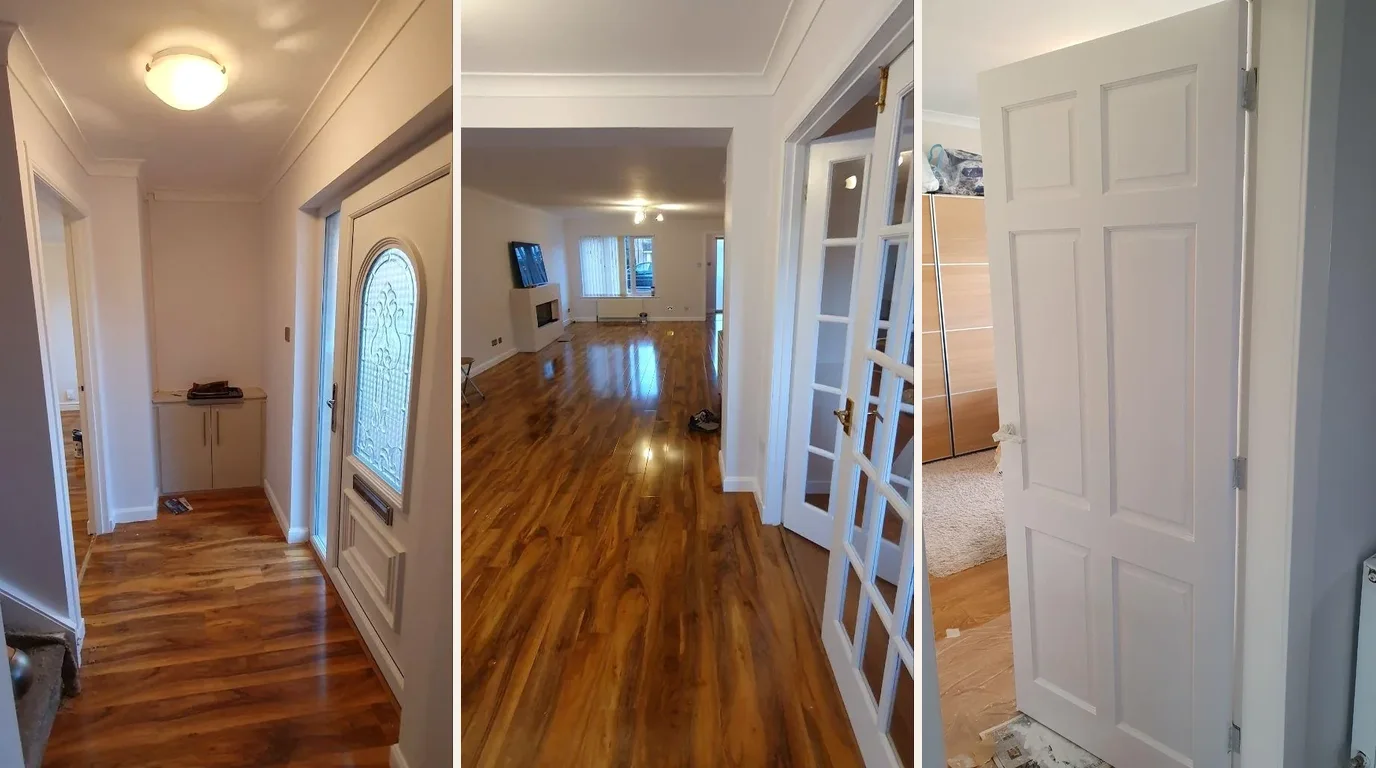
In Scotland a landlord can only deduct repainting from a deposit for damage beyond fair wear and tear, backed by check-in and check-out evidence. Tribunals cut claims after long tenancies. A two-bed Glasgow flat repaint costs roughly £1,500–£2,850 before the hall, using MyJobQuote's September 2026 room prices, and takes one decorator six to eight days.
When a tenant hands back the keys, the walls tell you how the tenancy went. Some flats need a light touch-up; others need a full repaint before the next viewing. For Glasgow landlords the questions are the same each time: who pays, how fast can it be done, and what finish will survive the next tenancy. This guide covers the Scottish deposit rules as they apply to decoration, what the tribunal has actually said about repainting, the tenant decorating right coming under the Housing (Scotland) Act 2025, and how to plan a quick, durable turnaround.
Can a landlord deduct repainting costs from a deposit in Scotland?
Only for damage beyond fair wear and tear, and only with evidence. The deposit is not a fund for routine redecoration.
The deposit rules in brief
According to the Scottish Government’s mygov.scot guidance:
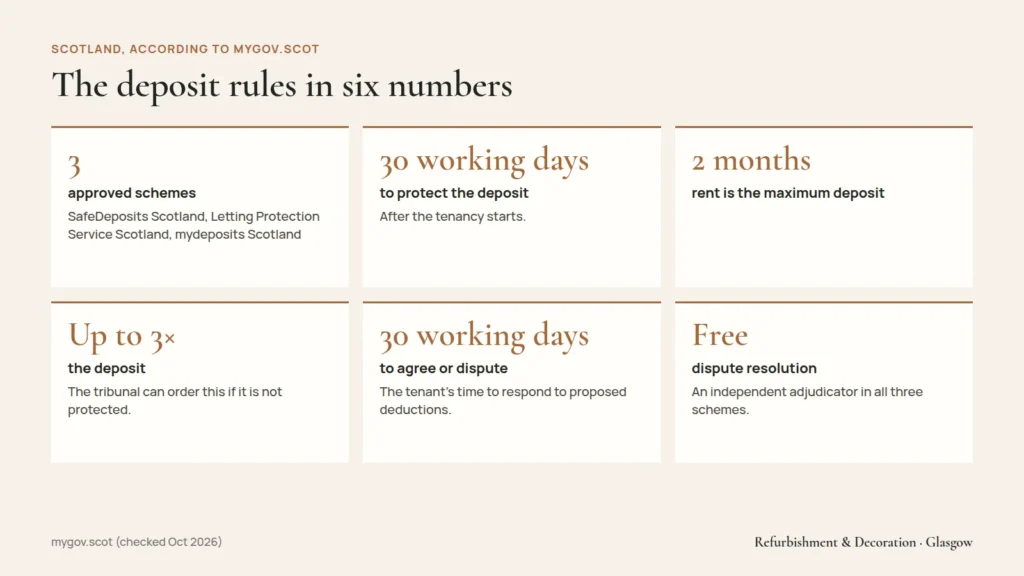
- A deposit must be lodged with one of three government-approved schemes: SafeDeposits Scotland, Letting Protection Service Scotland or mydeposits Scotland.
- It must be protected within 30 working days of the tenancy starting, and the tenant must be given written details of the deposit.
- A deposit cannot be more than two months’ rent.
- If a deposit is not protected, the First-tier Tribunal for Scotland can order the landlord to pay the tenant up to three times the deposit.
- At the end of the tenancy, the landlord tells the scheme about any proposed deductions. The tenant then has 30 working days to say whether they agree.
- If they disagree, all three schemes offer a free dispute resolution service. An independent adjudicator looks at both sides’ evidence. If the landlord cannot show why a deduction is justified, the tenant gets the full deposit back.
These rules change from time to time, so check the current position on mygov.scot or with your scheme before acting.
What the tribunal has said about repainting
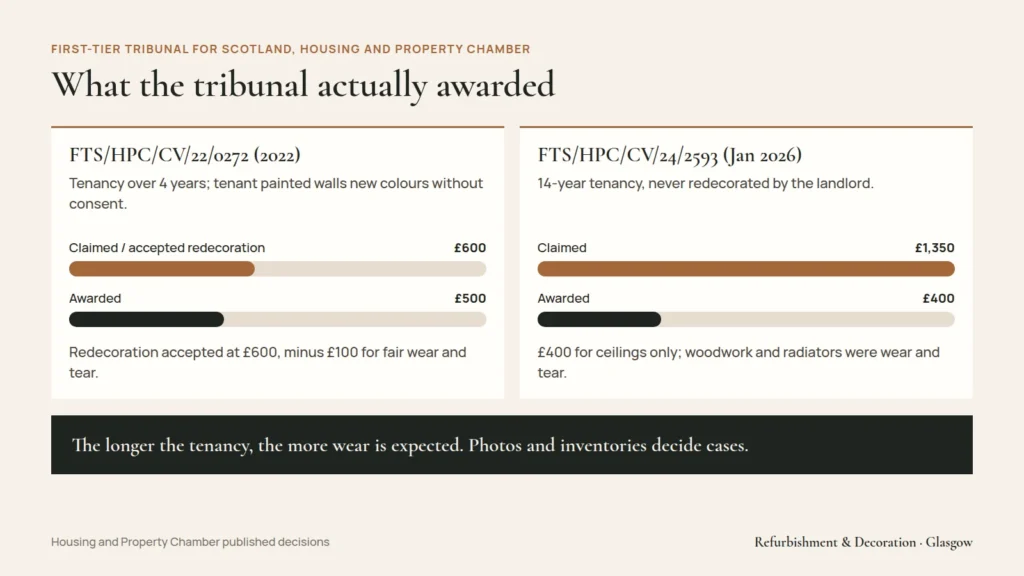
Disputes that go beyond the scheme can end up at the First-tier Tribunal for Scotland (Housing and Property Chamber). Its published decisions show how decoration claims are treated in practice. Two examples:
- FTS/HPC/CV/22/0272 (2022). A tenant had painted a wall in each of four bedrooms a different colour, and the living room, without the landlord’s consent, which the tenancy agreement prohibited. The tribunal accepted redecoration costs of £600 but deducted £100 for fair wear and tear “in view of the fact that the tenancy had lasted for over 4 years”. Check-in and check-out reports were central to the claim.
- FTS/HPC/CV/24/2593 (decided January 2026). After a 14-year tenancy in which the landlord had never redecorated, the tenant had painted rooms in dark colours, then paid a decorator £900 to repaint the walls white before leaving. The landlord claimed £1,350 for a further full redecoration. The tribunal found the woodwork and radiators would have needed repainting anyway because of fair wear and tear over 14 years, and awarded only £400 for the ceilings, which photographs showed had been marked by the tenant’s redecorating.
The lessons are consistent. Normal ageing of décor is the landlord’s cost. The longer the tenancy, the more wear is expected. A landlord who claims a full redecoration after a long tenancy is likely to see the claim cut back, because otherwise the landlord ends up better off than at the start (“betterment”). And photographs and inventories decide cases.
What counts as fair wear and tear on decoration?
Fair wear and tear is the natural deterioration of something used normally over time; the tribunal decision above puts it in exactly those words. Adjudicators weigh the age and condition of the décor at the start, how long the tenancy lasted, how many people lived there, and which rooms are affected. Halls, stairs and landings are expected to wear faster than a spare bedroom.
| Usually fair wear and tear | Often treated as damage |
|---|---|
| Faded or slightly dulled paint after a few years | Walls painted a new colour without consent |
| Light scuffs along hall walls and behind doors | Large gouges, holes or crayon and pen marks |
| A small number of picture-hook holes, where allowed | Dozens of screw holes or wall plugs left in |
| Minor marks around light switches | Burn marks, heavy grease, or nicotine staining through the paint |
| Hairline cracks from the building settling | Paint splashes on ceilings, carpets or woodwork from tenant DIY |
| Worn gloss on skirtings in a long tenancy | Pet damage to doors, facings and skirtings |
Even where there is damage, the claim is usually limited to a fair share of the cost, not a new-for-old repaint. If the walls were last painted five years ago and would have needed doing soon anyway, expect any award to reflect that.
The evidence that wins disputes
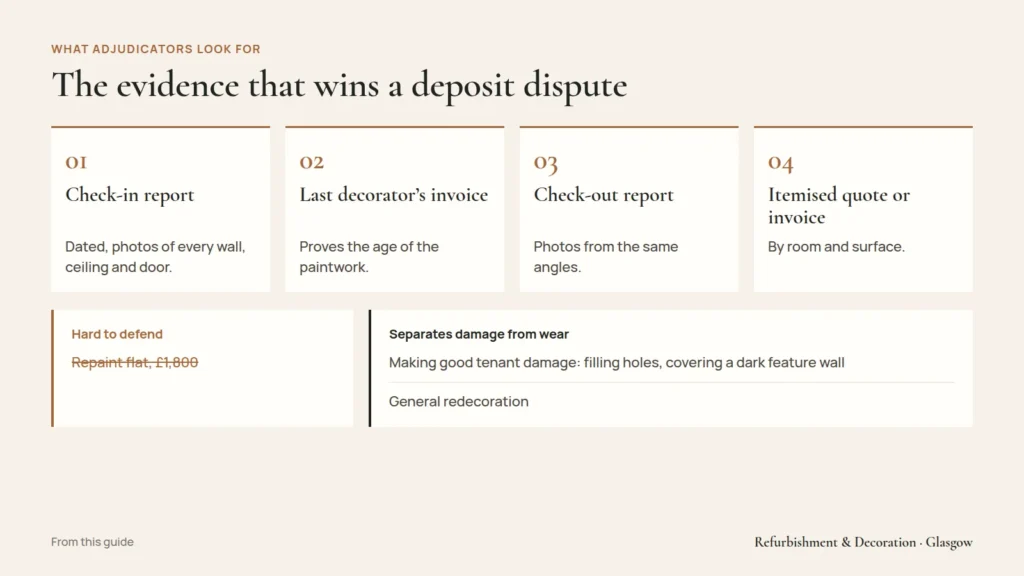
- A dated check-in report with photographs of every wall, ceiling and door, stating whether the décor was freshly painted.
- The decorator’s invoice from the last redecoration, so the age of the paintwork can be proved.
- A matching check-out report with photographs taken from the same angles.
- A written quote or invoice for the remedial work, broken down by room and surface, so the adjudicator can see what relates to damage and what is general refreshing.
Decorator’s tip: Ask your decorator for an itemised invoice that separates “making good tenant damage” (filling holes, covering a dark feature wall) from “general redecoration”. A single line saying “repaint flat, £1,800” is very hard to defend in a deposit dispute.
Can tenants decorate? The Housing (Scotland) Act 2025
At the moment, whether a private tenant can paint depends on the tenancy agreement. Many agreements forbid changes to the décor without the landlord’s written consent, and both tribunal cases above turned partly on clauses like that.
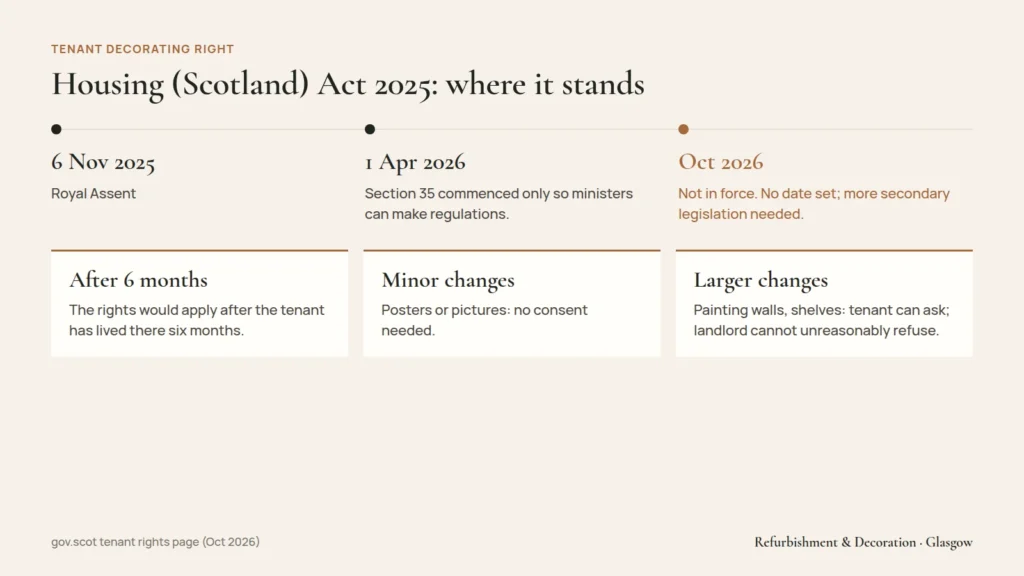
That is set to change. The Housing (Scotland) Act 2025 received Royal Assent on 6 November 2025. Among other things, it gives private tenants greater rights to personalise and decorate their home. According to the Scottish Government’s tenant rights page:
- The rights would apply after the tenant has lived in the property for six months.
- Minor changes, such as putting up posters or pictures, would not need the landlord’s consent.
- Larger changes, such as painting walls or putting up shelves, could be requested, and the landlord could not unreasonably refuse.
- The exact list of changes in each category will be set out in later regulations.
It is not in force yet. The relevant section (section 35) was commenced on 1 April 2026 only so that ministers can make the regulations. As of October 2026, the Scottish Government says a date for the change coming into force has not been set and further secondary legislation is required. Commentators disagree on details such as what happens if a landlord does not reply to a request, so do not rely on second-hand summaries. Check the current position on gov.scot, or with your letting agent or solicitor, before acting.
Once the right is in force, landlords who prefer to control the finish may find it easier to agree a palette with tenants in advance, or to offer to have a professional decorator carry out an agreed colour change, than to argue about it at check-out.
How often should a rental be redecorated?
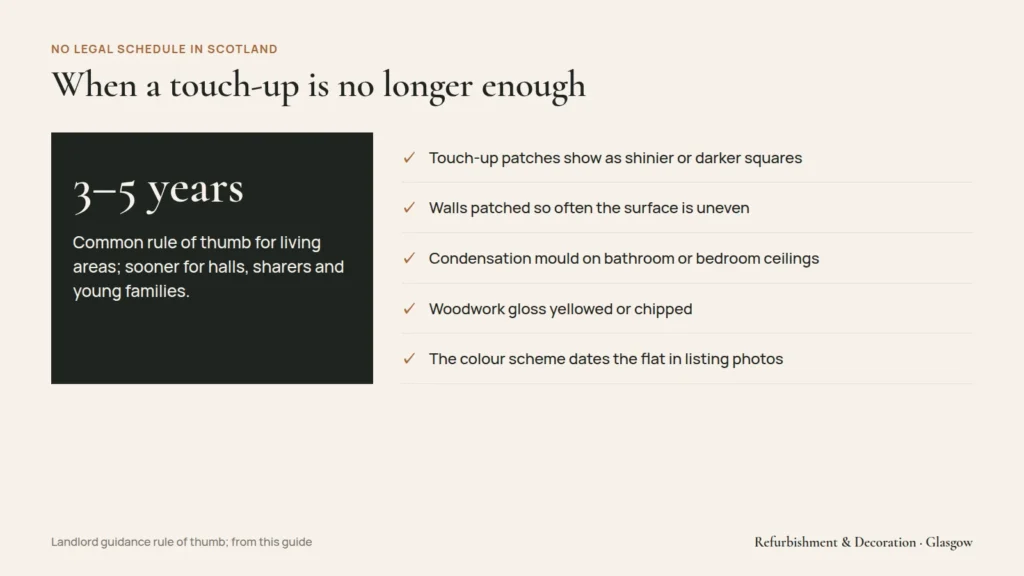
There is no legal schedule for redecorating a let property in Scotland. A common rule of thumb in landlord guidance is every three to five years for living areas, sooner for halls and for flats with sharers or families with young children. Treat that as a planning guide, not a rule.
In practice, the best time is between tenancies, when the flat is empty and the work can be done in days rather than squeezed round someone’s life. A repaint every second or third changeover keeps the property letting well and means decoration is rarely old enough to cause a dispute about who caused what.
Signs a flat needs a full repaint, not a touch-up
- Touch-up patches show as shinier or darker squares, which happens when paint has faded or a different batch is used.
- Walls have been patched so many times that the surface is uneven.
- Condensation mould has marked bathroom or bedroom ceilings.
- Woodwork gloss has yellowed or chipped along skirtings and door edges.
- The colour scheme dates the flat in listing photographs.
Which paints and finishes last best in a rental?
The cheapest paint is rarely the cheapest choice in a rental. Contract matt emulsion is inexpensive and easy to touch up, but it marks easily and does not wipe clean. Durable, scrubbable matt finishes cost more per tin, but they survive a tenancy far better.
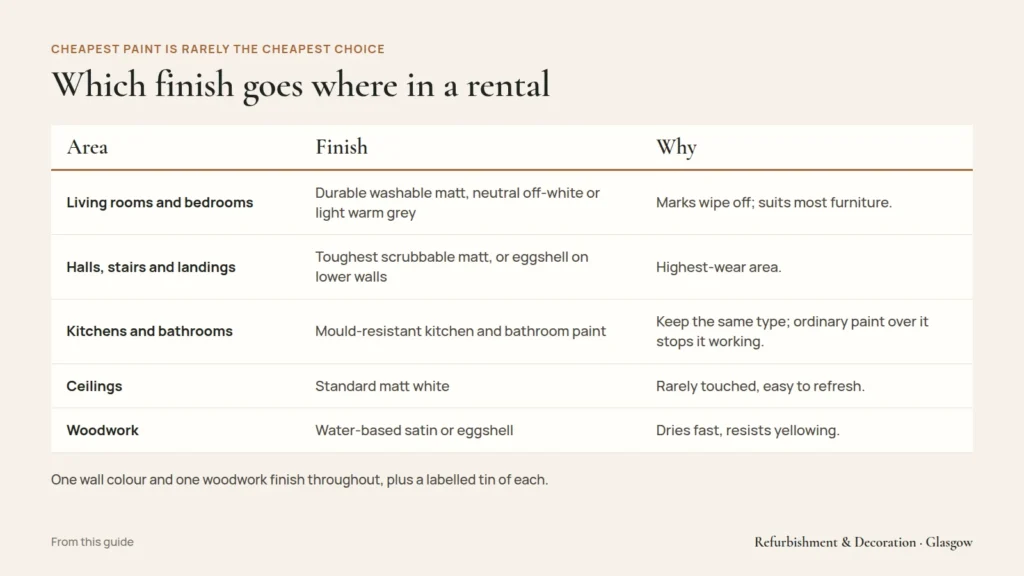
| Area | What we recommend | Why |
|---|---|---|
| Living rooms and bedrooms | A durable, washable matt in a neutral off-white or light warm grey | Marks can be wiped off; neutral colours suit most tenants’ furniture. |
| Halls, stairs and landings | The toughest scrubbable matt you can get, or an eggshell on lower walls | The highest-wear area in any flat. |
| Kitchens and bathrooms | A kitchen and bathroom paint with mould resistance | Condensation is common in Glasgow flats. Anti-mould paint stops working if ordinary paint goes over it, so keep using the same type. |
| Ceilings | Standard matt white | Rarely touched; easy to refresh. |
| Woodwork | Water-based satin or eggshell | Dries fast for quick turnarounds and resists yellowing. |
Keep it simple and record everything
Using one wall colour throughout, and one woodwork finish, is the single most useful thing a landlord can do. Touch-ups become quick, a part-used tin is never wasted, and future quotes are easier. Keep a note of the brand, colour name, code and finish for every room, along with a labelled tin of each. Store the note with your check-in paperwork.
If a property has recurring condensation mould, painting is not the fix. The cause needs dealing with first: ventilation, extractor fans and heating. Our guide to damp, condensation and mould covers diagnosis and the right products.
How quickly can a flat be repainted between tenancies, and what does it cost?
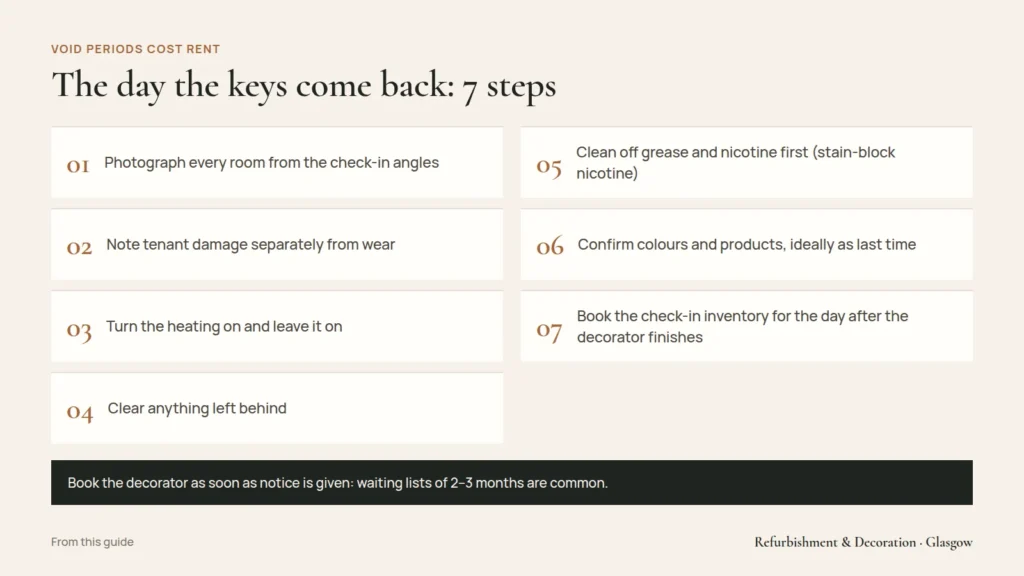
Void periods cost rent, so speed matters. The usual sequence is check-out inspection, cleaning of anything that will affect paint (grease in kitchens, nicotine), repairs and joinery, then decorating, then a final clean and the check-in inventory. Book the decorator as soon as notice is given; waiting lists of two to three months are common in the trade.
Checklist for the day the keys come back
- Photograph every room from the same angles as the check-in report, before anything is moved or cleaned.
- Note tenant damage separately from general wear, room by room.
- Turn the heating on and leave it on. An empty flat with cold walls slows drying, especially in winter.
- Clear anything left behind, so the decorator is not paying for time spent moving boxes.
- Get grease and nicotine cleaned off first; paint will not stick well to either, and nicotine stains bleed through emulsion unless sealed with a stain-blocking primer.
- Confirm the colour and product list with your decorator, ideally the same as last time.
- Book the check-in inventory for the day after the decorator finishes, so the report records fresh paintwork.
Market prices
| Item | Market range | Typical time | Source |
|---|---|---|---|
| Decorator day rate, Glasgow / Scotland | £150–£290 a day | n/a | BestBuilders Glasgow (Aug 2026); Trade2Base Scotland (Jun 2026) |
| Small bedroom repaint | £250–£400 | About 1 day | MyJobQuote (Sep 2026) |
| Large bedroom repaint | £350–£660 | 1–1.5 days | MyJobQuote (Sep 2026) |
| Living room | £300–£530 small / £500–£990 large | Up to 1.5–2 days for a large room | MyJobQuote (Sep 2026) |
| Kitchen | £250–£500 | About 1 day | MyJobQuote (Sep 2026) |
| Bathroom | £150–£300 | Under 1 day | MyJobQuote (Sep 2026) |
| Average room, Glasgow, materials included | £350–£600 | 1–2 days | BestBuilders Glasgow (Aug 2026) |
| 3-bed interior repaint, Glasgow | £1,400–£3,200 | About 10 days to 2 weeks | BestBuilders Glasgow (Aug 2026) |
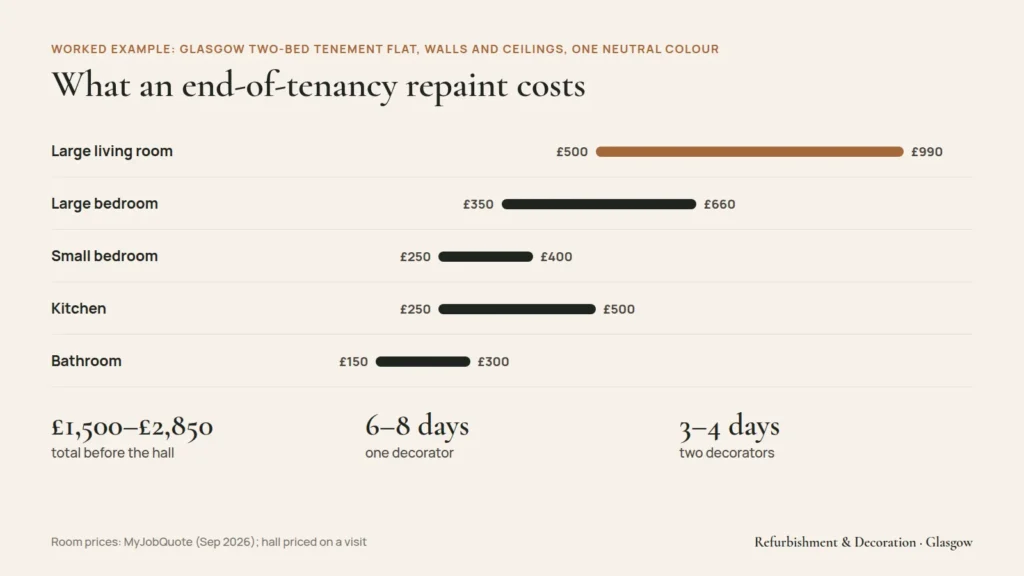
Worked example: a typical two-bedroom tenement flat
Here is an illustration using the market ranges above, for a typical Glasgow two-bedroom tenement flat with a large living room, one large and one small bedroom, a kitchen and a bathroom, walls and ceilings repainted in one neutral colour:
- Large living room: £500–£990
- Large bedroom: £350–£660
- Small bedroom: £250–£400
- Kitchen: £250–£500
- Bathroom: £150–£300
That comes to roughly £1,500–£2,850 before the hall, which varies so much in size between flats that it needs pricing on a visit. One decorator would take around six to eight working days in total; two decorators can bring the void period down to three or four days. High tenement ceilings, a lot of tenant damage to fill, or covering dark colours (which can need an extra coat) all push the figure towards the top of the range. A light refresh of a well-kept flat sits at the bottom.
For a fuller picture of prices, see our Glasgow painting and decorating prices guide. For planning, timings and choosing a decorator, read our guide to redecorating in Glasgow. If the void falls in winter, our article on painting in winter in Scotland explains why the heating must go back on before the decorator arrives.
Getting a price for your property
A good end-of-tenancy repaint is quick, uses hard-wearing finishes, and comes with an itemised invoice that stands up if a deposit is disputed. Tell us your void dates and how keys will be handled when you call, and we will plan the work around them.
We give a guide price on the phone and a fixed written quote after a free visit. Call 07777 780557, or book a free visit online. See our painting service for landlords and our interior painting service across Glasgow and Central Scotland.
Questions people ask
Can my landlord charge me for repainting when I move out?
Only for damage beyond fair wear and tear, such as walls painted a new colour without consent, large holes or heavy marks. Normal fading and light scuffs are the landlord's cost. If you disagree with a deduction, all three Scottish deposit schemes offer free dispute resolution, and the landlord must show evidence to justify the claim.
How long does paintwork last in a rented flat?
There is no fixed legal lifespan. Adjudicators weigh the age of the décor at check-in, the length of the tenancy, the number of occupants and the room. In one Scottish tribunal case, woodwork and radiators were found to need repainting anyway after a 14-year tenancy. Many landlords plan to repaint living areas every three to five years.
Which deposit schemes are approved in Scotland?
There are three government-approved schemes: SafeDeposits Scotland, Letting Protection Service Scotland and mydeposits Scotland. A landlord must lodge the deposit within 30 working days of the tenancy starting, and it cannot exceed two months' rent. If it is not protected, the tribunal can order the landlord to pay up to three times the deposit.
Can I paint my rented flat in Scotland?
For now, it depends on your tenancy agreement, and many require the landlord's written consent. The Housing (Scotland) Act 2025 will let private tenants ask to make larger changes such as painting walls after six months, and landlords will not be able to refuse unreasonably. As of October 2026 this is not in force; check gov.scot for the current position.
What is the best paint for a rental property?
A durable, washable matt emulsion in one neutral colour throughout, a tougher scrubbable finish in halls, mould-resistant kitchen and bathroom paint, and water-based satin or eggshell on woodwork. Using one colour and keeping a labelled tin makes touch-ups between tenancies quick, and it avoids patchy repairs that show in listing photographs.
How long does an end-of-tenancy repaint take?
It depends on the size of the flat and the damage. Using MyJobQuote's September 2026 timings, a typical two-bedroom flat takes one decorator around six to eight working days for walls and ceilings, or three to four days with two decorators. Book as soon as notice is given, because good decorators often have waiting lists of two to three months.

Painters and decorators working across Glasgow & Central Scotland, specialising in interior painting and wallpaper hanging. Prices in our guides are reviewed every year.
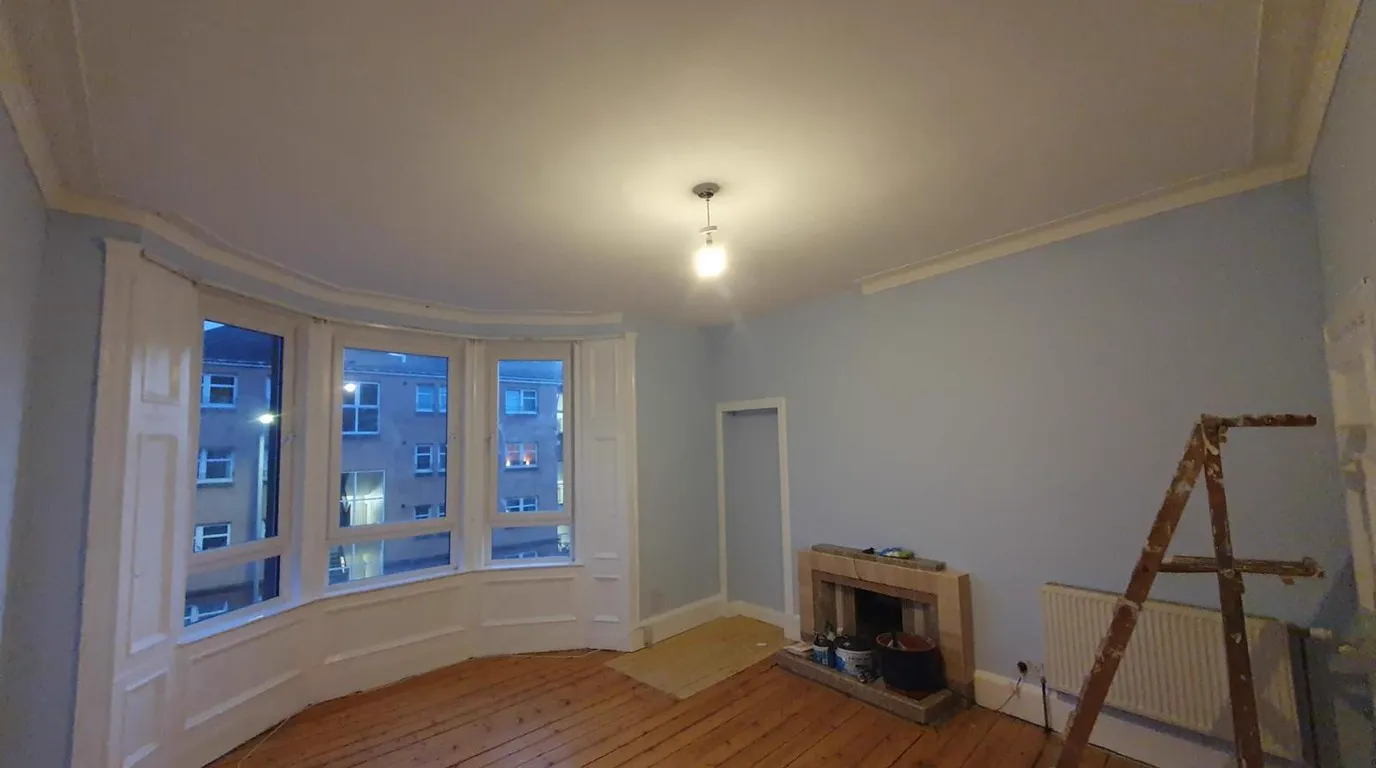 How Long Does It Take to Paint a House? Room-by-Room Timings
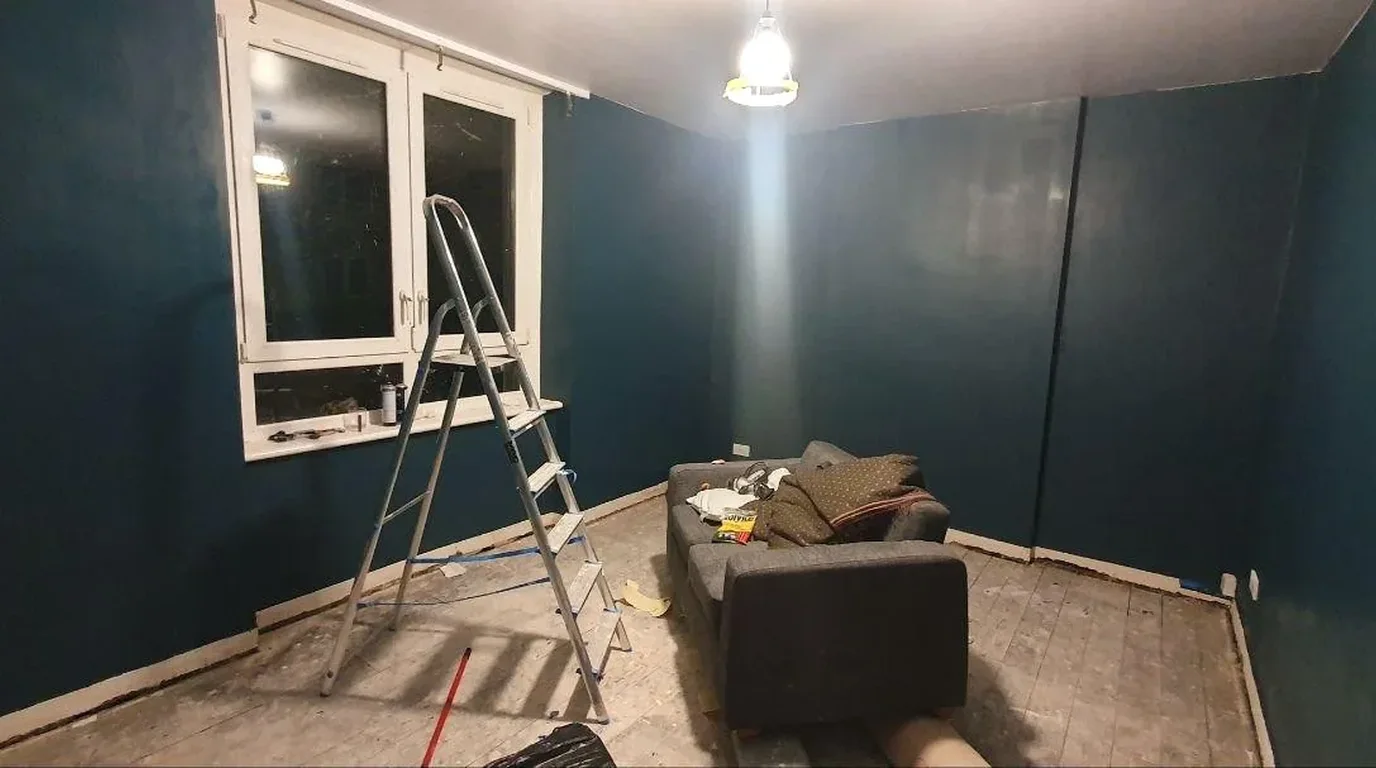 Can You Paint a House Interior in Winter in Scotland?
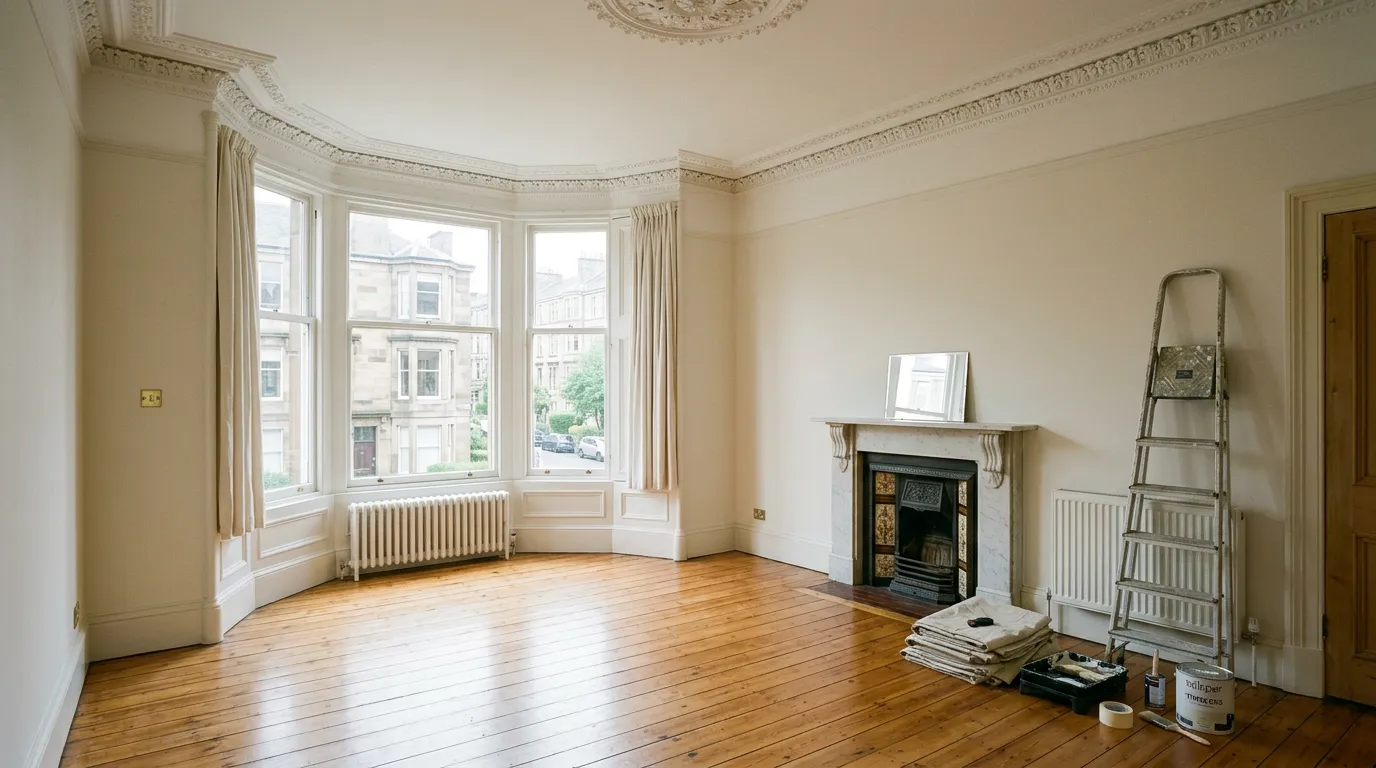 Redecorating in Glasgow: Planning, Timings & Choosing a Decorator