Having a feature wall papered costs about £120–£250 in labour (MyJobQuote £120–£180, Oct 2026; BestBuilders £140–£250, Aug 2026), plus two to five rolls of paper at typically £25–£100 each. A typical 3.5 m wall behind a bed comes to roughly £195–£550 in total on a wall that is ready to paper.
Papering one wall is the cheapest way to get a bold paper into a room, and it suits Glasgow homes well, from a tenement chimney breast to the wall behind the bed in a new-build flat. It only works if the wall, the paper and the rest of the room are chosen together. This guide covers what a feature wall costs, which wall to pick, which papers work, and the mistakes we see most often.
How much does a wallpaper feature wall cost?
R&D’s own prices are not published yet. The market figure for hanging a feature wall is £120–£250 in labour. MyJobQuote (October 2026) gives £120–£180, taking 4–6 hours on a wall that is ready to paper. BestBuilders (August 2026) gives £140–£250 when the wall is done alongside a room repaint. Some other price guides quote higher figures, but we could not verify them, so we have left them out.
The paper is extra, and on a feature wall it is often the bigger cost, because people choose more expensive papers for a single wall. BestBuilders puts the papers people typically choose at £25–£100 a roll. MyJobQuote lists paste-the-wall papers at £15–£50.
Worked example: a feature wall behind a bed
A typical wall in a modern Glasgow flat: 3.5 m wide, 2.4 m high (about 8.4 m²), with a patterned paper on a 53 cm repeat. It needs 7 lengths. With the pattern allowance, each roll gives three lengths, so 3 rolls.
| Item | Market range | Based on |
|---|---|---|
| Hanging the wall | £120–£250 | MyJobQuote (Oct 2026); BestBuilders (Aug 2026) |
| Paper, 3 rolls | £75–£300 | £25–£100 a roll, BestBuilders (Aug 2026) |
| Stripping old paper, if needed | about £42–£101 | £5–£12 a m², BestBuilders (Aug 2026) |
| Lining paper, if needed | about £59–£118 | £7–£14 a m², BestBuilders (Aug 2026) |
| Total, ready wall | £195–£550 | Hanging plus paper |

How many rolls does one wall need?
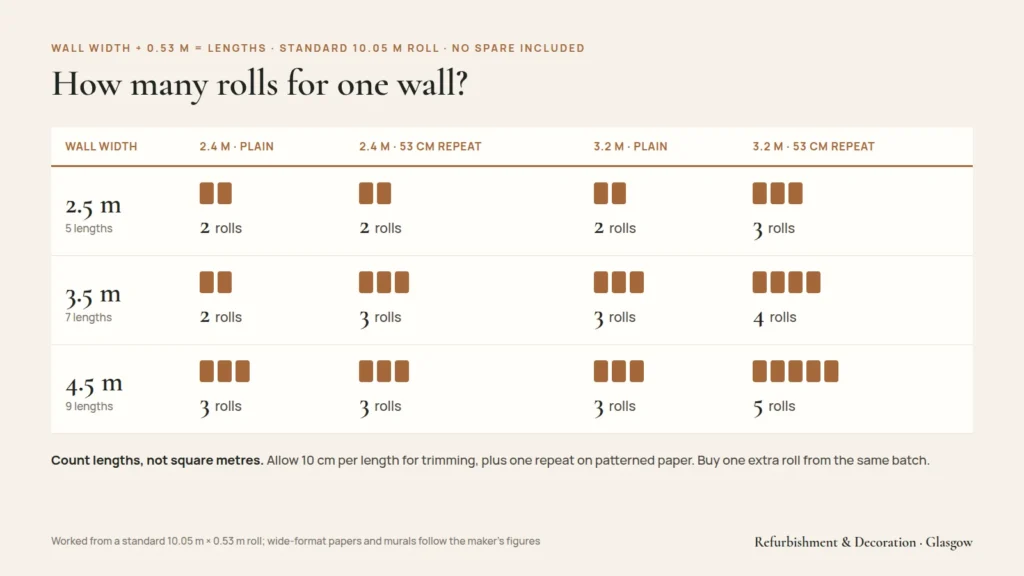
Count lengths, not square metres. Divide the wall’s width by 0.53 m (the width of a standard roll) and round up. Then work out how many full-height lengths each 10.05 m roll gives, allowing 10 cm for trimming and one pattern repeat if the paper has one. This table gives typical answers, with no spare roll included.
| Wall width | Lengths | 2.4 m high, plain | 2.4 m high, 53 cm repeat | 3.2 m high, plain | 3.2 m high, 53 cm repeat |
|---|---|---|---|---|---|
| 2.5 m | 5 | 2 rolls | 2 rolls | 2 rolls | 3 rolls |
| 3.5 m | 7 | 2 rolls | 3 rolls | 3 rolls | 4 rolls |
| 4.5 m | 9 | 3 rolls | 3 rolls | 3 rolls | 5 rolls |
Wide-format papers and murals are sold differently, so follow the maker’s coverage figures for those.
A tenement wall costs more, because the drops are longer and a patterned paper may give only two lengths per roll. A tenement chimney breast with alcoves, 4.5 m wide and 3.2 m high, can need 5 rolls of a large-repeat paper, and the cutting round the breast puts the labour at the top of the range. Our wallpaper hanging cost guide works through that example in full, alongside whole-room prices.
Decorator’s tip: If the room is being painted anyway, have the feature wall papered on the same visit. The decorator is already set up, the walls are being prepared, and it costs less than booking it as a separate job.
Which wall should be the feature wall?
The right wall is the one your eye already goes to. A feature wall emphasises a focal point; it rarely creates one from nothing. Stand in the doorway and notice where you look first.
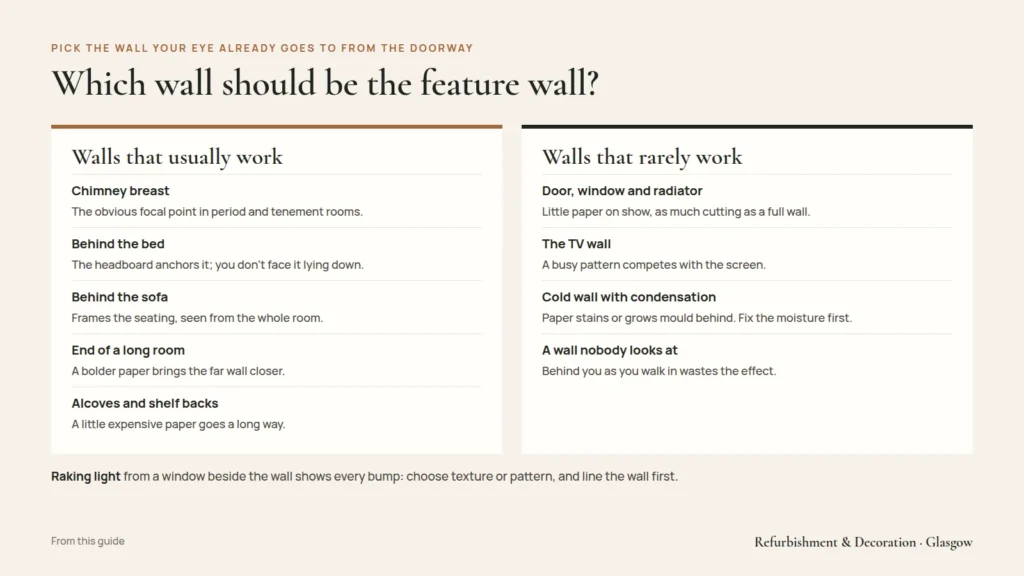
Walls that usually work
- The chimney breast. In Victorian and Edwardian rooms, and most tenement front rooms, this is the obvious choice. You can paper the breast alone and paint the alcoves, or paper the backs of the alcoves and paint the breast. Both work. Papering everything on that wall gives the boldest result.
- The wall behind the bed. The headboard anchors the pattern, and you do not face it when lying down, so a strong design is less tiring.
- The wall behind the sofa. It frames the seating and is seen from the rest of the room.
- The end wall of a long, narrow room. A darker or bolder paper on the far wall seems to bring it closer, which makes a long tenement hall or a galley kitchen feel better proportioned.
- Alcoves and the backs of shelving. A small amount of an expensive paper goes a long way here.
- The ceiling. In a tall tenement room, a papered ceiling can work well, but it is slow, awkward work and should be left to a professional.
Walls that rarely work
- A wall broken up by a door, window and radiator. Very little paper ends up on show, and the cutting takes as long as a full wall.
- The TV wall. A busy pattern behind a screen competes with it. A plain, darker paint usually does the job better.
- A cold outside wall prone to condensation. North-facing gable walls in some flats run with condensation in winter, and paper on them can stain or grow mould behind. Sort the moisture first; our guide to damp, condensation and mould explains how.
- A wall nobody looks at. Papering the wall behind you as you enter wastes the effect.
Check the light on the wall
Light shining along a wall from a window right next to it (raking light) shows every joint and bump in the plaster. Light falling straight onto a wall opposite a window is much kinder. If your chosen wall gets raking light, choose a paper with texture or pattern, and line the wall first.
Which wallpapers work best on a feature wall?
Because it is one wall, you can afford a paper you would never use on all four. The choice comes down to scale, type and colour.
Pattern scale
- Large-scale patterns suit big walls. A tenement wall over 3 m high can carry a large botanical or a mural that would overwhelm a box room.
- Small rooms can still take a bold paper. A strong pattern on one wall of a small bedroom often looks better than a timid one.
- Vertical designs, such as stripes or trailing patterns, make a low ceiling feel taller, which helps in modern flats with 2.4 m ceilings.
- Horizontal emphasis makes a narrow wall feel wider.
Paper types that suit one wall
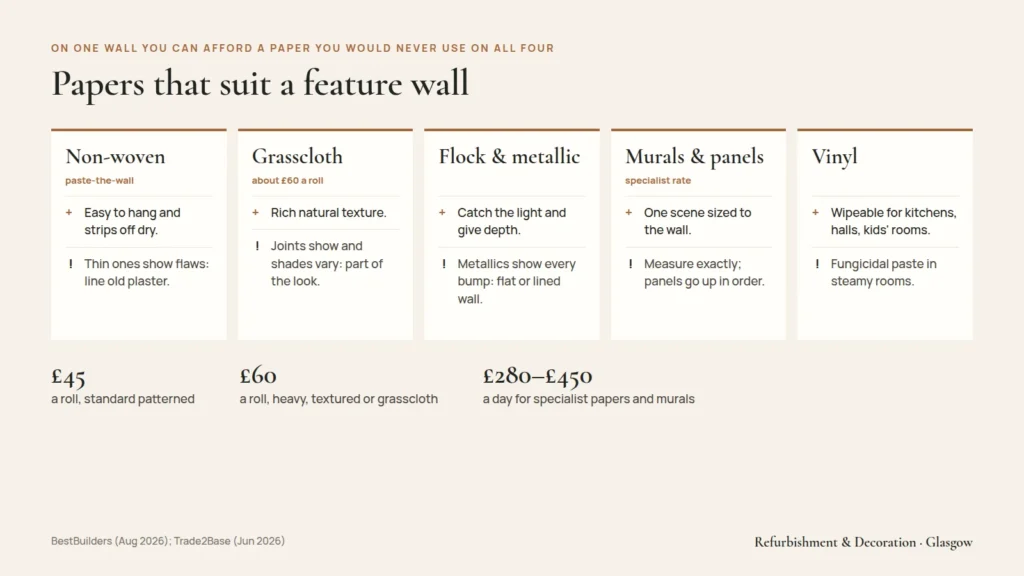
| Paper | Why it suits a feature wall | What to watch for |
|---|---|---|
| Non-woven, paste-the-wall | Easy to hang and strips off dry when you change it. | Thin ones show wall flaws. Line old plaster first. |
| Grasscloth | Rich natural texture on a single wall. | The joints always show and each length varies in shade. That is part of the look. |
| Flock and metallic | Catch the light and give depth. | Metallics show every bump, so the wall must be flat or lined. |
| Murals and panels | One scene sized to the wall. | Measure exactly before ordering. Panels go up in a set order. |
| Vinyl | Wipeable for kitchens, halls and children’s rooms. | Needs a fungicidal paste in steamy rooms. |
Expect a higher rate for grasscloth, flock and murals. BestBuilders (August 2026) lists £60 a roll for heavy, textured or grasscloth papers against £45 for standard patterned papers, and Trade2Base (June 2026) gives £280–£450 a day for specialist papers and murals.
Colour in Scottish light
Glasgow’s grey winter light flattens colours and pulls them cooler, especially in north-facing rooms. Order a large sample, tape it to the wall you plan to paper, and look at it in the morning, in the afternoon and under your own lamps before you buy. Our guide to choosing colours for Scottish light explains what to look for.
How do you make the rest of the room work with it?
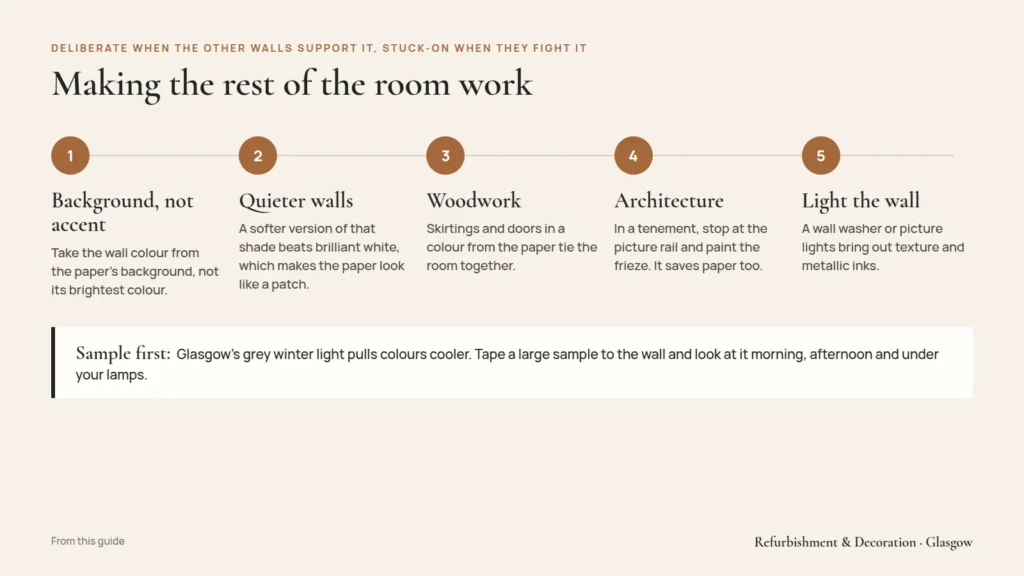
A feature wall looks deliberate when the other three walls support it, and stuck-on when they fight it.
- Take the wall colour from the paper’s background, not its brightest accent. A paint shop can colour-match a sample, or choose a ready-mixed shade close to it.
- Keep the other walls quieter in tone. A softer version of the background shade usually works better than brilliant white, which can make the paper look like a patch.
- Think about the woodwork. Skirtings and doors in a colour from the paper tie the room together, especially in period rooms with deep skirtings.
- Respect the architecture. In a tenement, the picture rail and cornice are natural stopping points. Papering below the picture rail and painting the frieze can look better than running paper to the ceiling, and it saves paper.
- Light the wall. A wall washer or picture lights bring out texture and metallic inks in the evenings.
How is a feature wall prepared and hung?
A single wall has nowhere to hide, so the preparation and setting out matter even more than in a fully papered room.
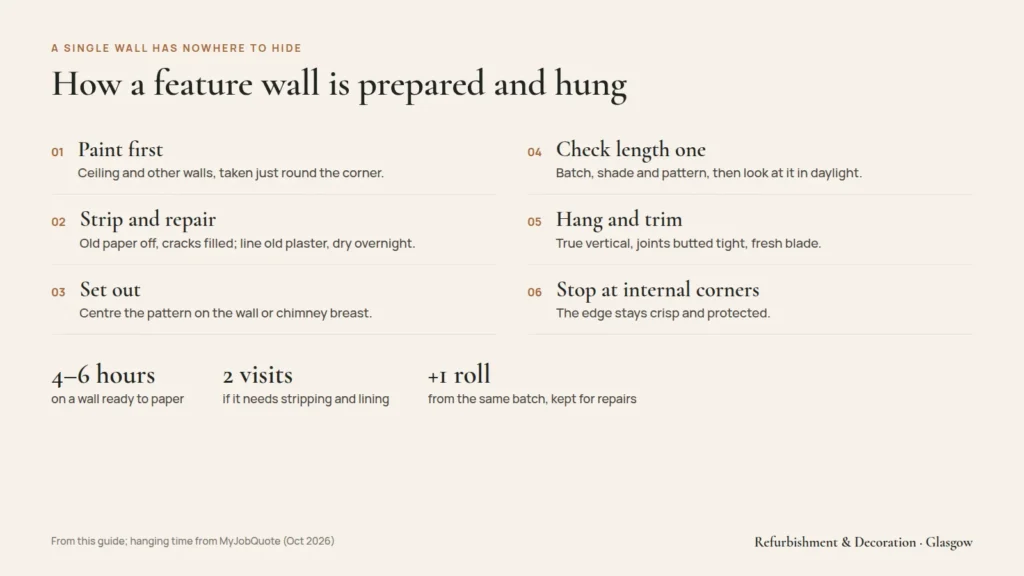
- Paint first. We paint the ceiling and the other three walls before papering, taking the paint just round the corner onto the feature wall. The paper then covers that edge, which gives a crisp line at the corner with no gaps.
- Strip and repair. Old paper comes off, cracks are filled, and loose plaster is repaired. On old Glasgow plaster we normally line the wall and let it dry overnight.
- Set out the pattern. The pattern is centred on the wall, or on the chimney breast, so the design sits symmetrically and both edges finish with matching part-patterns.
- Check the first length. Before going further, we check the batch, shade and pattern of every roll, then hang one length and look at it in daylight. Most makers will not accept a complaint about paper that has been hung.
- Hang and trim. Lengths are hung to a true vertical, butted tight and trimmed into the cornice, skirting and corners with a fresh blade.
- Finish at internal corners. A feature wall should start and stop at internal corners, where the edge is protected. On a chimney breast, we usually wrap the paper onto the returns and stop where the breast meets the alcove.
On a ready wall this is half a day’s work, in line with MyJobQuote’s 4–6 hours. Stripping, lining and a tall tenement wall can turn it into a two-visit job. Our complete guide to wallpaper hanging in Glasgow explains each step, and how to count rolls, in more detail.
Decorator’s tip: Buy one more roll than the count, from the same batch, and keep it. If the wall is ever damaged, you can repair it with a length that matches, long after the paper has been discontinued.
Mistakes to avoid with a feature wall
- Choosing the wall by convenience. The easiest wall to paper is often not the one people look at.
- Too many features. One papered wall per room is plenty. A second patterned wall usually cancels out the first.
- Ignoring the repeat. On a tall wall, a large repeat can almost double the number of rolls. Count lengths, not square metres.
- Papering over old paper. Fresh paste loosens the old paper, and both can bubble. Strip it first.
- Skipping lining on old plaster. On a single wall, every crack shows, especially in raking light.
- Choosing from a screen. Colours on a phone or monitor rarely match the printed paper in Scottish daylight. Always get a sample.
- Ending the paper on an outside corner. The edge gets knocked and lifts. Plan for the paper to end at internal corners.
If you rent
Tenants need their landlord’s written permission before papering, even with “removable” peel-and-stick paper, which can still pull paint off when it comes away. The Housing (Scotland) Act 2025, which received Royal Assent on 6 November 2025, includes a right for tenants to ask to decorate, but that part was not yet in force when we wrote this. Check the current position with the Scottish Government or your letting agent before acting. Landlords choosing a feature wall for a rental should go for a durable, wipeable paper in a neutral pattern; our guide to landlord and end-of-tenancy painting in Glasgow covers finishes that last between tenancies.

Getting a price for your home
A feature wall is a small job, but the price depends on the wall’s height, its condition and the paper you choose. We can give you a guide price over the phone, then a fixed written quote after a free visit, with the number of rolls to order. See our wallpaper hanging service for what is included; we work across Glasgow and Central Scotland.
Call 07777 780557, or book a free visit.
Questions people ask
Which wall should I wallpaper in a living room?
Choose the wall your eye goes to first when you walk in. In most period and tenement living rooms that is the chimney breast. In modern rooms it is often the wall behind the sofa. Avoid the TV wall, where a busy pattern competes with the screen, and walls broken up by doors, windows and radiators.
How many rolls of wallpaper do I need for one wall?
Divide the wall width by 0.53 m to get the number of lengths, then work out how many full-height lengths each 10.05 m roll gives. A 3.5 m wall at 2.4 m high needs two rolls of plain paper or three with a 53 cm repeat. At 3.2 m high, the same wall needs three plain or four patterned.
Should the other walls match the feature wallpaper?
They should support it, not copy it. Take the paint colour from the paper's background rather than its brightest accent, and keep the other walls a little quieter in tone. Brilliant white next to a strong paper often makes it look like a patch. Painting skirtings or doors in a colour from the paper helps tie the room together.
Can I put a feature wall in a rented flat?
Only with your landlord's written permission, even with peel-and-stick paper, which can pull paint off when removed. The Housing (Scotland) Act 2025 includes a right for tenants to ask to decorate, but that part was not yet in force when this was written. Check the current position with the Scottish Government or your letting agent first.
Is a wallpaper feature wall cheaper than papering the whole room?
Much cheaper. A feature wall costs £120–£250 in labour (MyJobQuote, Oct 2026; BestBuilders, Aug 2026), compared with £325–£775 to strip and paper a whole Glasgow room (BestBuilders Glasgow, Aug 2026). It also needs far fewer rolls, which lets you choose a more expensive paper for the one wall people actually look at.
How long does it take to wallpaper a feature wall?
On a wall that is already sound and ready to paper, about half a day: MyJobQuote (Oct 2026) gives 4–6 hours. If old paper has to be stripped, cracks filled and the wall lined, the lining needs to dry overnight, so it becomes a two-visit job. Tall tenement walls and chimney breasts with alcoves take longer.

Painters and decorators working across Glasgow & Central Scotland, specialising in interior painting and wallpaper hanging. Prices in our guides are reviewed every year.
 Wallpaper Hanging Cost in Glasgow: per Roll, per Room, per Feature Wall
 Wallpaper Hanging in Glasgow: the Complete Guide