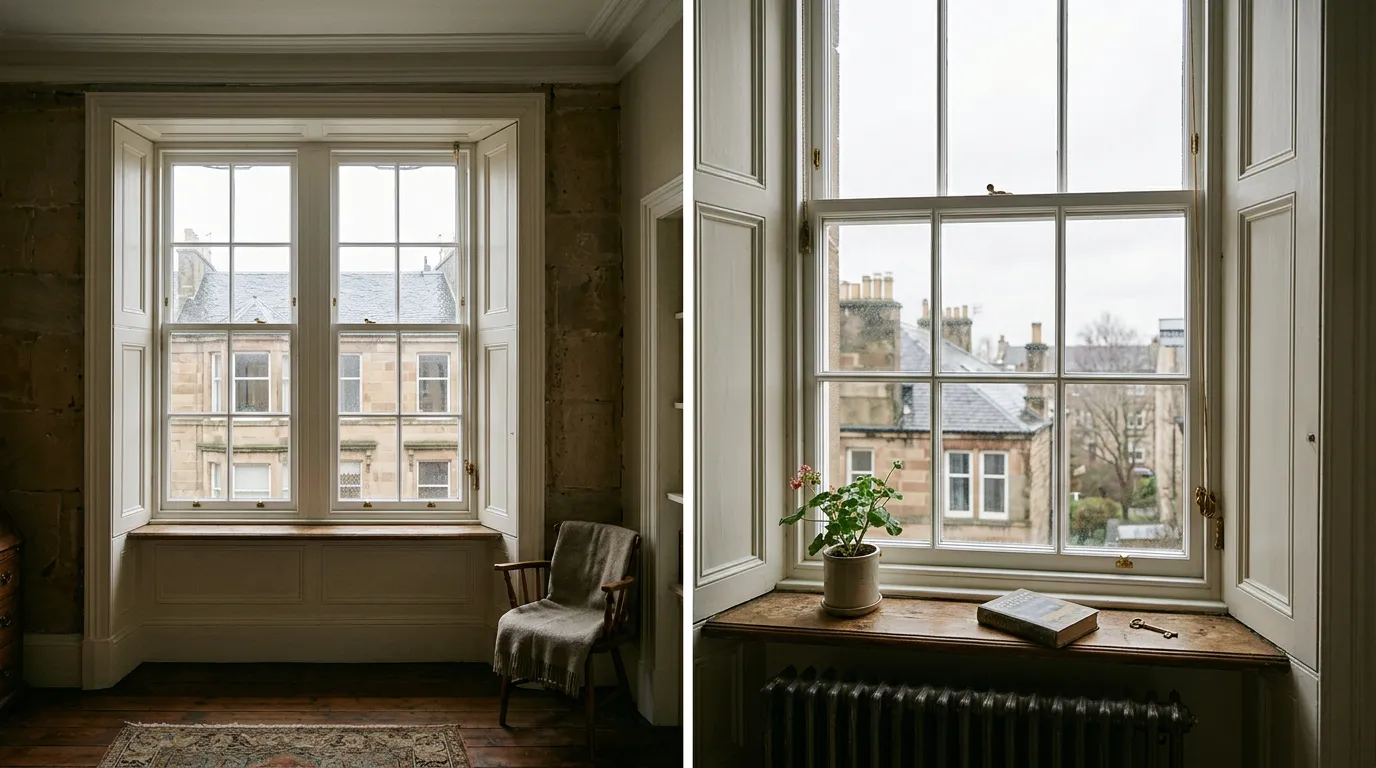
Paint sash windows in two stages, swapping the sashes so they never set shut, and never paint the cords or hidden pulley stiles. Historic Scotland suggests repainting outside faces about every 5 years. At Glasgow and Scottish day rates of £150–£290 (BestBuilders, Aug 2026; Trade2Base, Jun 2026), a typical sash takes half a day to two and a half days.
Timber sash and case windows are a big part of what makes a Scottish tenement or villa flat look right, and they last for well over a century if the paint is kept up. Paint is also how most of them get ruined: sashes glued shut, cords painted stiff, putty left bare to the rain. This guide covers how sash windows should be painted, how to deal with old paint that may contain lead, what Glasgow’s rules say about colours and consent, and how much time and money a proper job takes.
Why do sash windows get painted shut, and how do you avoid it?
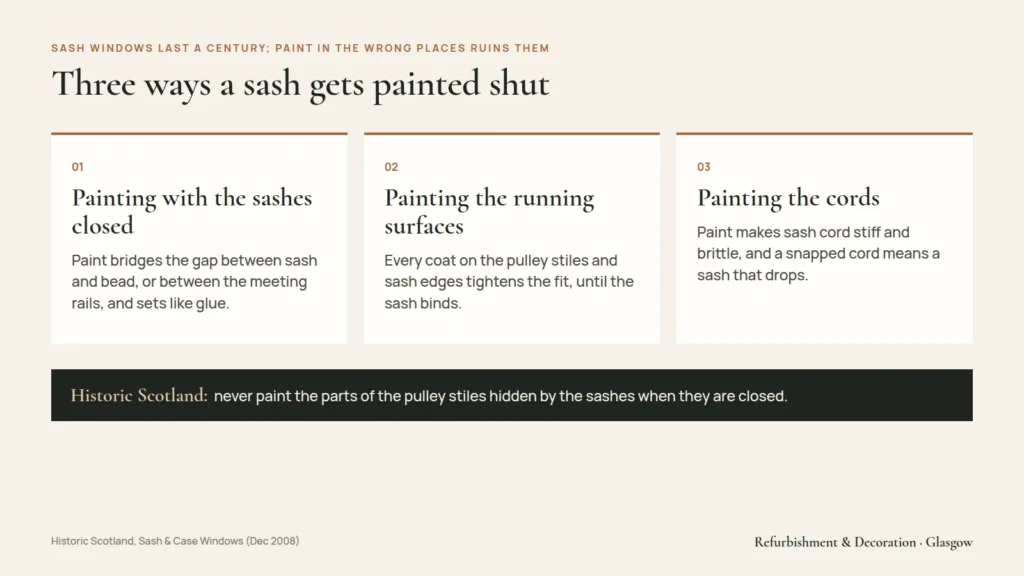
A sash window is two timber frames sliding past each other in a box case, balanced by cast-iron weights on cords running over pulleys. It only works if the sashes slide freely against the beads and the pulley stiles (the vertical sides of the case). Paint gets into the wrong places in three ways:
- Painting with the sashes closed. The paint bridges the gap between sash and bead, or between the two meeting rails, and sets like glue.
- Painting the running surfaces. Every coat on the pulley stiles and the edges of the sashes makes the fit tighter. After a few decades of this the sash binds or will not move at all.
- Painting the cords. Paint stiffens sash cord and makes it brittle, and a snapped cord means a sash that drops.
Historic Scotland’s short guide Sash & Case Windows (December 2008) lists paint build-up “where the smooth running of the sashes is interfered with by multiple coats of paint” as one of the reasons for stripping back to bare timber. It also says plainly: do not paint the parts of the pulley stiles that are hidden by the sashes when they are closed.
Freeing a sash that is painted shut
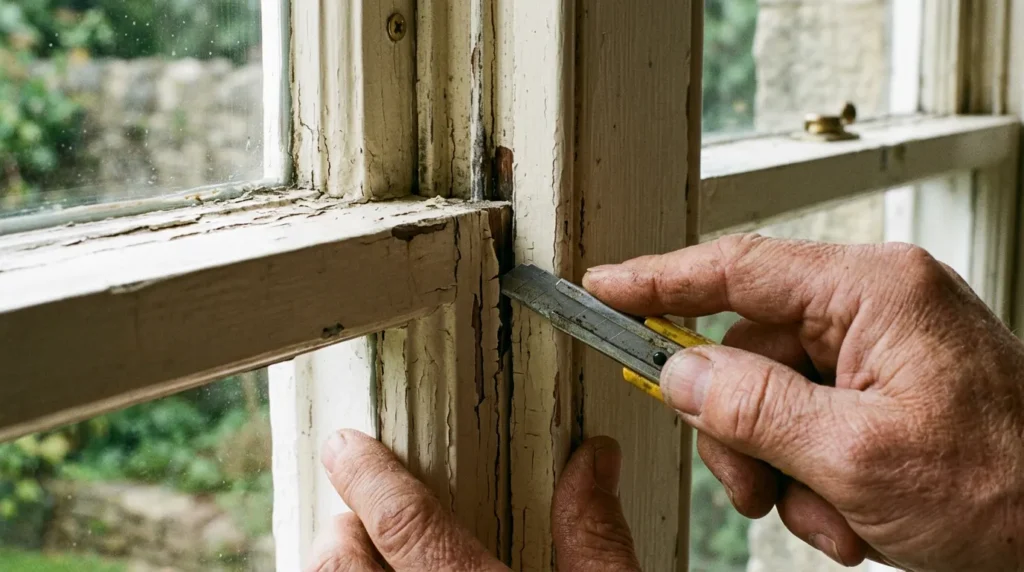
Run a sharp craft knife along every painted joint: sash to staff bead, sash to parting bead, and along the meeting rails. Then tap gently along the sash with the heel of your hand or a block of wood. Do not lever at the bottom rail with a screwdriver; it crushes the timber and the paint. If the sash still will not move, the staff bead usually has to come off, which is a job for a decorator or joiner. Remember that freed sashes from before the 1960s are likely to shed old paint flakes, which brings us to lead.
Is there lead paint on my windows?
On original tenement windows, probably somewhere in the layers. The British Coatings Federation’s guide Lead in painted surfaces (HS032, December 2015) says lead pigments were taken out of most paints in the 1960s and fully removed from decorative paints by the early 1980s, and that “many wood or metal surfaces painted before the 1960s could contain significant levels of lead”. Window joinery is exactly that kind of surface, and the friction of a sash rubbing on its beads can wear the old layers into dust.
What the BCF guidance says, in short:
- Sound paint, especially where lead is not the top layer, is safest left in place and painted over.
- Do not dry sand, do not use blowlamps or gas torches, and do not overheat the paint.
- Rub down wet with waterproof abrasive paper, keep debris damp, and wipe it up with a damp cloth.
- Keep children and pregnant women out of the area during work that disturbs lead paint.
- Clean up with a HEPA-filtered vacuum and bag all waste.
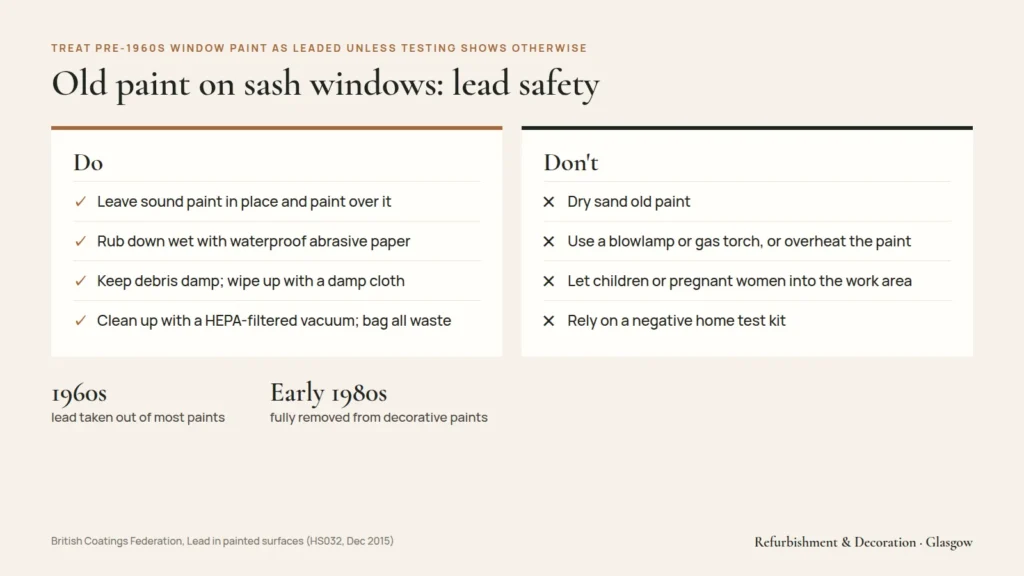
Home test kits exist, but the BCF warns that a negative result should not be relied on. We treat pre-1960s window paint as leaded unless testing shows otherwise, and plan the preparation around that. If you are doing any of this yourself, read the BCF guide first. The UK government also publishes advice on lead paint in older homes.
Decorator’s tip: powdery paint on the window board and sill, especially on the inside of the bottom sash, is a sign the sash is grinding old paint as it moves. Wipe it with a damp cloth, not a dry duster or a vacuum without a HEPA filter, and get the window looked at.
How should a sash window be painted, step by step?
The order of work matters more on a sash window than anywhere else in the house. This is the method we use, which follows the sequence in Historic Scotland’s guide.
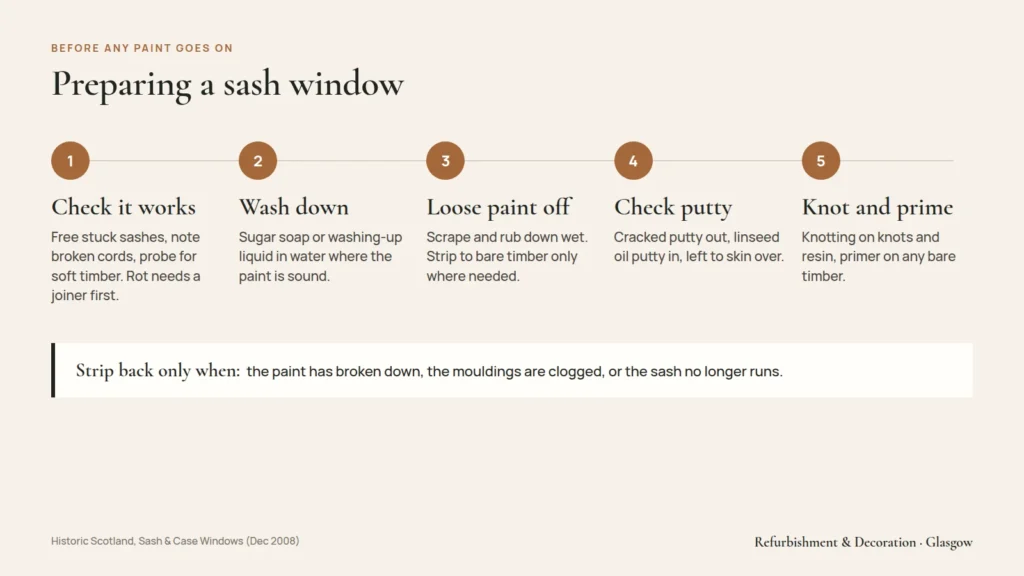
Preparation
- Check the window works. Free stuck sashes, note broken cords, and check for soft timber with a blade at the bottom rail, the sill and the base of the case. Rot needs a joiner before paint.
- Wash down. Historic Scotland suggests sugar soap or washing-up liquid in water where the paint is sound. Window paint in a city collects grime that stops new paint gripping.
- Remove loose paint. Scrape and rub down wet, as above. Strip back to bare timber only where it is needed: paint broken down, mouldings clogged, or the sash no longer running.
- Check the putty. Cracked or missing putty is cut out and replaced with linseed oil putty, which needs time to skin over before painting.
- Treat and prime bare wood. Knotting on knots and resinous patches, then primer on any bare timber.
Painting in place
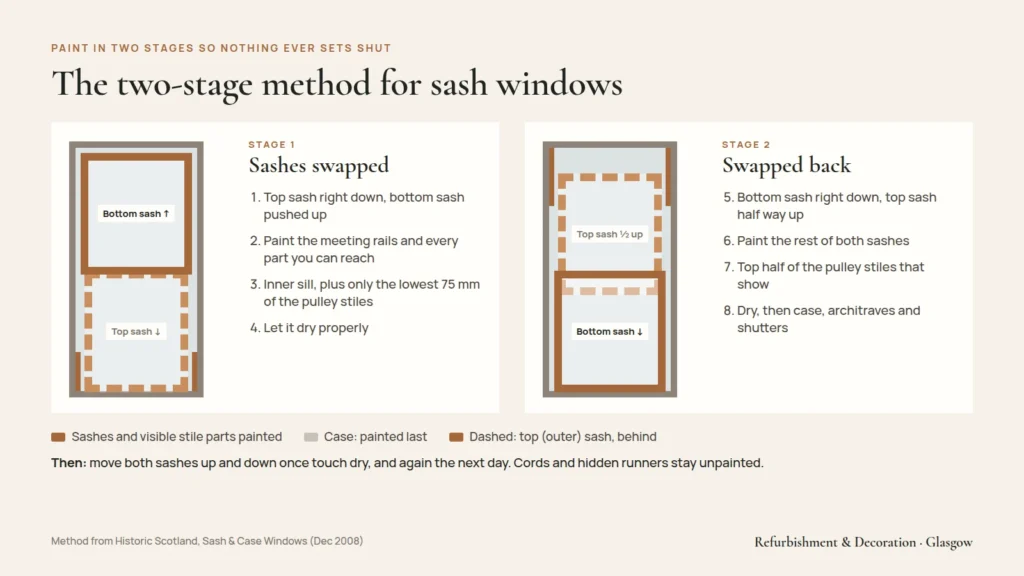
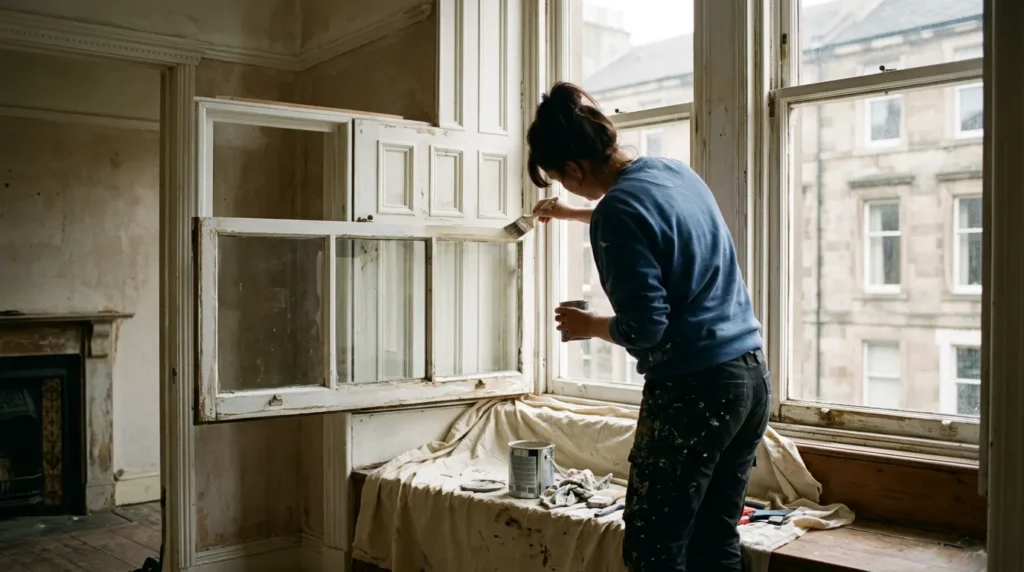
- Pull the top sash right down and push the bottom sash up past it.
- Paint the meeting rails, the lower parts of the top sash and the parts of the bottom sash you can reach, the inner sill, and only the lowest 75 mm of the pulley stiles.
- Let it dry properly.
- Swap the sashes: bottom sash right down, top sash half way up.
- Paint the rest of both sashes and the top half of the pulley stiles that show.
- Let it dry, then paint the surrounding case, architraves and shutters.
- Move the sashes up and down a few times once touch dry, and again the next day, so nothing sets in one position.
On the glass, Historic Scotland’s advice is to cover the putty completely and seal the putty-to-glass joint with paint, taking the paint just a millimetre or two onto the glass in a straight line. That bead of paint is what keeps water out of the putty. Scraping it all back to a perfectly clean edge looks crisp for a year and then lets the putty fail.
Which paint?
For outside faces, Historic Scotland calls for “an appropriate gloss paint or microporous paint specification”, following the maker’s guidance on primers and number of coats. Inside, a durable satin or eggshell suits sashes and shutters, and it is easier to keep clean than gloss in a condensation-prone flat. Some owners of listed flats choose traditional linseed oil paint, which is slower to dry and needs a different routine. Whatever the system, two thin coats beat one thick coat, because thick paint is what builds up on the running surfaces.
Mistakes to avoid
- Painting the sashes in the closed position and leaving them shut overnight.
- Painting the cords, the parting beads’ running faces or the hidden pulley stiles.
- Dry sanding old paint, or using a blowlamp near glass and putty.
- Painting over wet putty, rot or bare timber without primer.
- Painting the shutters to the case, so they no longer fold out. Tenement shutters are worth keeping working: Historic Scotland notes closing them reduces heat loss at night.
- Caulking the gap between sash and bead to stop draughts. It stops the window opening. Proper draught-stripping is the fix.

Painting the outside of tenement windows
The outside face takes the weather, and Historic Scotland’s guide says windows “normally require external repainting every 5 years depending upon exposure”. On a west-facing elevation in Glasgow, that may be optimistic. Repainting before the paint breaks down keeps preparation, and cost, down.
Access
Ground-floor windows can be reached from a ladder or low platform. Above that, there are three options:
- From inside. Much of the outside face of a sash can be reached by swapping sash positions. For a full job, the sashes can be taken out by removing the staff beads, painted indoors and refitted with new cords if needed. Historic Scotland notes sashes “can be taken out for these works comparatively easily”. This is often the most practical route for a top-floor flat.
- Powered access. A cherry picker for the outside of the case and the sill. If it stands on the pavement or road, a permit from the council is usually needed, and the access firm normally arranges this.
- Scaffold. Usually only worth it when the whole elevation is being repaired, often as a common repair organised through the factor. If the stonework or gutters are being done, ask whether window painting can be added while the scaffold is up. Our guide to painting a tenement close explains how owners make shared decisions.

Who is responsible for the outside of a tenement window depends on your title deeds. Windows serving one flat are often that owner’s responsibility, but deeds vary, so check before booking anything.
Weather
Outside work needs dry timber, a dry forecast and temperatures above the paint’s minimum, which is printed on the tin. As an example, Dulux Trade’s datasheet for its standard Weathershield masonry paint says not to apply below 7 °C, in rain or fog, or above 80% relative humidity, and joinery paints carry similar limits. In the west of Scotland that usually means May to September, and starting after the morning dew has dried. Interior faces can be done at any time of year, which is why we often split the job: inside in winter, outside in summer.

Do you need permission to paint sash windows in Glasgow?
For ordinary repainting in the same colour, usually not. A Pollokshields Heritage summary of Glasgow City Council’s guidance says routine maintenance such as “repainting timber window frames and repainting ironwork will not require consent from the Planning Authority”, and the council’s window design guide says like-for-like repairs need neither planning permission nor listed building consent.
Changing the colour is different:
- Listed buildings. Historic Scotland’s sash window guide lists “changes to paint colour or finish” among works that need listed building consent. Historic Environment Scotland’s consents page also names changing the colour of external paintwork as work that might need permission.
- Conservation areas. Councils can set acceptable colours for external joinery. The Dennistoun conservation booklet, written with Glasgow City Council, says window colour “should match the established pattern of the tenement block” to keep its unified appearance. Glasgow’s supplementary guidance SG9 covers conservation areas and listed buildings.
- Tenements generally. Even outside these rules, one flat’s windows painted a different colour from the rest of the block stand out, and your title deeds may say something about the external appearance.
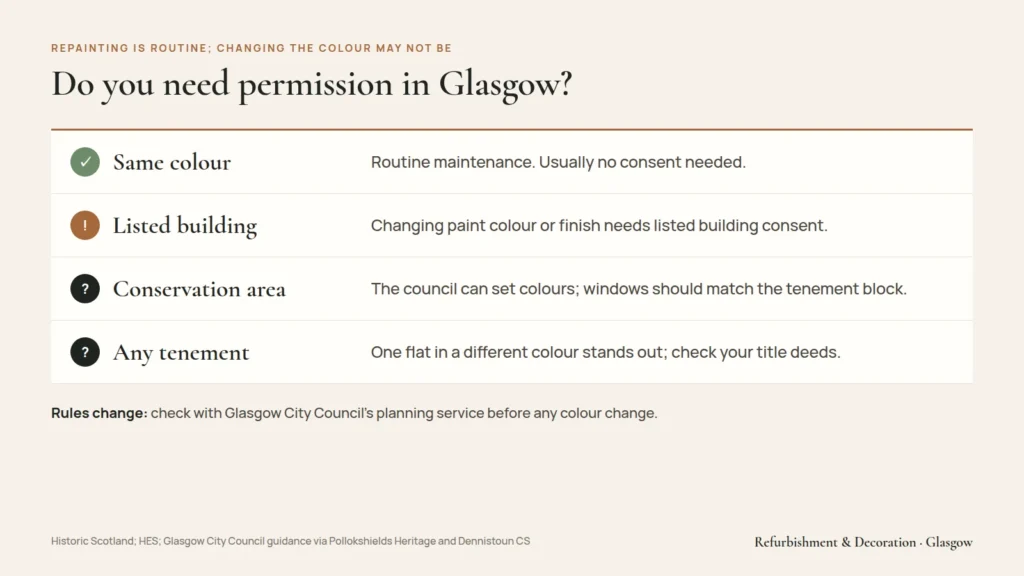
Planning rules change, and a change in May 2024 already altered the position for replacement windows in Glasgow conservation areas. Check the current position with Glasgow City Council’s planning service before acting on any colour change.
What does painting sash windows cost, and how long does it take?
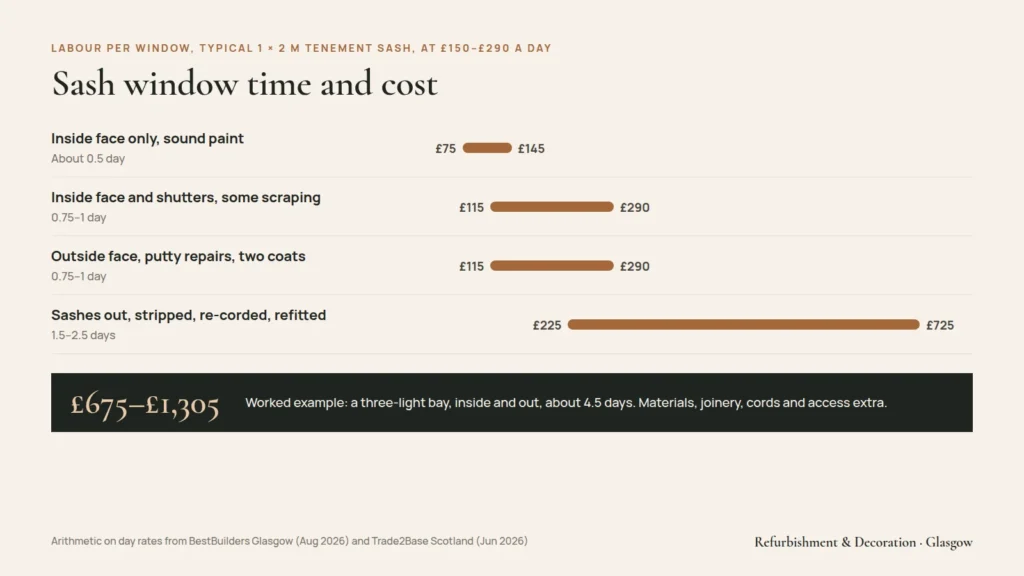
We could not find a reliable published price per sash window in Glasgow, so we do not quote one here. What can be sourced is the day rate: about £150–£290 a day for a decorator in Glasgow and Scotland (BestBuilders Glasgow, August 2026, and Trade2Base Scotland, June 2026). For context, Which? (May 2026) puts painting the woodwork in one room at £70–£650 in good condition and £90–£1,200 in poor condition across the UK, which shows how much the state of the paint matters. The real variable is time per window, and these are our estimates for a typical tenement sash, about 1 m wide by 2 m tall:
| Work, per window | Typical time | Labour at £150–£290 a day |
|---|---|---|
| Inside face only, sound paint, wash, key and two coats | About 0.5 day | £75–£145 |
| Inside face and shutters, some scraping and filling | 0.75–1 day | £115–£290 |
| Outside face from inside or ground level, putty repairs, two coats | 0.75–1 day | £115–£290 |
| Sashes taken out, stripped where needed, re-corded, painted and refitted | 1.5–2.5 days | £225–£725 |
This is arithmetic on sourced day rates, not R&D’s price list. Time spreads over several visits because each coat must dry. Materials, joinery repairs, new cords and any powered access are extra.
Worked example: a typical tenement front room
A typical first-floor front room has a three-light bay: three sash windows with panelled shutters. Inside, all three sashes and shutters need washing, wet rubbing down, some filling and two coats: roughly 2.5 days. Outside, putty needs patching and two coats, done from inside by swapping the sashes: roughly 2 days. That is 4.5 days, or £675–£1,305 on the market day rate, before materials. Done on the same visit as the room’s walls and ceiling, some of that time is shared. See our Glasgow painting prices guide for whole-room figures.
For the wider picture, our complete guide to painting a Glasgow tenement flat covers high ceilings, plaster and the order of work, and restoring cornicing and ceiling roses covers the plasterwork above the window.
Getting a price for your windows
Sash window prices depend on the paint underneath, the putty, the access and how many coats have built up on the running surfaces, so we look before we quote. We give a guide price on the phone, then a fixed written quote after a free visit, where we check how each window runs. Windows are usually priced as part of our interior painting or exterior painting work across Glasgow and Central Scotland. Call 07777 780557 or book a free visit.
Questions people ask
How do I stop sash windows being painted shut?
Never paint with the sashes closed. Paint in two stages, swapping the sash positions between them, and move the sashes up and down once the paint is touch dry and again the next day. Keep paint off the cords, the running faces of the beads and the parts of the pulley stiles hidden when the window is closed. Two thin coats build up far less than one thick one.
Do old sash windows have lead paint?
Original windows very likely have lead somewhere in their layers. The British Coatings Federation says many wood surfaces painted before the 1960s could contain significant lead. Sound paint is safest painted over. Where preparation is needed, rub down wet, never dry sand or use a blowlamp, keep children and pregnant women away, and clean up with a HEPA-filtered vacuum.
How often should sash windows be painted outside?
Historic Scotland's sash window guide says windows normally need external repainting every 5 years depending on exposure. West-facing windows in Glasgow may need it sooner. Repainting while the paint is still sound keeps preparation, and cost, down, because bare timber and cracked putty take far longer to put right than a wash, key and two coats.
Do I need permission to change the colour of my sash windows in Glasgow?
Repainting in the same colour is routine maintenance and usually needs no consent. On a listed building, Historic Scotland lists changes to paint colour or finish among works needing listed building consent. In conservation areas, the council can set acceptable colours, and tenement windows are expected to match the block. Check the current position with Glasgow City Council's planning service before acting.
How do you paint the outside of upper-floor tenement windows?
Often from inside. Swapping the sash positions reaches much of the outside face, and for a full job the sashes can be taken out by removing the staff beads, painted indoors and refitted. Otherwise a cherry picker is used, which usually needs a council permit if it stands on the pavement or road. Scaffold is worth it mainly when the whole elevation is being repaired.
What paint should I use on sash windows?
Outside, Historic Scotland calls for a suitable gloss or microporous paint system, with the maker's primer and knotting. Inside, a durable satin or eggshell is easy to keep clean in a condensation-prone flat. Some owners of listed flats choose linseed oil paint, which dries more slowly. Whichever you choose, seal the putty-to-glass joint with a thin line of paint.

Painters and decorators working across Glasgow & Central Scotland, specialising in interior painting and wallpaper hanging. Prices in our guides are reviewed every year.
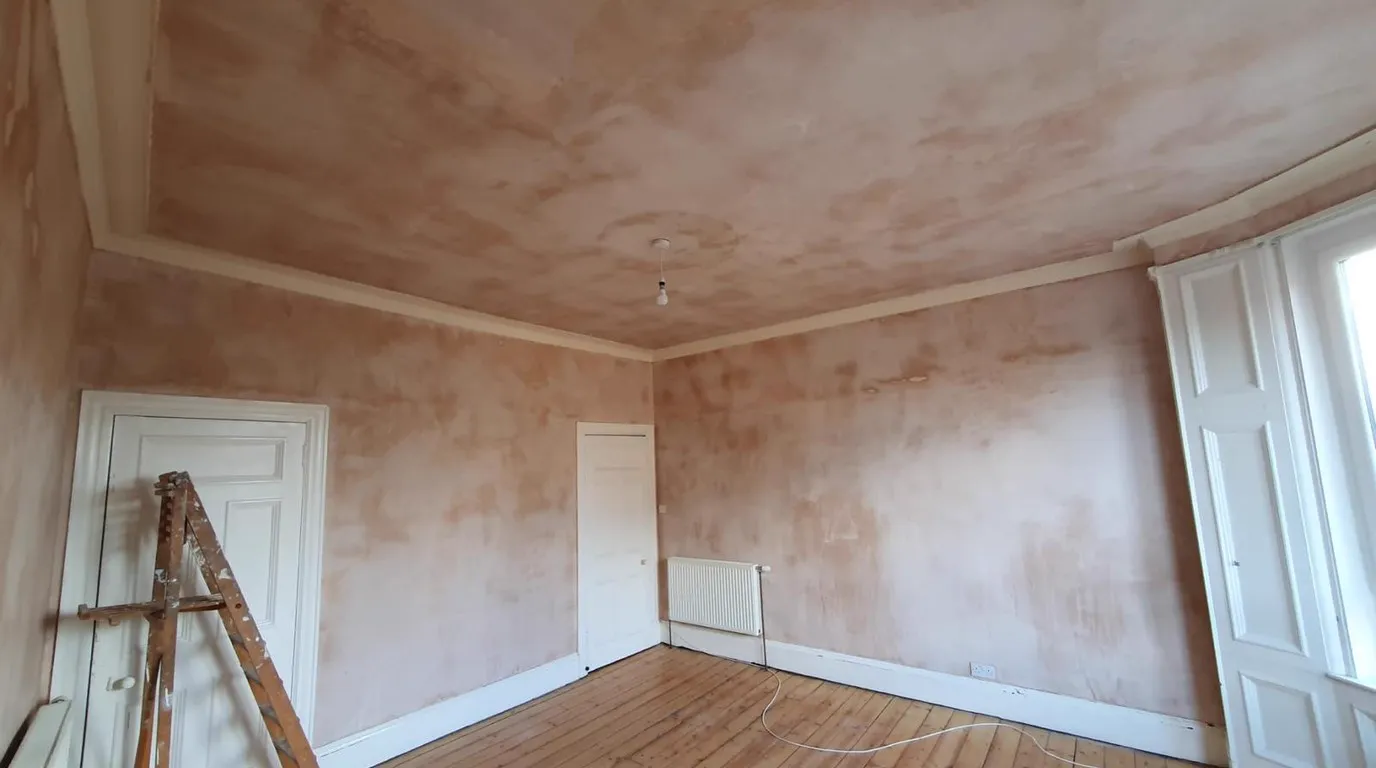 Painting New Plaster: Mist Coats, Drying Times & Mistakes to Avoid
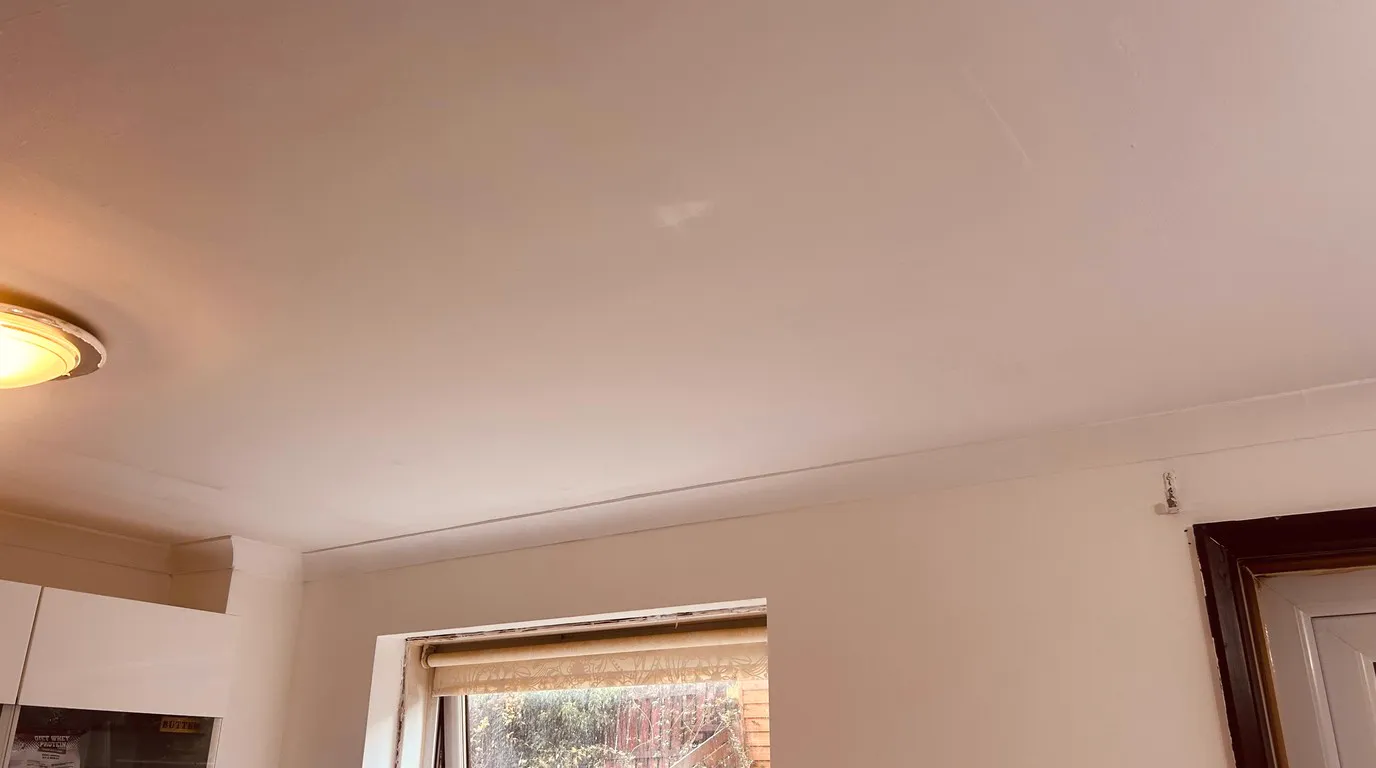 Cracked Ceiling Repair & Painting: What a Decorator Can Fix
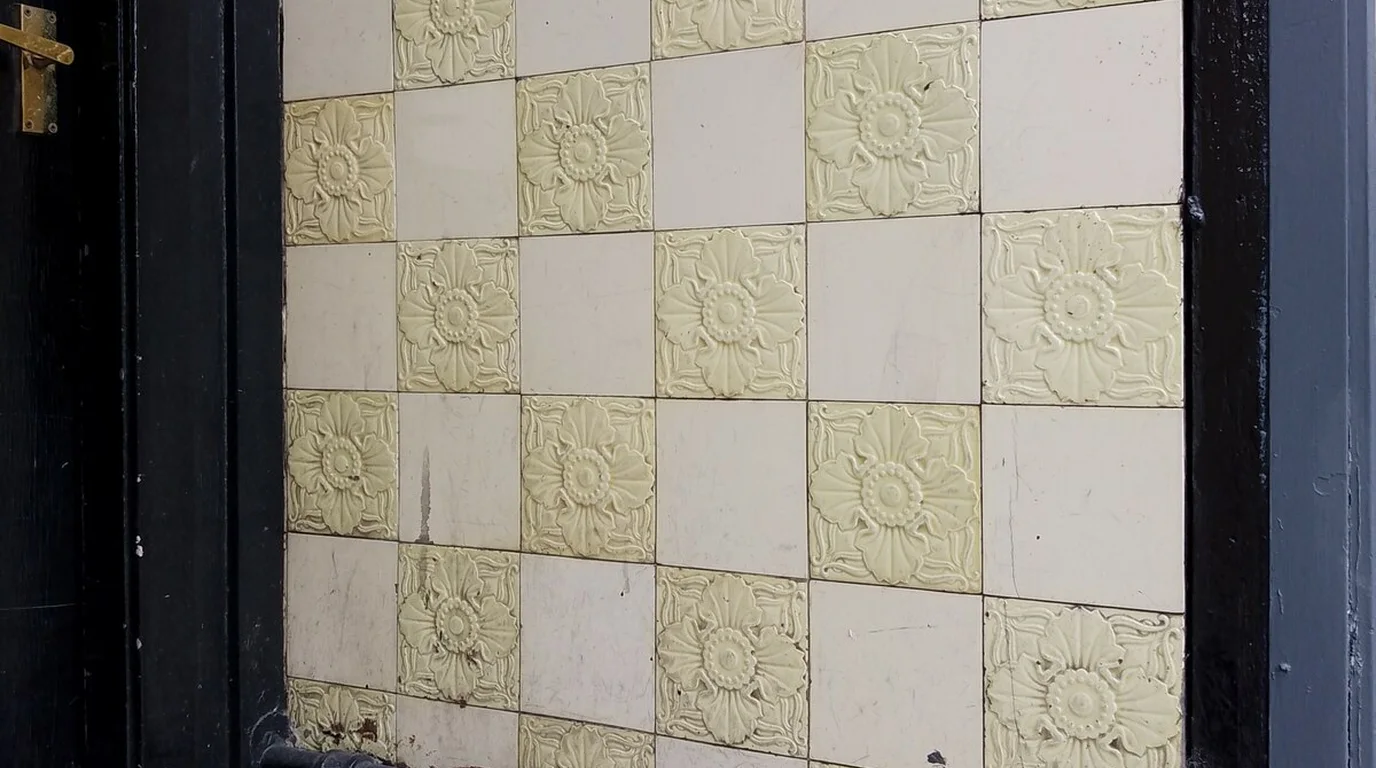 Painting a Tenement Close: Factors, Owners & Costs