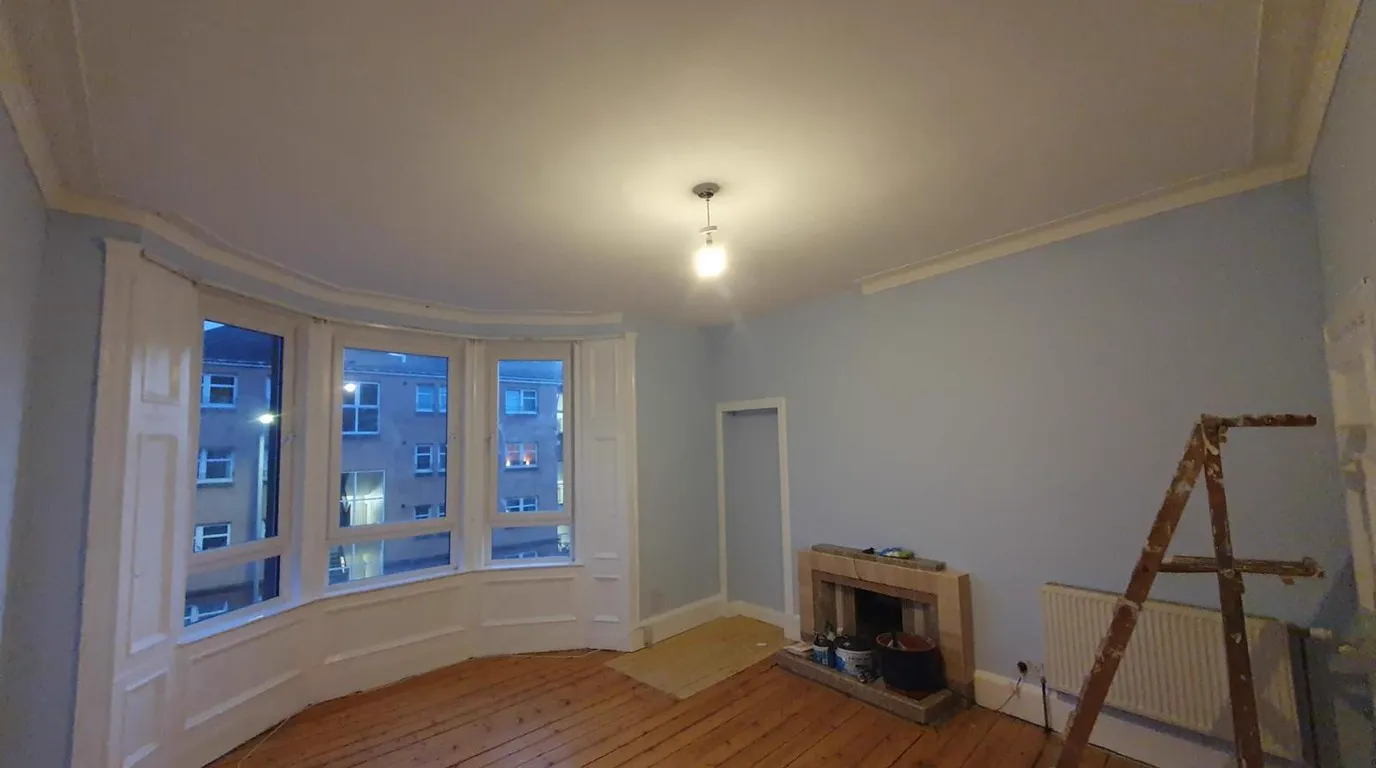
A decorator working alone usually needs about 7–9 working days to paint the walls, ceilings and woodwork of a typical 3-bed house (MyJobQuote, Sep 2026). Published guides that allow for drying and snagging give 10 days to two weeks. A bedroom takes about 1 day, and the hall, stairs and landing 1.5–2 days.
Most people asking how long a repaint takes are really asking two things: when will it be over, and how much of that time do I have to put up with it? The honest answer is that the painting itself is the short part. This guide gives timings room by room, two worked day-by-day schedules, the things that add days, and what to expect at home while it happens. It is about time, not money; for the price side, see how much to paint a 3-bedroom house in Glasgow. Timings checked: October 2026.
How long does it take to paint a whole house?
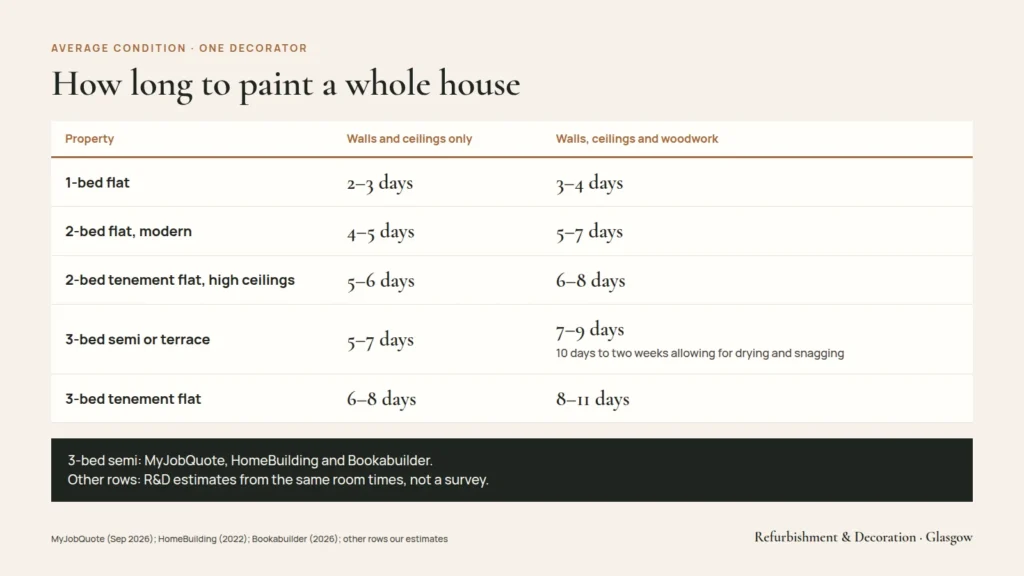
For a typical 3-bedroom house in sound condition, one decorator needs about seven to nine working days of actual painting for walls, ceilings and woodwork, based on MyJobQuote’s room times (September 2026). Published guides that allow for the whole job, including preparation, drying gaps and finishing off, give about 10 days to two weeks (HomeBuilding, 2022; Bookabuilder, 2026). Both figures are right. They describe the same house with different amounts of slack built in.
A rough guide for a house or flat of average condition, with one decorator:
| Property | Walls and ceilings only | Walls, ceilings and woodwork |
|---|---|---|
| 1-bed flat | 2–3 days | 3–4 days |
| 2-bed flat, modern | 4–5 days | 5–7 days |
| 2-bed tenement flat, high ceilings | 5–6 days | 6–8 days |
| 3-bed semi or terrace | 5–7 days | 7–9 days (10 days to two weeks allowing for drying and snagging) |
| 3-bed tenement flat | 6–8 days | 8–11 days |
The 3-bed semi row comes from MyJobQuote (September 2026), HomeBuilding (2022) and Bookabuilder (2026). The other rows are our own estimates built from the same room times, not a survey.
If the whole house is stripped back to bare plaster, repainted in a different colour throughout, or has the woodwork rubbed down to a sound base, add days. If you are only freshening similar colours on sound walls, expect the bottom of each range.
How long does each room take?
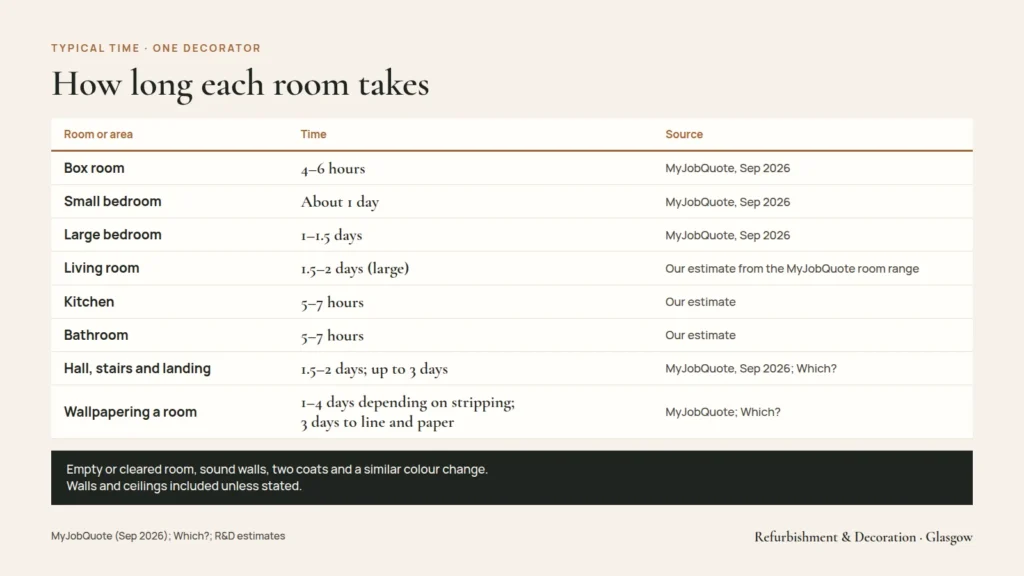
These are the times a decorator works to when pricing a job. They assume an empty or cleared room, sound walls, two coats and a similar colour change. Walls and ceilings are included unless stated.
| Room or area | Typical time, one decorator | Source |
|---|---|---|
| Box room | 4–6 hours | MyJobQuote, Sep 2026 |
| Small bedroom | About 1 day | MyJobQuote, Sep 2026 |
| Large bedroom | 1–1.5 days | MyJobQuote, Sep 2026 |
| Living room | 1.5–2 days (large) | Our estimate from the MyJobQuote room range |
| Kitchen | 5–7 hours | Our estimate |
| Bathroom | 5–7 hours | Our estimate |
| Hall, stairs and landing | 1.5–2 days; up to 3 days | MyJobQuote, Sep 2026; Which? |
| Wallpapering a room | 1–4 days depending on stripping; 3 days to line and paper | MyJobQuote; Which? |
Fantastic Services puts a standard room at one to two days, and Which? at one to three days depending on size. That is a wider spread than the MyJobQuote figures, because it allows for preparation and drying between coats.
Ceilings
A ceiling is one of the quickest surfaces and one of the most tiring. Rolling two coats on an average bedroom ceiling is a morning’s work once the room is covered, and the second coat has to wait for the first. On a bright white ceiling we would not try to save time by applying one thick coat. The paint drags and shows roller marks in side light. In a tenement room with a 3.2 m ceiling and a cornice, allow roughly half as long again, because a platform or small tower is slower to move than steps.
Woodwork
Woodwork is where time goes unnoticed. Skirting boards, architraves, door frames, doors and window frames take far longer per square metre than a wall, because every surface needs washing, sanding, caulking and, if the old paint is chipped, a primer or undercoat. A modern house with plain skirting and flush doors can finish in a day or two across the whole property. A tenement flat with tall skirtings, panelled doors and sash windows can take that long in a single room. For the sash windows alone, see painting sash windows in a Scottish flat.
Hall, stairs and landing
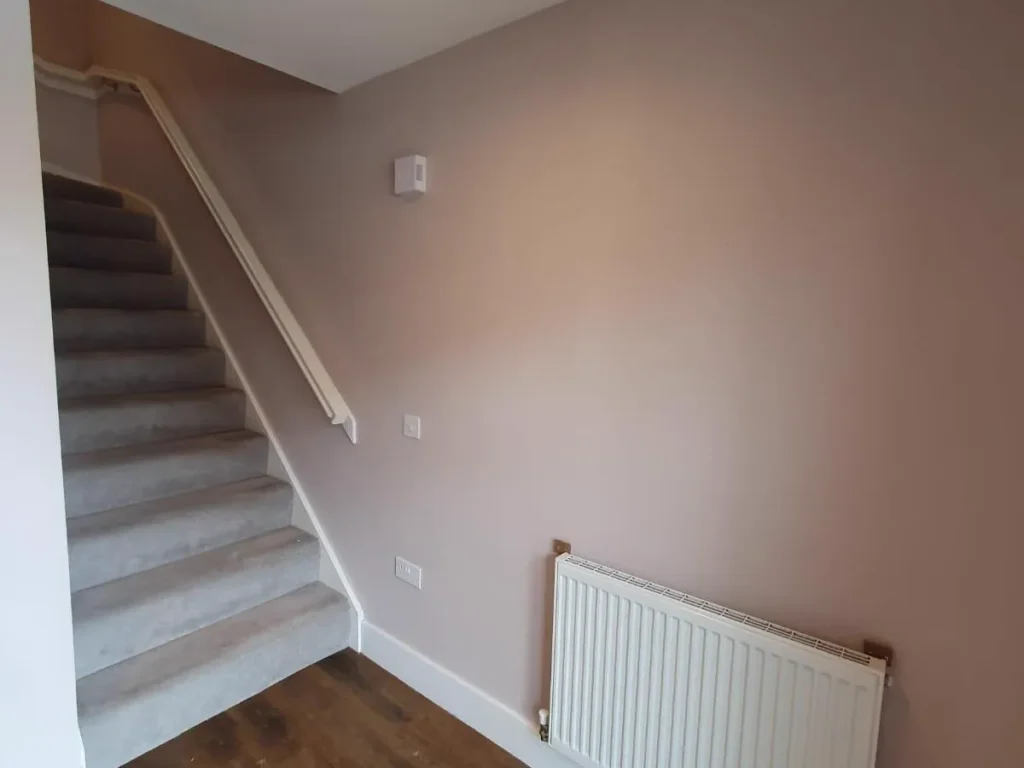
This area takes longer than its size suggests because the access is awkward. A stair ladder or platform has to be set up for the stairwell, and the walls are cut in around every spindle, handrail and door. Many decorators leave it for last, so the rest of the house is finished and nobody brushes wet walls while carrying things through.
What does a worked day-by-day schedule look like?
Here are two worked examples. They are typical schedules, not records of particular jobs, and the timings are our own estimates from the room times above.
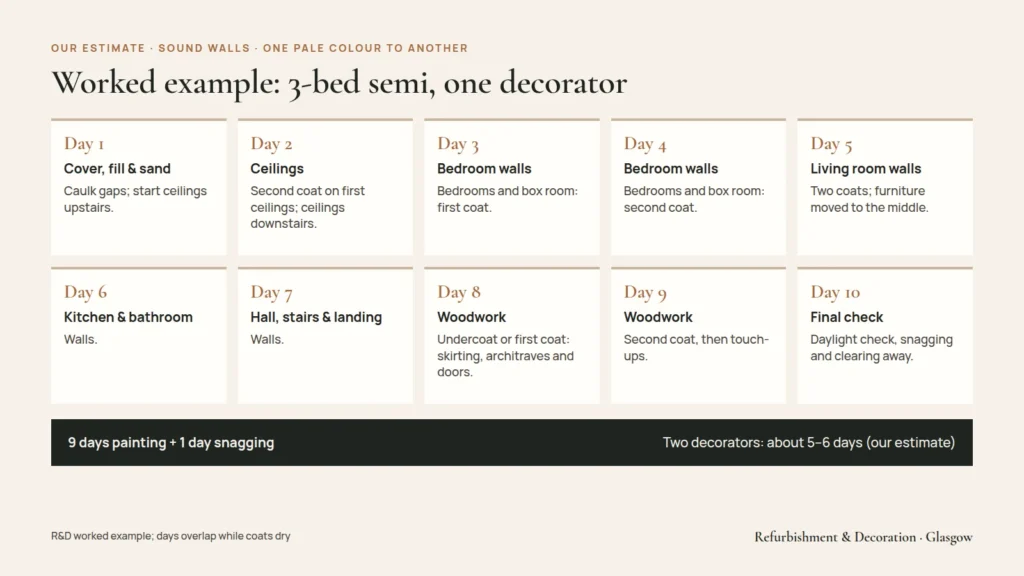
Worked example: a typical 3-bed semi, one decorator
Picture a 1970s semi with a through lounge, kitchen, upstairs bathroom, two double bedrooms and a box room. Ceilings are 2.4 m, the walls are sound, and the job is walls, ceilings and woodwork from one pale colour to another.
| Day | Work |
|---|---|
| 1 | Cover floors and furniture, fill and sand throughout, caulk gaps, then start ceilings upstairs |
| 2 | Finish ceilings, second coat on the first ceilings, then ceilings downstairs |
| 3 | Bedrooms and box room walls, first coat |
| 4 | Bedrooms and box room walls, second coat |
| 5 | Living room walls, two coats, working around furniture that has been moved to the middle |
| 6 | Kitchen and bathroom walls |
| 7 | Hall, stairs and landing walls |
| 8 | Woodwork: undercoat or first coat on skirting, architraves and doors |
| 9 | Woodwork: second coat, then touch-ups |
| 10 | Final check in daylight, snagging and clearing away |
That is nine days of painting and a tenth for snagging, which is where the “10 days to two weeks” figure in published guides comes from. The days overlap by design. While one room’s first coat dries, the decorator moves to the next. It is the same order of work we describe in the 3-bed cost guide, with the drying gaps shown.
Worked example: a typical 2-bed tenement flat, one decorator
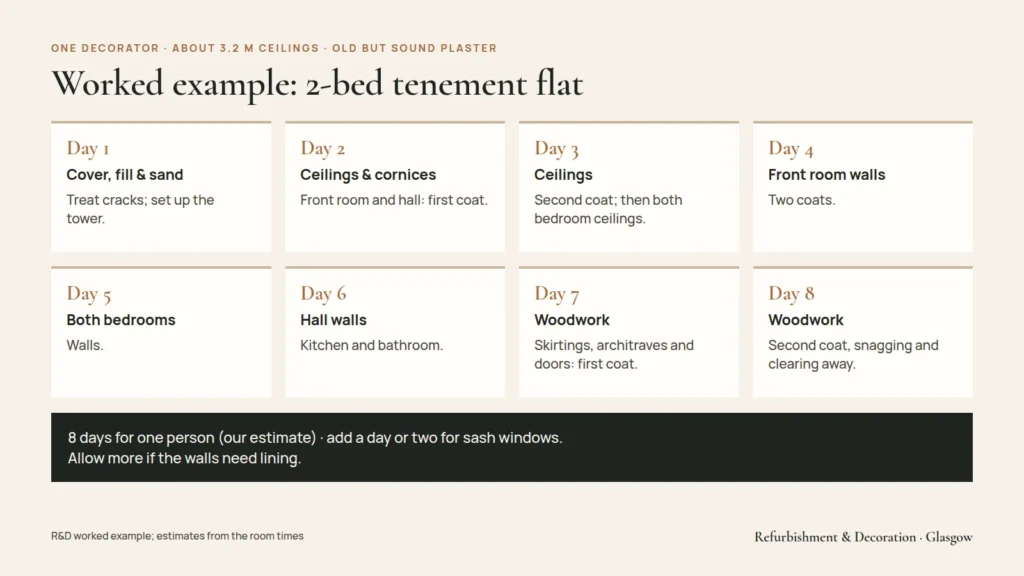
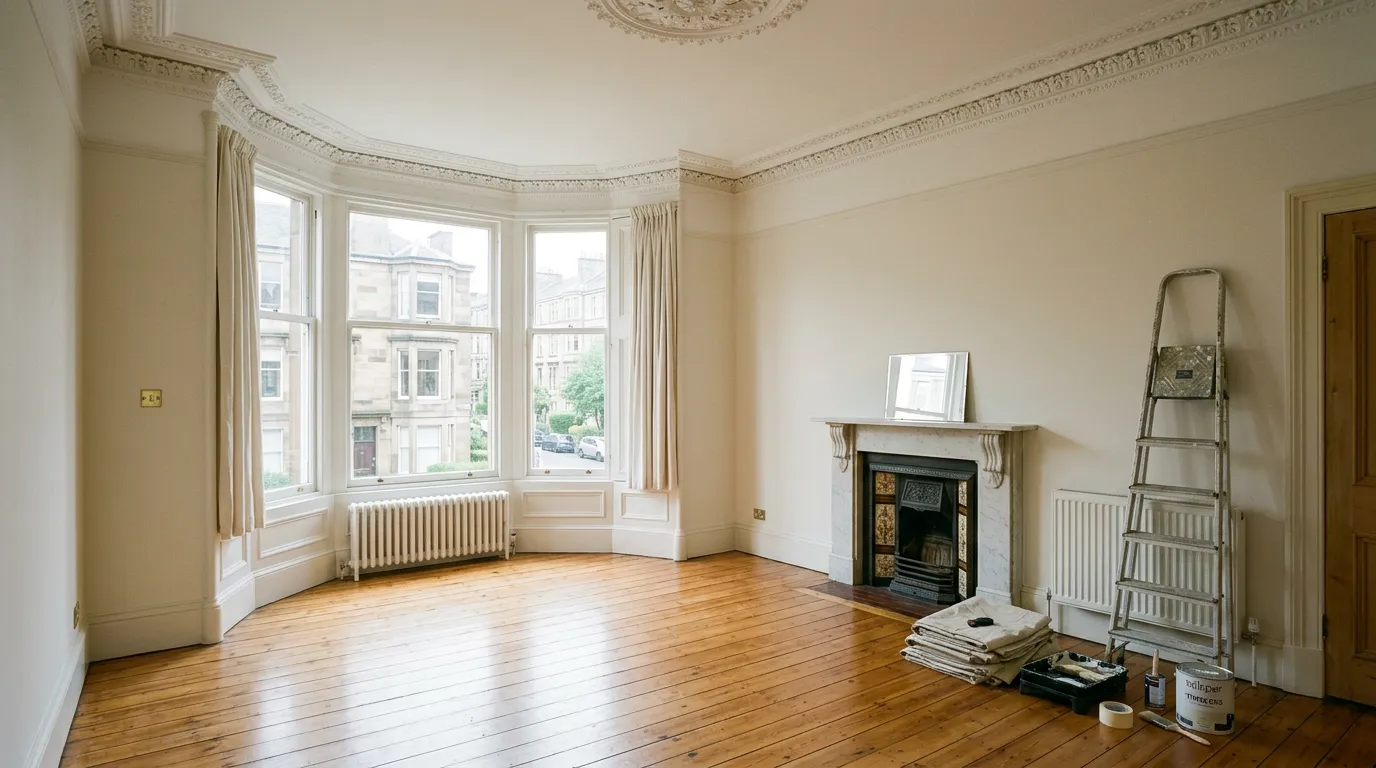
Now picture a 2-bed flat on the first floor of a sandstone tenement, with a bay-windowed front room, a bedroom, a smaller second bedroom, a long hall, a kitchen and a bathroom. Ceilings are about 3.2 m, the front room and hall have cornices, and the plaster is old but sound.
| Day | Work |
|---|---|
| 1 | Cover, fill and sand, treat cracks, set up the tower |
| 2 | Ceilings and cornices, first coat, front room and hall |
| 3 | Second coat ceilings, then bedroom and second bedroom ceilings |
| 4 | Front room walls, two coats |
| 5 | Both bedrooms, walls |
| 6 | Hall walls, kitchen and bathroom |
| 7 | Woodwork: skirtings, architraves and doors, first coat |
| 8 | Woodwork second coat, snagging and clearing away |
Eight days for one person, as our estimate. Add a day or two if the sash windows are included, and more if the walls need lining. Our guide to painting a Glasgow tenement flat covers those extras, including lead paint and cornices.

What adds time to a paint job?
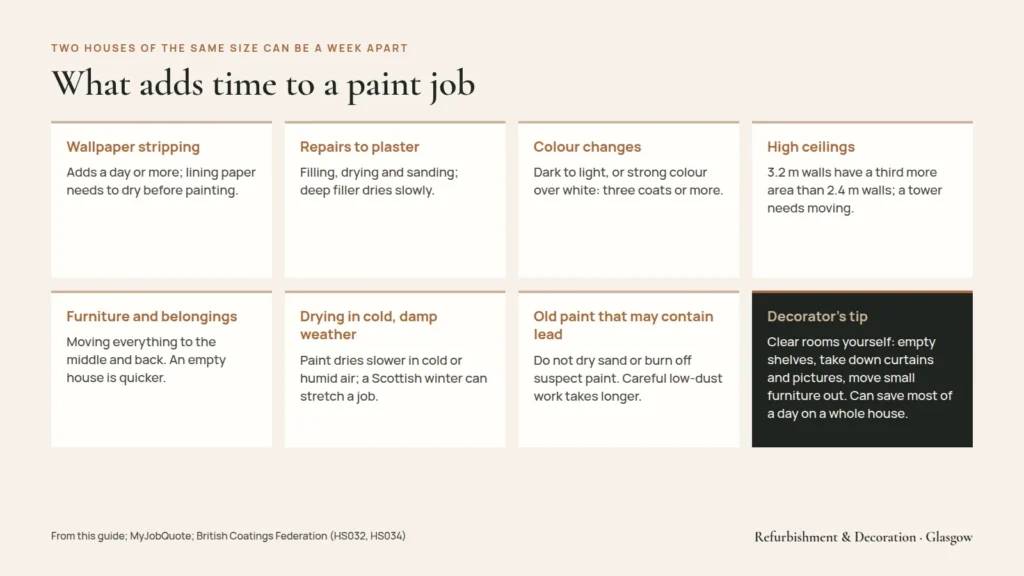
Two houses of the same size can be a week apart. These are the usual reasons, roughly in order of how much they matter.
- Wallpaper stripping. Taking old paper off a room adds a day or more, and sometimes lining paper adds another because it needs to dry before it is painted. MyJobQuote shows a one-day room stretching to three or four days once wallpaper removal and moving furniture are added.
- Repairs to plaster. Cracks, patches and blown plaster need filling, drying and sanding. Deep filler dries slowly, and in a cold house a repair that would be ready overnight in summer can take two days.
- Colour changes. Pale to pale is two coats. A dark colour to a light one, or a strong colour over white, can take three coats or more, sometimes with a primer or tinted undercoat first, and each coat has to dry.
- High ceilings. Walls at 3.2 m have a third more area than walls at 2.4 m, and a tower needs moving.
- Furniture and belongings. A full house means moving everything to the middle of each room and putting it back. An empty house is quicker.
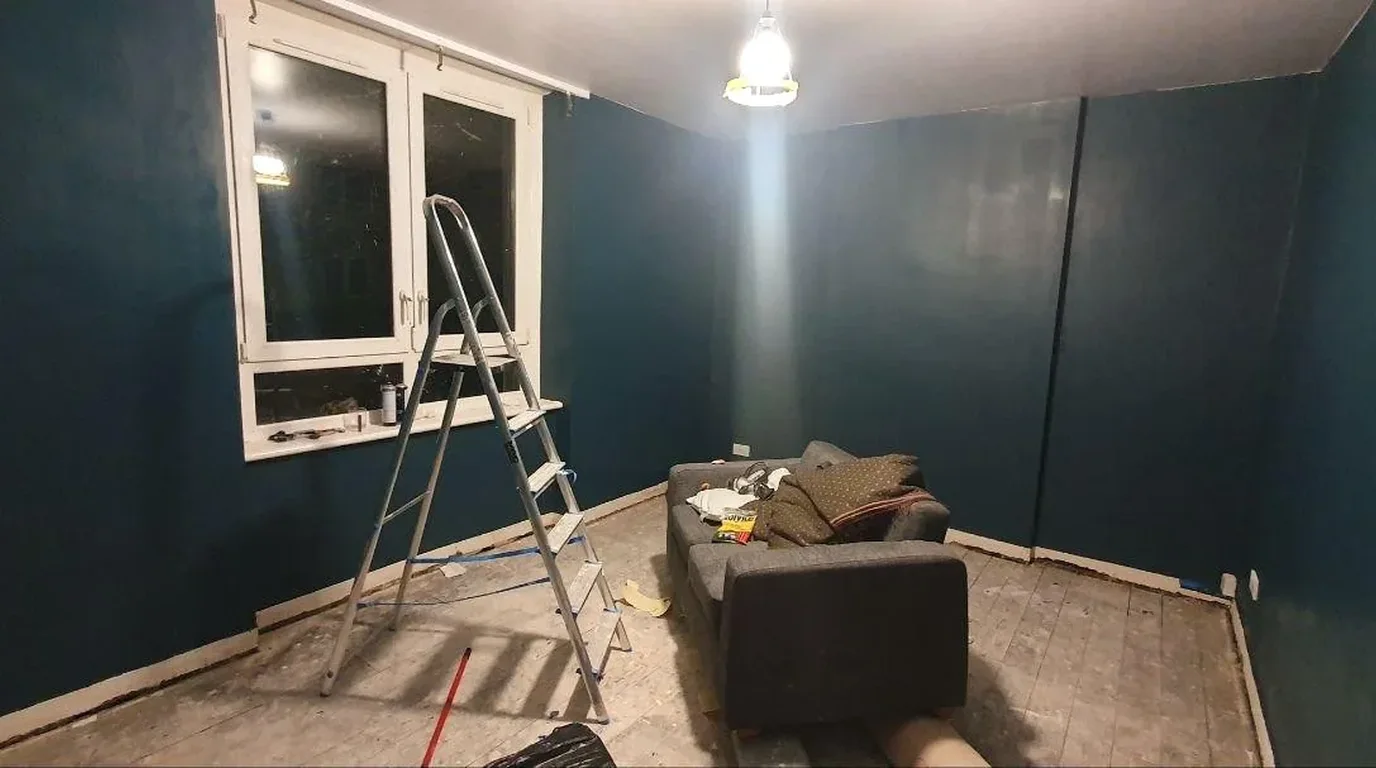
- Drying in cold, damp weather. Paint dries slower in cold or humid air, and a Scottish winter can stretch a job. Our guide to painting a house interior in winter in Scotland covers heating and ventilation.
- Old paint that may contain lead. In homes built before about 1960, older layers can contain lead. The British Coatings Federation guidance (HS032 and HS034) says not to dry sand or burn off paint that may contain lead, so careful low-dust work takes longer.
Decorator’s tip: the quickest way to save time is to clear the rooms yourself before the decorator arrives. Empty shelves, take down curtains and pictures, and move small furniture out. It can save most of a day on a whole house.
How long do paint coats take to dry?
Drying times depend on the product, the temperature and the humidity, so the tin or data sheet is the only reliable guide. As a general rule, a water-based emulsion is touch dry within an hour or two and ready for a second coat after a few hours. Satin and gloss for woodwork usually need longer between coats, and oil-based products longer still. A decorator plans around these gaps, which is why a room is rarely painted start to finish in one go.
One decorator or two?
Two decorators do not halve the job exactly, but they come close on a whole house. While one rolls ceilings, the other can cut in or start on woodwork elsewhere, and the first coat in one room dries while both move on. For a typical 3-bed semi, two people can usually finish in about five to six working days instead of nine (our estimate). The saving is smaller on a small flat, where there is not enough room for two people to work without waiting for each other.
The trade-off is cost and control. Two decorators cost two day rates, so the total labour stays about the same while the time shortens. That suits you if you want to be back in your house quickly, or if there is a hard deadline such as a house move or a tenant arriving. It makes less sense if the budget is the priority and the house is happy to be a work site for two weeks. If a quote lists the days, ask whether it assumes one person or two.
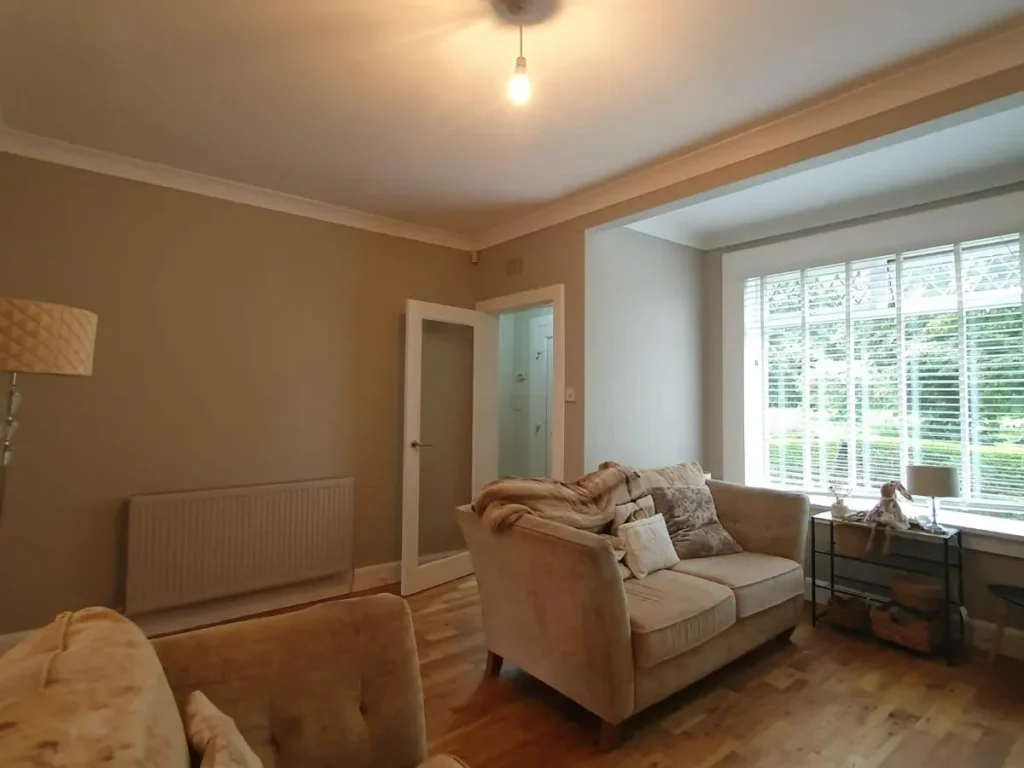
Can you stay in the house, and when can furniture go back?
Living at home during the work
Usually yes. Most people live at home during a repaint, and decorators plan the order of work around that. A few things help:
- Keep one room clear. Many decorators finish a bedroom first so that you have somewhere clean to sleep. Ask for this at the start.
- Allow for smell and ventilation. Water-based paints have a mild smell. Keep windows open if the weather allows, or ventilate when the decorator leaves for the day.
- Plan the bathroom and kitchen. These rooms are small and quick, but you will lose use of them for a few hours. Tell your decorator which one you need first.
- Think about stairs. The stairs are usually painted last. In a house they remain usable between coats, though not while the paint is wet.
- Children, pets and allergies. Keep them out of the room being worked on, because tools, ladders and dust sheets are hazards. If anyone in the house has asthma, a plan for ventilation is worth discussing first.
Plan to stay out of a freshly painted room for the first 24 hours before sleeping in it, with the windows open, as MyJobQuote also advises. A house with a baby, a pregnancy or a breathing condition may prefer a longer gap, or a low-VOC paint. Check the tin for the manufacturer’s advice.
Pictures, furniture and cleaning afterwards
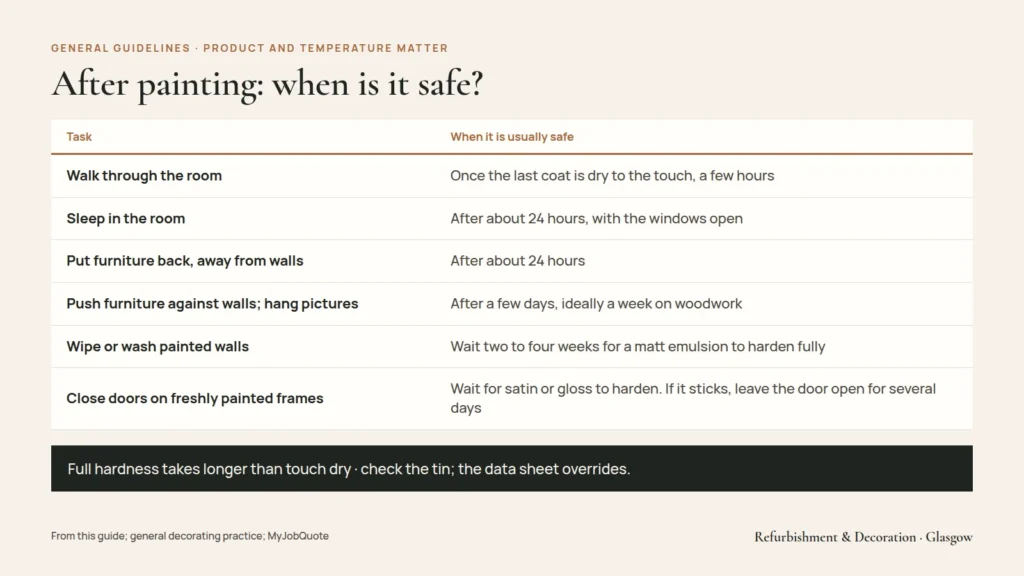
Paint is touch dry long before it is hard. A rough guide, which depends on the product and the temperature (check the tin):
| Task | When it is usually safe |
|---|---|
| Walk through the room | Once the last coat is dry to the touch, a few hours |
| Sleep in the room | After about 24 hours, with the windows open |
| Put furniture back in the room, away from the walls | After about 24 hours |
| Push furniture against walls and hang pictures | After a few days, ideally a week on woodwork |
| Wipe or wash painted walls | Wait two to four weeks for a matt emulsion to harden fully |
| Close doors on freshly painted frames | Wait for the satin or gloss to harden. If it sticks, leave the door open for several days |
These are general guidelines from decorating practice. Full hardness takes longer than touch dry, and the manufacturer’s data sheet overrides them.
Woodwork needs the most patience. Satin and gloss stay soft for days, and putting a bed or a bookcase against a fresh skirting board can mark it. Felt pads under furniture and a gentle first clean are sensible for the first month.
Getting a price and a timetable for your home
How far ahead to book
Booking time is the part most guides leave out. The Decorators Forum reports a wait of two to three months as common for good decorators. A fixed start date and a clear finish estimate belong in the written quote. Our cornerstone guide to redecorating in Glasgow: planning, timings and choosing a decorator covers booking, deposits and what to ask.
What to ask for
The timings above are a guide. Your timetable depends on the number of rooms, their height, the state of the walls and woodwork, and whether the house is empty. We give a guide price over the phone once we know the basics, and a fixed written quote after a free visit, with the days and the order of work written down.
We work across Glasgow and Central Scotland, mainly on interior painting and wallpaper hanging. Call 07777 780557 or book a free visit.
Questions people ask
How long does it take to paint a bedroom?
A small bedroom takes about one day and a large one 1–1.5 days, with a box room at 4–6 hours (MyJobQuote, Sep 2026). That covers two coats on walls, ceilings and woodwork when the room is cleared and the walls are sound. Stripping wallpaper, repairs or a big colour change can stretch it to two or three days.
Can I stay in the house while it is being painted?
Usually yes. Ask the decorator to finish one bedroom first so you have somewhere clean to sleep, and keep children and pets out of the room being worked on. Wait about 24 hours before sleeping in a freshly painted room, with the windows open. Check the paint tin for the manufacturer's own advice.
How long should I wait before putting furniture back?
About 24 hours for furniture in the room, kept slightly away from the walls. Wait a few days before pushing it against the walls or hanging pictures, and ideally a week for freshly painted woodwork, which stays soft longer than walls. The tin or data sheet gives the exact drying and recoat times for that product.
Does painting take longer in winter in Scotland?
It can. Cold, damp air slows drying, so coats take longer and filler repairs need extra time. Keep the house heated and ventilated, and check the minimum application temperature on the tin. Interior work is still very possible in winter, and exterior decorators are often quieter then, so start dates may be easier to book.
Is it quicker with two decorators?
Yes, by roughly a third to a half on a whole house. As our estimate, two people might finish a typical 3-bed semi in 5–6 working days instead of nine. The labour cost stays about the same because you pay two day rates. It helps less in a small flat, where two people get in each other's way.
How long does it take to paint the hall, stairs and landing?
MyJobQuote (Sep 2026) gives 1.5–2 days, and Which? gives up to 3 days. It takes longer than the size suggests because of the stair access, ladders or platforms, and cutting in around spindles, handrails and doors. Decorators often paint it last so nobody brushes against wet walls while carrying things through.

Painters and decorators working across Glasgow & Central Scotland, specialising in interior painting and wallpaper hanging. Prices in our guides are reviewed every year.
 Can You Paint a House Interior in Winter in Scotland?
 Landlord & End-of-Tenancy Painting in Glasgow
 Redecorating in Glasgow: Planning, Timings & Choosing a Decorator