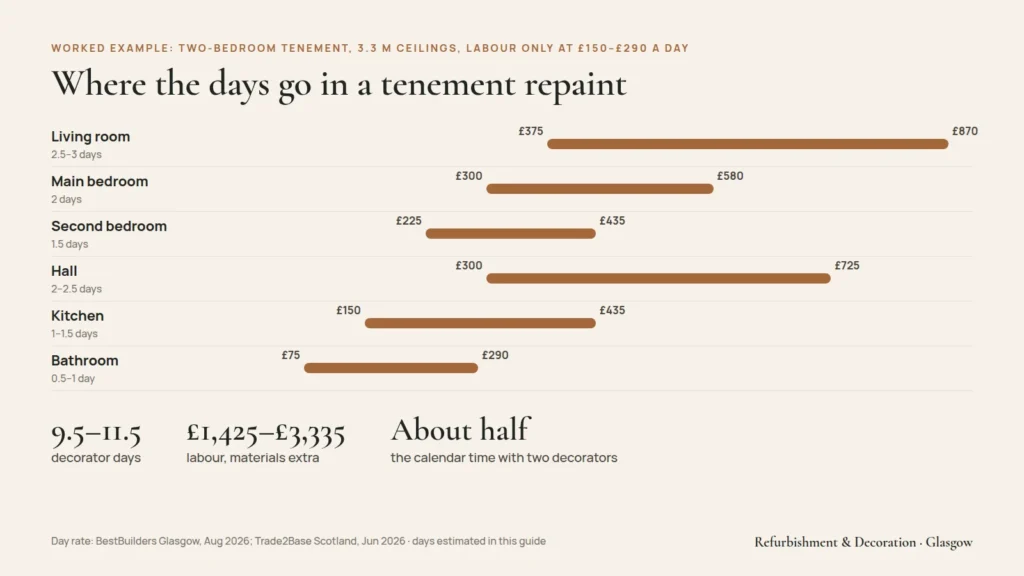
Painting a typical two-bedroom Glasgow tenement flat takes about 9.5 to 11.5 decorator days. At the Glasgow and Scotland market day rate of £150–£290 (BestBuilders, Aug 2026; Trade2Base, Jun 2026), labour comes to roughly £1,425–£3,335 before materials. Ceilings of 3 to 3.6 metres, cornice and old woodwork push tenement rooms to the top of standard room prices.
A Glasgow tenement flat is one of the most rewarding homes to decorate and one of the easiest to get wrong. The ceilings are high, the plaster is old, the woodwork carries a century of paint, and the details that make the flat special, from cornice to shutters, are the parts that take the time. This guide walks through what is different about tenement work, what it costs on today’s market figures, and how to plan the job so the finish lasts.
What makes a tenement flat different to paint?
Most of Glasgow’s sandstone tenements went up between the 1860s and the First World War. A flat from that period behaves very differently from a modern semi, and the differences all show up in the time a job takes.
- Ceiling height. Victorian and Edwardian flats commonly have ceilings around 3 to 3.6 metres high. A modern home is usually about 2.4 metres. Every wall is bigger, and nothing above head height can be reached from the floor.
- Old plaster. Outside walls are usually plastered straight onto the stone (“on the hard”). Ceilings and many internal walls are lath and plaster: thin timber strips with lime plaster pushed through the gaps. Both move and crack over time.
- Decorative plaster. Cornice, ceiling roses and friezes, often clogged with layers of paint and sometimes still coated in old distemper.
- Woodwork, lots of it. Deep moulded skirtings, picture rails, four- and six-panel doors with wide facings, window shutters, press (cupboard) doors and sash windows. In a typical tenement room the woodwork can take as long as the walls.
- Layers of old paint. Woodwork painted before the 1960s may contain lead. That changes how it can be prepared (see the lead section below).
- Shared building. Materials, dust sheets and a scaffold tower all come up a common stair, and the close itself belongs to all the owners who use it.
Later tenements, from the interwar and post-war years, usually have lower ceilings and plainer plaster. Much of the advice here still applies, but the height and cornice costs shrink.

How much does it cost to paint a tenement flat in Glasgow?
No published price guide covers tenement flats specifically, so the honest starting point is the general market data, then an adjustment for height and detail. These are the current published ranges for Glasgow and the UK. They include labour and materials unless stated.
| Job | Market range | Typical time | Source |
|---|---|---|---|
| Decorator day rate, Glasgow / Scotland | £150–£290 a day | per decorator | BestBuilders Glasgow (Aug 2026); Trade2Base Scotland (Jun 2026) |
| Average room, Glasgow, materials included | £350–£600 | not stated | BestBuilders Glasgow (Aug 2026) |
| Small bedroom repaint | £250–£400 | about 1 day | MyJobQuote (Sep 2026) |
| Large bedroom repaint | £350–£660 | 1–1.5 days | MyJobQuote (Sep 2026) |
| Living room | £300–£530 small / £500–£990 large | 1.5–2 days (large) | MyJobQuote (Sep 2026) |
| Hall, stairs and landing | £875–£1,350+ | 1.5–2 days | MyJobQuote (Sep 2026) |
| 3-bed interior repaint, Glasgow | £1,400–£3,200 | not stated | BestBuilders Glasgow (Aug 2026) |
| Lining paper | +£80–£150 a room | adds time | BestBuilders (Aug 2026) |
| Strip old paper | +£150–£300 a room | adds time | BestBuilders (Aug 2026) |
Those room prices assume ordinary ceiling heights. A tenement room usually lands at or above the top of each range, for three reasons: more wall area, slower work at height, and more woodwork and detail per room.
What a high ceiling does to the area
Take a typical 4.5 by 4 metre bedroom. The floor is the same whatever the height, but the walls are not.
| Ceiling height | Wall area (before doors and windows) | Compared with 2.4 m |
|---|---|---|
| 2.4 m (modern home) | 40.8 m² | baseline |
| 3.0 m | 51.0 m² | 25% more |
| 3.4 m (common in a Victorian flat) | 57.8 m² | 42% more |
Add 17 metres of cornice running round that room, a picture rail, a deep skirting and a pair of shutters, and it is easy to see why a “bedroom” in a tenement can take twice as long as a bedroom in a new-build.
Worked example: a typical two-bedroom tenement flat
This worked example prices labour by the day, using the £150–£290 market day rate named above. It assumes 3.3 metre ceilings, walls and ceilings in fair condition with normal filling, two coats throughout, and all woodwork glossed or satined. Materials, lining paper and plaster repairs are extra.
| Room | What is included | Decorator days | Labour at £150–£290 a day |
|---|---|---|---|
| Living room | Bay window, cornice and rose, picture rail, shutters | 2.5–3 | £375–£870 |
| Main bedroom | Cornice, picture rail, press door | 2 | £300–£580 |
| Second bedroom | Plainer cornice, one door | 1.5 | £225–£435 |
| Hall | Long, high walls, five or six doors and facings | 2–2.5 | £300–£725 |
| Kitchen | Walls, ceiling, woodwork, cutting round units | 1–1.5 | £150–£435 |
| Bathroom | Ceiling and walls in moisture-resistant finish | 0.5–1 | £75–£290 |
| Total | 9.5–11.5 | £1,425–£3,335 |
That sits close to BestBuilders’ £1,400–£3,200 figure for a whole 3-bed home in Glasgow, which makes sense: a two-bedroom tenement has fewer rooms, but each one is bigger and more detailed. Two decorators working together would finish in roughly half the calendar time.
What pushes the price up: sash windows that need stripping back, distemper on the ceilings, cracked lath-and-plaster ceilings that need lining, lead paint that has to be prepared wet, and strong colour changes needing a third coat. What brings it down: walls already in good order, keeping the existing colours, or doing walls and ceilings only and leaving the woodwork for another year.
For full room-by-room figures across all home types, see our Glasgow painting and decorating prices guide.
How do decorators reach 3.5 metre ceilings safely?
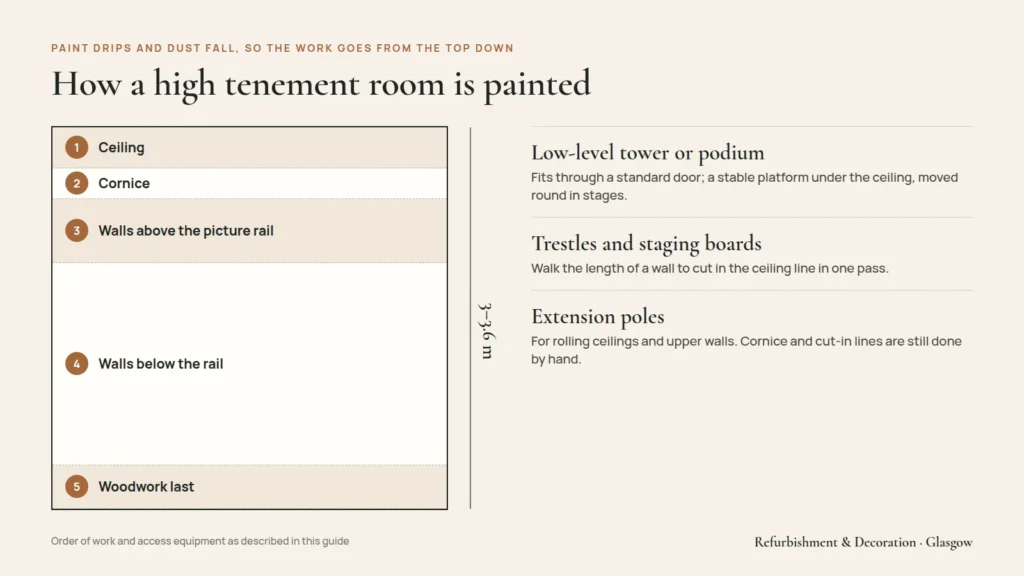
A pair of household steps will not reach a tenement ceiling, and leaning a ladder against a freshly filled wall marks it. Working at height is where most of the extra tenement time goes, so it is worth knowing what a decorator will bring and why.
- A low-level scaffold tower or podium. A narrow-width aluminium tower that fits through a standard door and gives a stable platform under the ceiling. It is moved round the room in stages.
- Trestles and staging boards. Two sets of steps or trestles with a board between them let a decorator walk the length of a wall to cut in the ceiling line in one pass.
- Extension poles. For rolling ceilings and the upper walls. Cornice and the ceiling-to-wall line still have to be done by hand from a platform.
The order matters. In a tenement room we work from the top down: ceiling, then cornice, then walls above the picture rail, then the walls below, then woodwork last. Paint drips and dust fall, so anything done lower down first will need touching up.
Getting the kit in also takes planning. A tower comes up the stair in sections and is assembled in the flat. If there is a narrow turn on the stair or the close door is on a controlled entry, it helps to let the decorator know in advance.
Decorator’s tip: clear the room as far as you can before the start date. A tower needs floor space, and in a high room it gets moved a dozen times. A room with furniture pushed to the middle under sheets is workable; a room full of boxes adds hours.
Cracks, lath and plaster, and lining paper: what is normal?
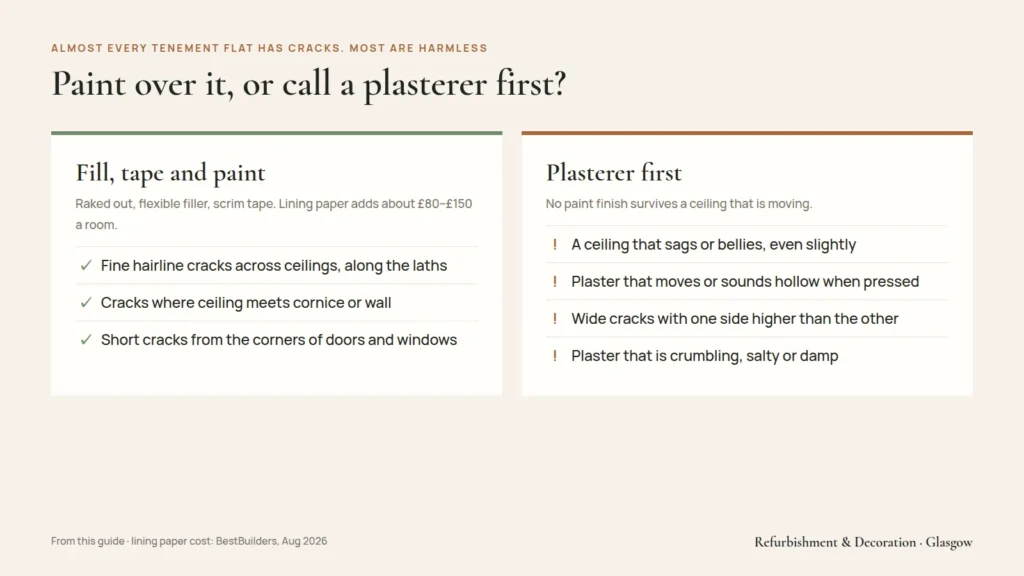
Almost every tenement flat has cracks. Most are harmless movement of an old building with timber floors and lime plaster. A few are a sign the plaster is coming away. Knowing the difference saves money.
Cracks you can paint over (after proper filling)
- Fine hairline cracks across ceilings, often following the line of the laths.
- Cracks where the ceiling meets the cornice or wall, which open and close with the seasons.
- Short cracks running from the corners of doors and windows.
These are raked out, filled with a flexible or fibre-reinforced filler, and often bridged with scrim tape so they do not reappear through the new paint within a winter.
Cracks that need a plasterer first
- A ceiling that sags or bellies, even slightly.
- Plaster that moves, or sounds hollow and loose, when pressed gently with a flat hand.
- Wide cracks with one side higher than the other.
- Plaster that is crumbling, salty or damp to the touch.
When lath-and-plaster ceilings sag, the plaster “nibs” gripping the laths have usually broken. Painting a sagging ceiling hides the warning without fixing anything. We stop and recommend a plasterer before decorating, because no paint finish survives a ceiling that is moving.
Where lining paper earns its place
Lining paper is a plain paper hung before painting or papering. On tenement walls and ceilings it covers a network of fine cracks, evens out patchy old plaster and gives a sound surface to work on. It costs £80–£150 extra per room on BestBuilders’ figures (Aug 2026), which is often far less than skimming. Heavier grades (1200 or 1400) hide more; lighter grades are easier on a ceiling.
Lining is also standard before wallpaper on old plaster. Our wallpaper hanging guide covers cross-lining, paper choice and how tall walls change the roll count.
Papering tall walls: why the roll count jumps
A standard UK roll is about 10 metres long and 53 centimetres wide. Each drop needs the wall height plus around 10 centimetres for trimming, and the leftover at the end of a roll is usually too short to use.
| Wall height | Length per drop | Full drops per roll |
|---|---|---|
| 2.4 m | about 2.5 m | 4 |
| 3.0 m | about 3.1 m | 3 |
| 3.4 m | about 3.5 m | 2 |
So a 3.4 metre wall can need close to twice the rolls of the same width of wall in a modern home, before any allowance for pattern repeat. That is why many tenement rooms are papered only up to the picture rail, with the frieze above painted to match the ceiling. It looks right in a period room, and it cuts the number of rolls and the time spent at height. BestBuilders (Aug 2026) notes that tall rooms and stairwells add £80–£400 to a wallpapering job.
How should cornice, ceiling roses and picture rails be painted?
Cornice is the feature most people want to save, and the one most often spoiled by years of thick paint. A well-painted cornice shows crisp lines and shadows; a clogged one looks like icing.
Check for distemper first
Many tenement ceilings and cornices were originally finished in soft distemper, a chalk and glue paint that was used long before modern emulsion. Rub a damp cloth on an unseen part of the cornice. If it comes away chalky, there is distemper underneath. Modern paint will not hold onto it, which is why some tenement ceilings peel in sheets a few months after decorating. Soft distemper has to be washed off, or properly stabilised, before any new paint goes on. It is slow, messy work, so it must be in the quote.
Painting the cornice
- Brush out loose and flaking paint gently with a soft brush; never attack detailed plaster with a scraper.
- Fill small chips and cracks with a fine filler, keeping it out of the detail.
- Use thin coats with a brush that reaches into the recesses. Two thin coats keep the detail; one thick coat buries it.
- Cut the line where the cornice meets the wall by hand. This line is what the eye sees, and it is the hardest part to do well at 3.4 metres.
Colour is a choice, not a rule. Painting the cornice the same colour as the ceiling is the traditional and calmest look. Picking it out in the wall colour lowers the visual height of the room, which can suit a narrow space. Separate colours on a busy cornice look fussy unless it is a period restoration.
Where cornice is badly damaged, missing in sections or so clogged that the pattern has gone, it becomes a plaster job. Our article on restoring and painting cornicing and ceiling roses covers stripping, repairs and when to bring in a specialist plasterer. For guidance on cost, Trade2Base (Jun 2026) puts specialist coving and cornice work at £250–£380 a day, above a general decorator’s rate.
Sash windows, shutters, doors and skirtings
Woodwork is where a tenement repaint is won or lost. It is also where the most hours disappear, so it is worth agreeing exactly what is included before work starts.
Sash windows
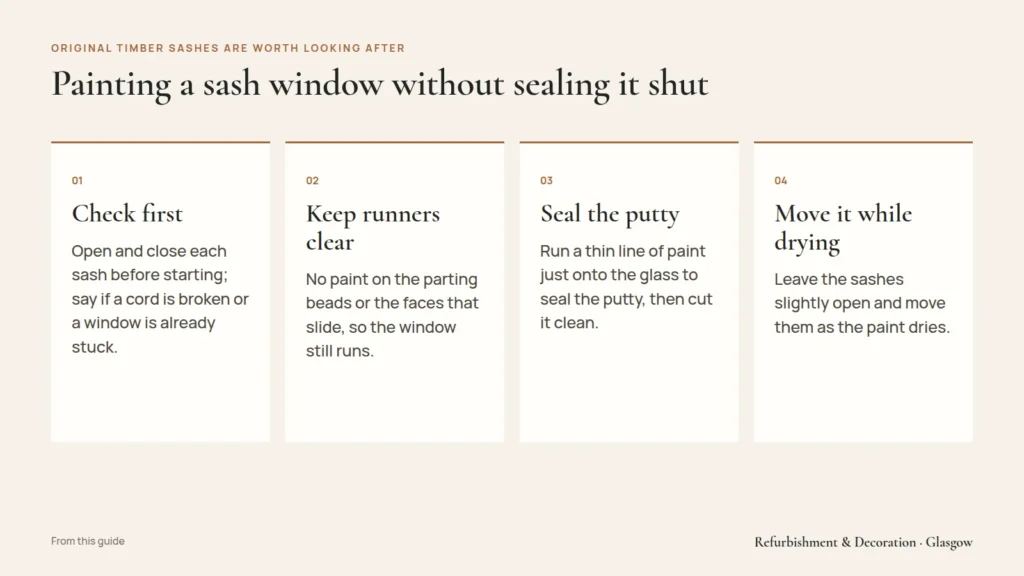
Original timber sashes are common in Glasgow flats and they are worth looking after. The two classic problems are windows painted shut and paint built up so thick that the sashes stick. When we paint sashes we:
- check the sashes open and close before starting, and say if a sash cord is broken or a window is already stuck;
- keep paint off the parting beads and the faces that slide, so the window still runs;
- run a thin line of paint just onto the glass to seal the putty, then cut it clean;
- leave the sashes slightly open and move them while the paint is drying, so they do not glue themselves shut.
Sashes often carry the oldest layers of paint in the flat, so they are the first place to think about lead. We cover them in detail in painting sash windows in a Scottish flat.
Shutters and doors
Folding window shutters are fiddly: they have several leaves, hinges on every leaf, and faces that are only visible when closed. Panelled doors are painted in a set order, mouldings and panels first, then the middle rails, then the outer stiles, so the brush marks run with the grain. Ask whether the inside of the shutter boxes and the edges of doors are included. They are on a good quote.
Oil or water-based?
Most old tenement woodwork has layers of oil-based gloss. Modern water-based satins and eggshells stay white longer and smell less, but they need a sound key and the right primer to grip old oil paint. Oil-based finishes are harder and flow out more smoothly, but yellow over time, especially in darker rooms. Either works if the preparation is right. The mistake is putting water-based paint straight onto shiny old gloss.
Is there lead paint in my tenement, and is sanding safe?
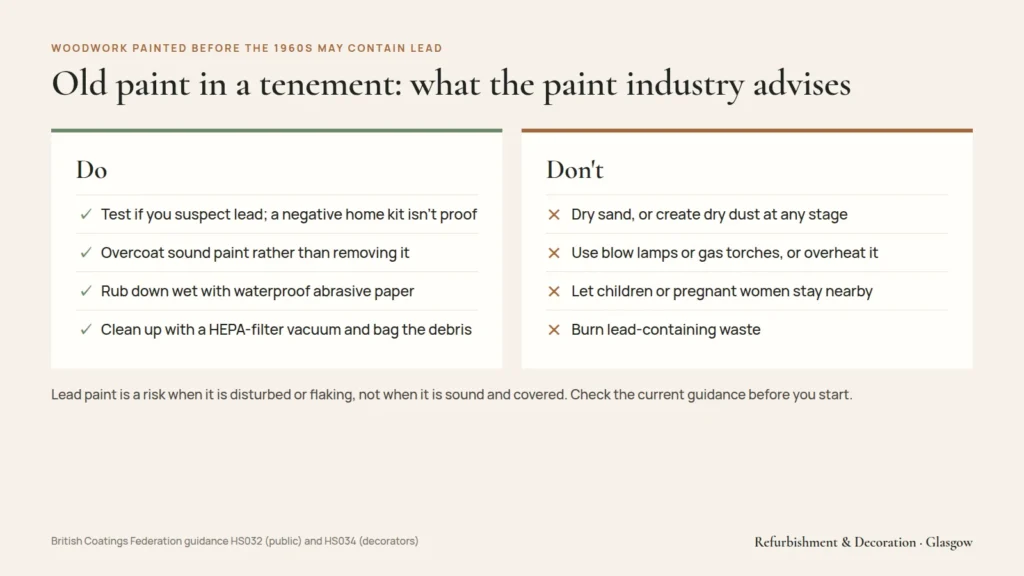
In a pre-war tenement, assume there may be. The British Coatings Federation, the paint industry body, says lead pigments were taken out of most paints in the 1960s, and that many wood or metal surfaces painted before then could contain significant levels of lead (BCF guidance HS032 for the public and HS034 for professional decorators). In a tenement that usually means the bottom layers on skirtings, doors, facings, shutters, sashes and old metal.
The BCF’s key point is that lead paint is a risk when it is disturbed or flaking, not when it is sound and covered. Its guidance says:
- Test if you suspect lead, especially in a house more than 40 years old. Home test kits give an indication, but a negative result should not be relied on; a professional or laboratory test is more certain.
- Don’t remove sound paint. Overcoating paint that is in good condition is the safest option.
- Never dry sand lead paint, and do not create dry dust at any stage. Rub down wet with waterproof abrasive paper and keep debris damp.
- Never use blow lamps or gas torches to strip it, and do not overheat it. Chemical strippers or wet scraping are preferred; a hot-air gun or infrared stripper can soften paint if used with care so it does not burn.
- Keep people out of the area while lead paint is being disturbed, and make sure no children or pregnant women are present.
- Clean up thoroughly: wash surfaces, vacuum with a HEPA-filter vacuum, and bag the debris. Never burn lead-containing waste.
In practice, this shapes the quote. If a decorator plans to machine-sand old woodwork in a pre-war flat, ask how they are managing lead. A careful job on old woodwork is slower, because wet preparation is slower. That time is worth paying for if there are children in the home.
Decorator’s tip: if you are planning DIY work on old sashes or skirtings, do the preparation wet and keep the rest of the flat shut off. The BCF also suggests considering a professional decorator where lead is confirmed. Check the BCF’s current guidance before you start, as it is updated from time to time.
Which paints and finishes suit a tenement flat?
Old plaster, solid stone outside walls and Glasgow’s damp climate all affect what works. The table below is how we would usually specify a tenement flat. The best choice for a particular room depends on its condition and how it is used.
| Surface | Usual finish | Why |
|---|---|---|
| Ceilings and cornice | Flat matt emulsion | Hides the unevenness of old plaster and gives cornice crisp shadows |
| Living room and bedroom walls | Matt or washable matt | Soft look on uneven walls; washable matt copes with fingermarks |
| Hall walls | Durable or scrubbable matt | Bikes, bags and shoulders; a tenement hall gets the heaviest wear |
| Kitchen and bathroom | Kitchen and bathroom emulsion, often with mould inhibitor | Copes with steam and condensation |
| Damp-prone outside walls (after the cause is fixed) | A more breathable matt | Lets old solid walls dry out rather than trapping moisture |
| Skirtings, doors, shutters, sashes | Satin, eggshell or gloss | Hard-wearing; sheen level is a matter of taste |
Damp and condensation
Tenement flats are prone to condensation in kitchens, bathrooms and cold bedrooms on outside walls, and to penetrating damp where gutters, downpipes or stonework have failed. Paint does not cure either. Find and fix the cause first, then decorate. Our guide to damp, condensation and mould explains how to tell the types apart and which paints help.
Colour in tall, north-facing rooms
Tall rooms with deep window reveals can feel dim in a Glasgow winter, especially on the north side of a street. Warmer whites and mid-tones usually sit better than cool, bright whites, which go grey in flat light. See choosing paint colours for Scottish light for colour choices by room and orientation.
Planning the job: permissions, mistakes and timings
A tenement flat sits inside a shared building, and some flats are in conservation areas or listed buildings. A few checks before the start date avoid problems later.
Permissions and neighbours
- Inside your flat, ordinary redecoration does not usually need permission. If your building is listed, removing or altering original features such as cornice, shutters or panelled doors may need listed building consent. Check with Glasgow City Council planning before stripping or replacing anything original.
- Outside faces of windows, the front door and any stonework are different. In a conservation area or on a listed building, changing external colours or painting stone can need consent. Check the current position with the council before acting.
- The close and stair belong to the owners together. You cannot repaint them on your own. Our article on painting a tenement close explains owners’ votes, factors and the cost split.
- Neighbours will see materials and equipment on the stair. A note through doors before work starts is a courtesy that goes a long way.
Mistakes to avoid
- Painting over a sagging or loose ceiling instead of getting it repaired.
- Putting emulsion over soft distemper, which peels within months.
- Dry sanding old woodwork without thinking about lead.
- Rolling thick paint into cornice detail until the pattern disappears.
- Painting sashes shut, or painting over the sliding faces.
- Using water-based woodwork paint straight over old gloss with no key or primer.
- Sealing a damp outside wall with a heavy vinyl paint before the cause is fixed.
- Comparing quotes that cover different scopes: one with woodwork and lining, one without.
Your pre-start checklist
- Agree in writing which rooms, surfaces and coats are included, and whether woodwork, shutters and sashes are part of it.
- Ask how ceiling cracks, distemper and lead will be handled, and whether they are priced or provisional.
- Confirm who supplies paint and which brand and finish.
- Clear shelves, pictures and fragile items; move what furniture you can.
- Arrange close door access and let neighbours know.
- Plan where you will sleep and live while rooms are being done; one room at a time is usually possible.

How long it takes, and in what order
The worked example above comes to about 9.5 to 11.5 decorator days for a two-bedroom flat. With one decorator that is roughly two and a half working weeks; with two, closer to a week and a half. Allow extra for drying if a ceiling needs lining or plaster repairs need to cure before painting.
A sensible sequence for a lived-in flat:
- Protect and prepare the whole flat. Floors and the stair route sheeted, cracks raked out and filled, distemper dealt with.
- Repairs and lining. Plaster patches and lining paper go up first, as they need time to dry.
- Ceilings and cornice, room by room, from a tower.
- Walls, two coats, more for a strong colour change.
- Woodwork last, once the dust has stopped, so the gloss or satin stays clean.
- Snagging walk-round in good daylight, which in a tenement means checking near the windows.
Many people decorate a tenement in stages: the public rooms one year, bedrooms the next. That spreads the cost, but it costs a little more overall because protection and setting up are repeated. Winter is a good time to book interior work, provided the flat is heated and ventilated so the paint dries properly.
Getting a price for your tenement flat
Every tenement is different: the ceiling height, the state of the plaster, how many layers are on the woodwork and what you want done all change the price. We give a guide price over the phone, then a fixed written quote after a free visit, with the scope set out room by room so you can compare it properly.
See our interior painting and wallpaper hanging services, or the areas we cover across Glasgow, Paisley, Clydebank, East Kilbride, Hamilton, Motherwell and Milngavie. Call 07777 780557 or book a free visit.
Questions people ask
How much does it cost to paint one room in a Glasgow tenement?
BestBuilders (Aug 2026) puts an average Glasgow room at £350–£600 including materials, and MyJobQuote (Sep 2026) gives £500–£990 for a large living room. A tenement room usually sits at the top of those ranges, because a 3.4 metre ceiling adds about 40% more wall area, plus cornice, shutters and deep skirtings. We give a guide price by phone and a fixed quote after a free visit.
Do decorators charge more for high ceilings?
Usually, yes, because the job takes longer rather than because of a set surcharge. A 4.5 by 4 metre room has 40.8 m² of wall at 2.4 metres high but 57.8 m² at 3.4 metres. Ceilings and cornice also have to be done from a tower or staging, which is slower than working from the floor. Ask for the price to be shown per room so you can see it.
Does a decorator's quote include paint and materials?
It depends on the decorator, so check the written quote. Some include paint, filler, caulk and lining paper; others price labour and list materials separately, or let you buy your own paint. Market room prices from BestBuilders and MyJobQuote include materials. If you choose a premium brand, expect the materials line to rise. Wallpaper is usually supplied by the customer.
Is it safe to sand old paint in a tenement flat?
Not dry. The British Coatings Federation says paint applied before the 1960s may contain significant lead, which is common on tenement woodwork and sashes. Its guidance (HS032) is to overcoat sound paint, rub down wet with waterproof abrasive paper, never use blow lamps, keep children and pregnant women away from the work, and clean up with a HEPA vacuum.
Do I need lining paper on tenement walls and ceilings?
Often, yes. Lining paper covers the web of fine cracks common on old lath-and-plaster ceilings and evens out patchy plaster on walls, and it is standard practice before wallpaper. BestBuilders (Aug 2026) puts it at £80–£150 extra per room, usually far cheaper than re-skimming. It will not fix a ceiling that sags or feels loose; that needs a plasterer first.
Do I need to move my furniture before the decorators arrive?
Clear small items, pictures, books and anything fragile, and move what furniture you can into another room. In a tenement the decorator needs floor space to set up and move a scaffold tower under a high ceiling. Heavy pieces can usually be pushed to the middle and covered. Agree beforehand who moves what, as some decorators charge for clearing rooms.
Do I need permission to paint my tenement windows or front door?
Painting inside your flat does not usually need permission. In a conservation area or a listed building, changing the colour of external window frames, the main door or painting stonework can need consent from Glasgow City Council, and altering original features inside a listed building may need listed building consent. Check the current position with the council planning team before acting.
Can a tenement flat be painted in winter?
Yes. Interior work suits the winter months, as long as the flat is heated and some ventilation is kept going so paint dries and condensation does not settle on cold outside walls. Winter can also be easier to book than spring. Expect slightly longer drying times between coats in cold, damp weather, especially for oil-based woodwork paint.

Painters and decorators working across Glasgow & Central Scotland, specialising in interior painting and wallpaper hanging. Prices in our guides are reviewed every year.
 Painting New Plaster: Mist Coats, Drying Times & Mistakes to Avoid
 Cracked Ceiling Repair & Painting: What a Decorator Can Fix
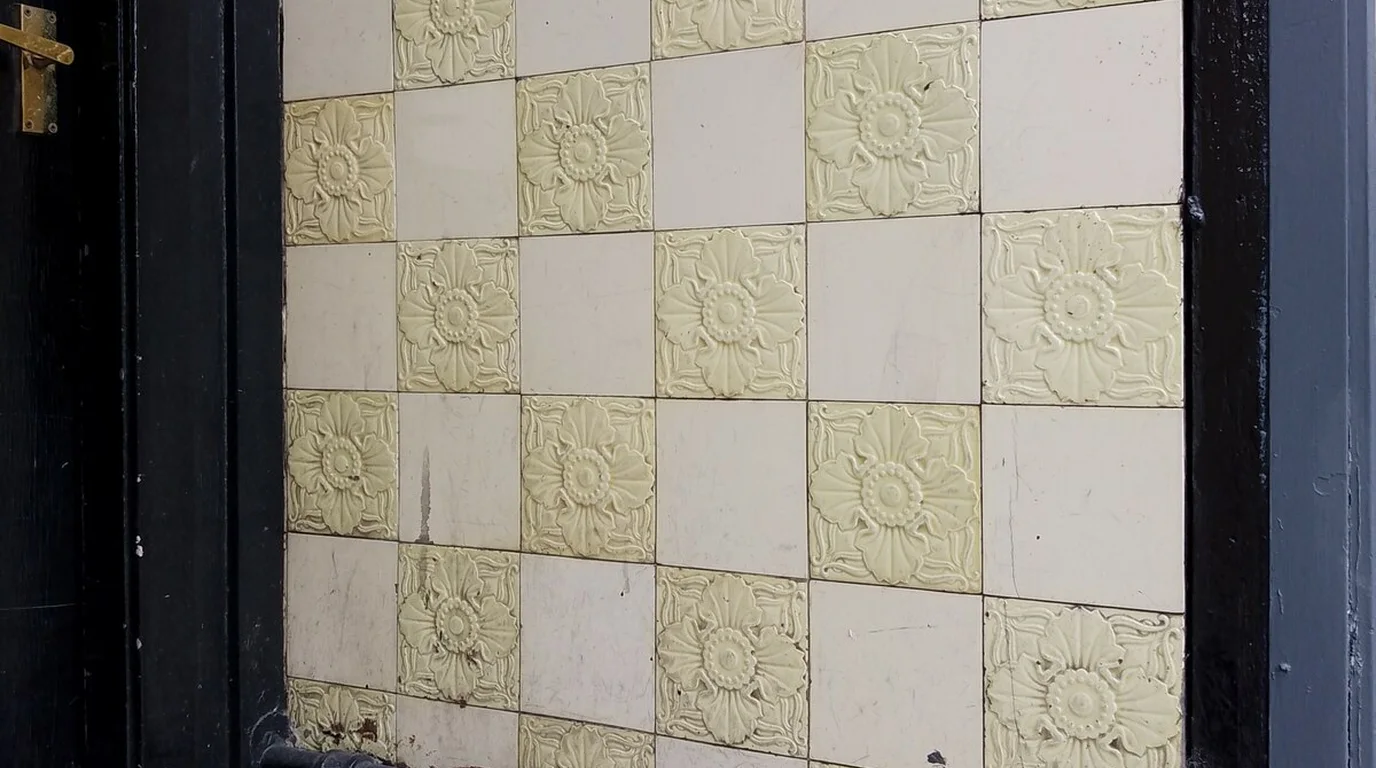 Painting a Tenement Close: Factors, Owners & Costs